
Gná — the one true spelling, and the forms that fail it
A letter to a colleague, 31 July 2026 — on the name Gná, and on the forms that keep failing it.
Your note said, roughly: surely the marks are a nicety. Permit me to use Gná to show they are not.
First, the attestation. The attested form is ᚴᚾᛅ, from the tradition's own record. The canonical transliteration is Gná.
And the marks themselves: a → á (Acute on a). Remove any one of them and you have not simplified the name — you have told a small lie about it, and the whole discipline is the refusal of such lies.
Say it aloud as the sources heard it: 'GNAH' — one syllable, the vowel held long like the 'a' in 'father' stretched out. The marks are what carry that sound to a reader who has never heard it spoken.
On the plain form — and I want to be precise, because you pushed on this. The plain form gna is not false — it is a fallback, and the register is exact about what that means. In systems that cannot carry diacritics (legacy databases, older tooling, parts of the address-bar pipeline) the flattened form is the accepted vehicle, and the rulebook names it explicitly as the final rung of the fallback hierarchy: full restoration first, circumflex where attested, macron-only by the academic standard, an attested variant, and only then plain ASCII.
What the fallback status forbids is promotion: gna may carry the name where marks are impossible, but it may not represent the name where marks are possible. Every mark it drops — a → á — is a fact the sources recorded. A fallback is a vehicle, never the primary.
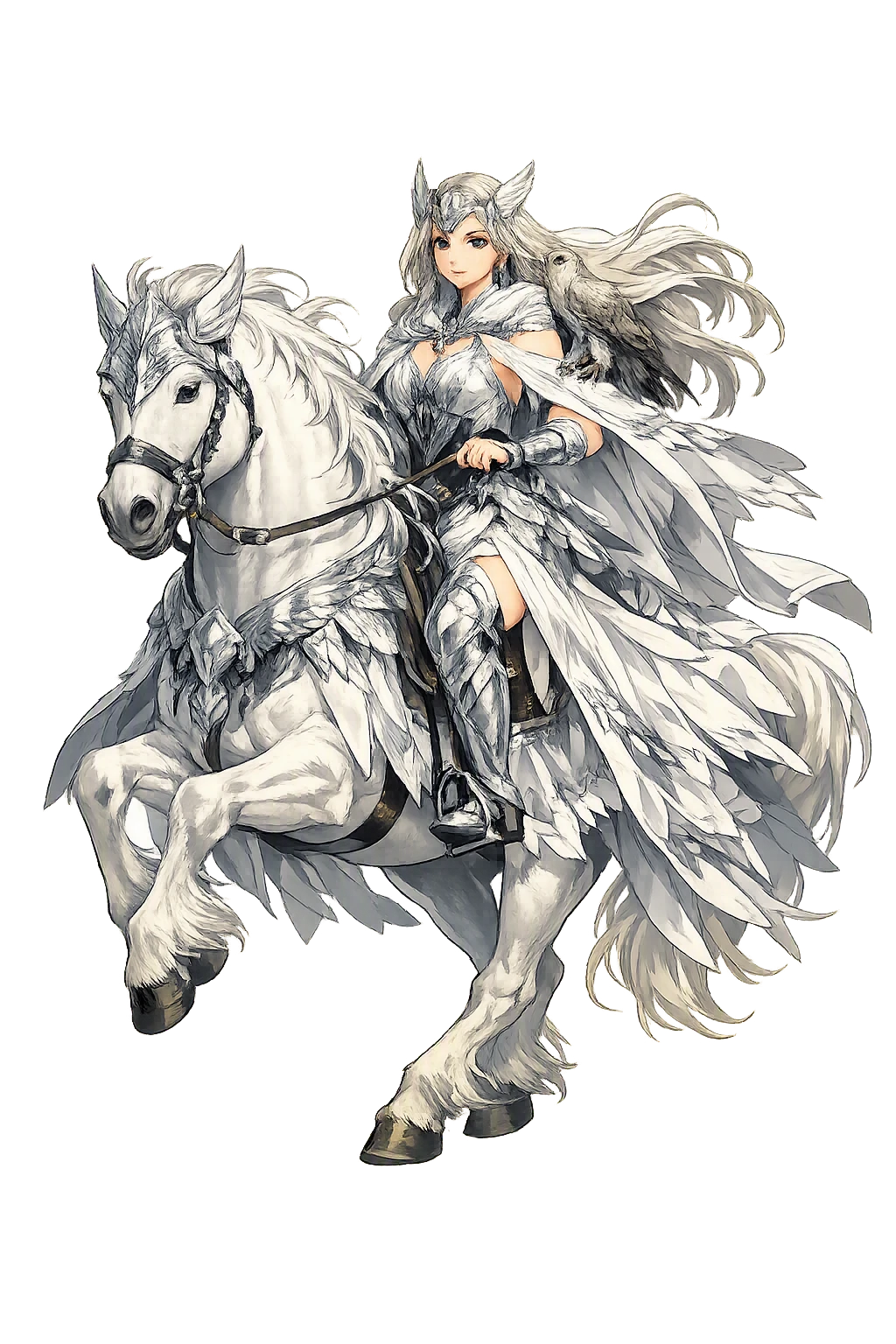
One more thing, because it always surprises: the name did not stay home. Gná has no clear foreign double, but her function — the divine messenger riding a supernatural horse — places her in a common Germanic and Indo-European type. The Vedic Pūṣan and Greek Hermês are wandering messengers with swift horses or sandals; the Irish Manannán rides Aonbharr over sea and land.
And it never stopped working. Gná remains a minor but beloved figure in modern retellings of Norse myth. Her name is sometimes given to characters who embody swiftness or loyal service, and her horse Hofvarpnir appears in games and fiction as a mount that can run on air.
The Convention's Own History
The Poetic Edda survives essentially in one manuscript — the Codex Regius, c. 1270 — and normalized Old Norse spelling descends from what that manuscript and its siblings actually write. Þ and ð are not decorations: they are letters of the alphabet the skalds used (and English later abandoned), and ǫ is a nasal vowel the normalization preserves because the sources carry it. The register's rule is the manuscript's rule: spell the names the way the tradition that sang them wrote them down.
Where Protocol Meets Practice
The technical answer is simple: the canonical marks are legal IDNA 2008 characters, encoded as punycode under `xn--`. The practical answer is messier: legal does not mean stocked (registrar inventory is partial), and stocked does not mean typeable (stacked diacritics defeat mobile keyboards).
So the register's rule is a hierarchy of attested forms — full restoration, circumflex, macron-only, attested variant, and finally plain ASCII for the systems that cannot carry marks. Every rung is defensible because every rung is attested. The forms this register rules against are not rungs; they are errors, and errors do not get rungs.
Write back when you have checked the sources; they are better company than I am.
— The Register
The Verdict
Gná is the canonical form: attested, checkable, and enforced across the temple, the lexicon, the cards, the APIs, and this register. The plain form gna is sanctioned as the fallback vehicle and nothing more. The false forms above are documented so that no reader has to take the temple's word on faith — the violations are stated, the sources are named, and the register stands open to challenge on every line.
The temple of Gná stands at /gna/.
The docket for this ruling: no false forms on the docket; 1 preserved mark verified: a → á; no contested forms attested; the attestation rests on 6 cited sources — Snorri Sturluson, Prose Edda: Gylfaginning 35 (Gná, her horse Hofvarpnir, and the falling fence), Prose Edda, þulur (Gná among the Ásynjur), Cleasby–Vigfusson, An Icelandic-English Dictionary, s.v. Gná.
The Register Continues
This is one of 548 entries in the Canonical Register — the authoritative reference for every flagship temple. The temple's founding dispatch tells the name's story; its Restoration File details the marks; its Resonance File reads the archetype into the industries. The blog index holds the whole archive, and the Rulebook states the convention this register enforces.
Continue the register — previous entry: Ginnungagap (read it) · next entry: Gnowee (read it).
The Canonical Register is written from the same canonical record as the lexicon itself. If a false form is missing from this page, it is because the evidence does not support calling it false — or because we have not seen it yet. Show us, with a citation, and the register will answer.