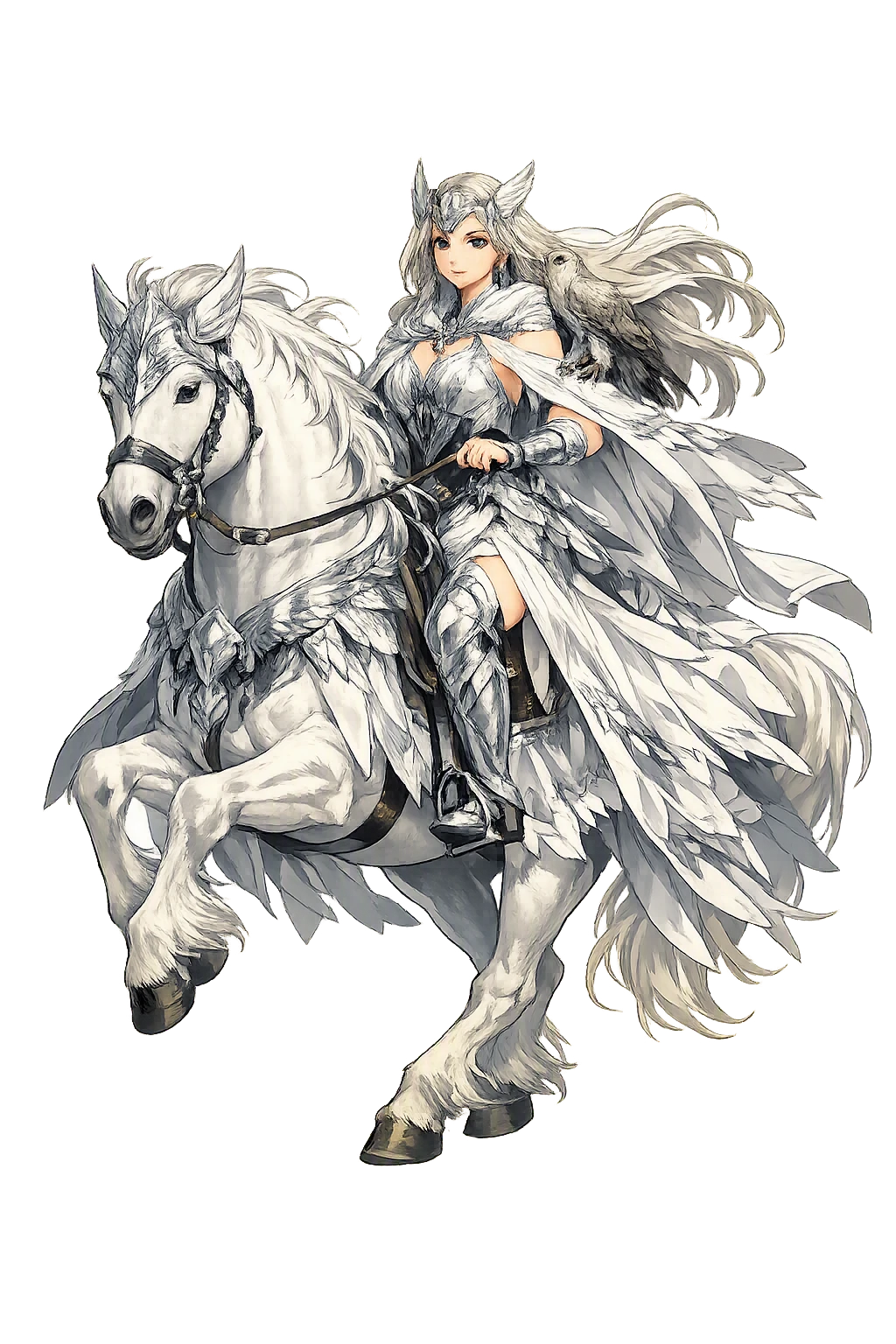
Stories of Gná
Gná's mythology is compact to the point of austerity: the entire narrative record is one chapter of Snorri's catalogue of the Ásynjur (Gylfaginning 35) and the name-lists of the þulur. Speed is her being, her horse Hofvarpnir her attribute, and one fallen fence her single miracle — a minor goddess with exactly enough story to be unforgettable.
Snorri's catalogue gives Gná a single function and lets it define her: 'Gná is the name of one of them; Frigg sends her into various worlds on her errands. She has the horse Hofvarpnir, which runs through the air and over the sea' (Prose Edda, Gylfaginning 35, Faulkes trans.). Wherever Frigg's word must travel — to the other halls of the gods, out among the giants, to whatever errand queens cannot ride to themselves — Gná is the one who carries it, and the carrying is her whole being. The myth is spare because the office is: a messenger is pure function, speed in the service of someone else's will. The Edda honours that function with a goddess of its own, and in doing so admits that the errands of the great are themselves divine work.
Snorri does not leave Hofvarpnir's pedigree to guesswork: the sky-runner 'is produced by Hófvarpni and Hamskerpir' (Gylfaginning 35; cf. the þulur lists of mythic horse-names) — two otherwise unknown horses whose mating produced a foal that runs on air and sea alike, unbothered by the boundary that stops ordinary hooves. The detail is Eddic in its economy: even a minor goddess's mount gets a genealogy, because in this world everything worth naming is born of something named. Hofvarpnir — the name suggests 'hoof-thrower' — is the divine household's answer to distance itself, and Gná's whole horizon is the ground such a horse can erase between one world and the next.
Snorri's one anecdote about Gná is her only recorded miracle. Riding past a farm, she heard a man call from his fence: who rides there? She answered that it was Gná, sent on Frigg's errands. The man mocked her — the fence stood too high for any horse to leap it. Gná reached out, and 'the fence-post fell, and the fence with it', and she rode on through the gap (Gylfaginning 35). The scene is comedy with a blade in it: the sceptic measures a goddess by an obstacle, and the obstacle is removed. The Edda's lesson is about rank and power — even the least of the Ásynjur holds dominion over the fixed world the moment she is mocked, and mockery of a goddess is itself a kind of falling fence.
Beyond Gylfaginning 35, Gná survives only in the name-lists — the þulur catalogues of the goddesses appended to the Prose Edda manuscripts — and in later glosses of the word itself, whose exact sense is uncertain; Cleasby–Vigfusson connect it with the notion of projecting or gazing out. The record should be stated plainly: one passage, one anecdote, one horse. Everything else said about her is modern inference — which is precisely why poets and novelists have made her their own, writing into the silence what the skalds left out: the errands themselves, the worlds at the far end of them, and the speed of a goddess who exists, fully and only, on the way.
Swift Errand-Runner Across Worlds
Gná is one of the Ásynjur, the goddesses of the Norse pantheon, and the special messenger of Frigg. Her horse, Hofvarpnir, runs through air and over sea, carrying her wherever the queen of the gods sends her. She is not a warrior or a mother in the surviving sources; she is speed, service, and the unseen thread that keeps the divine household in motion.
Her horse, born of Hófvarpni and Hamskerpir, can gallop through the sky and across the waves.
Gná carries the queen's word to every corner of the cosmos, the diplomatic courier of Ásgarðr.
A farmer once mocked her from a fence; she made the fence-post fall, teaching him to respect a goddess.
She is the answer Frigg gives when asked which Ásynjur can be trusted to move between worlds without delay.
From the original script to the living URL
ᚴᚾᛅ
The name in its original Norse form. Gná (ᚴᚾᛅ) is attested in the source tradition — “To project, to gaze”. Its acute stress marks carry the full phonetic and orthographic weight of the source tradition.
gna
Reduced to plain gna, the name loses everything that made it specific: acute stress marks. What remains is an ASCII string that machines can parse but that no longer speaks with its original voice.
Gná
The Unicode restoration recovers what ASCII flattened. Gná restores acute stress marks, returning the name to its original written dignity. The domain encodes to Punycode, but the browser displays the truth.
Gná.com → xn--gn-nia.com
The non-ASCII characters in Gná are encoded while the ASCII remains visible. To the DNS, it is Punycode. To humanity, it is Gná.
Owned, ideal, and ASCII forms of Gná
Gná
Restores ᚴᚾᛅ. The live temple domain — gná.com.
gna
Flattens ᚴᚾᛅ. The plain ASCII fallback — what DNS and legacy systems see.
How Gná was spoken
How Gná travels from ancient script to the modern URL
The lore you have read is the living myth. Extended Lore opens the scholarly vault beneath it: the cult and its material remains, a history of the image, the name after antiquity, a meditation on what the name still means, and the full scholarly apparatus — etymology, orthography, sources.
Enter Extended Lore