
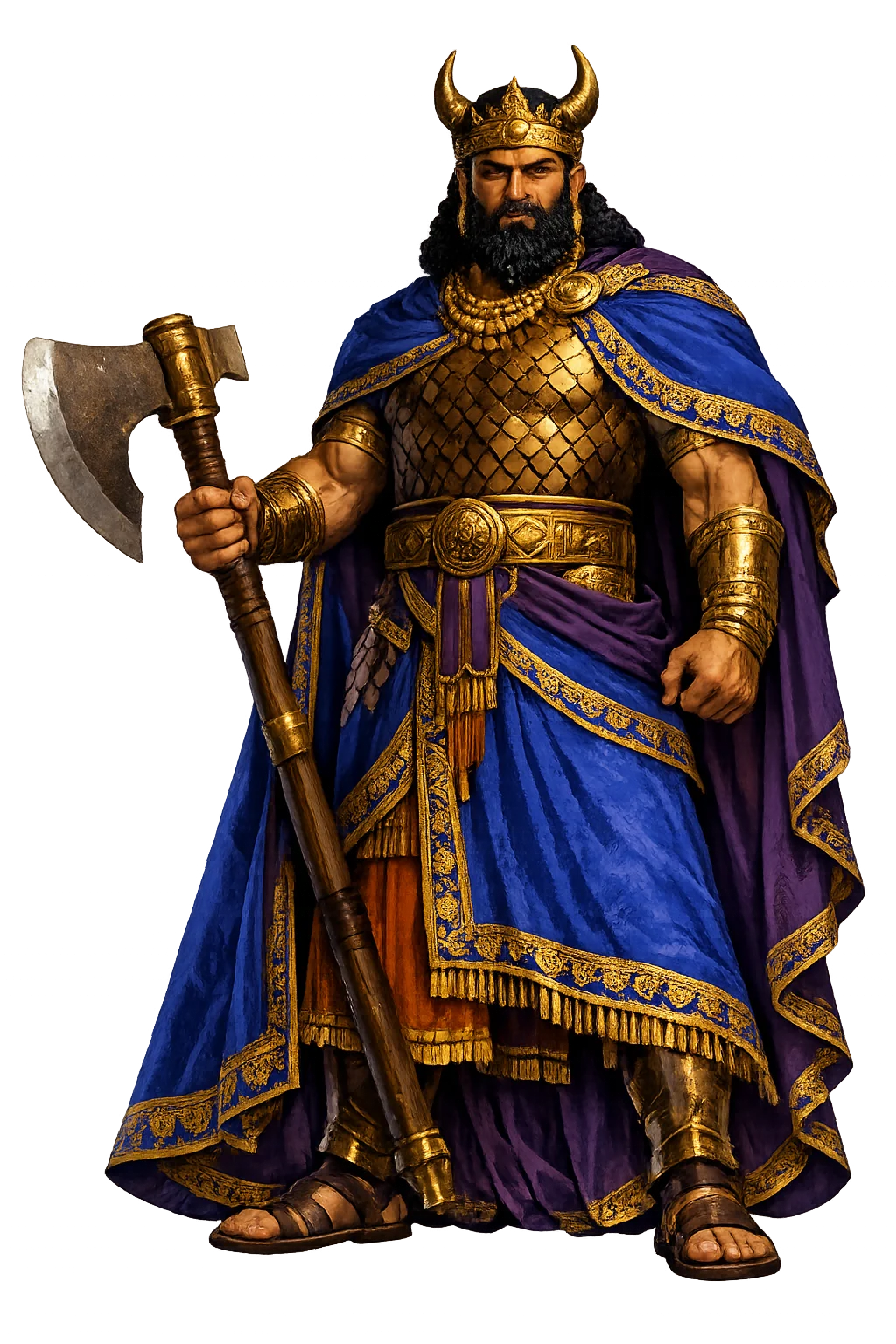
The appointments Gilgameš made — and who is keeping them
Take Gilgameš's stories in sequence. They are not episodes; they are appointments — and the modern trades are keeping them.
At a Glance
- Temple: Gilgameš
- Pantheon: Mesopotamian
- Domain of influence: Hero, King of Uruk
- Pattern seats: 7
- Sectors touched: Home & Lifestyle · Health & Wellbeing · Energy & Natural World · Commerce & Governance · Society & Spirit · Culture & Entertainment
- Strongest seat: Architecture & Spatial Design
- Series: The Resonance Files, No. 174 of 546
The Cycle, Read Forward
Architecture & Spatial Design — through Enkidu Comes from the Wild
Uruk groans under its young king — Gilgameš harries his people 'like a wild bull on the rampage', claiming the wedding-night privilege no bridegroom can refuse — and the gods answer by fashioning his equal from clay: Enkidu, a wild man who runs with gazelles, eats grass, and wrecks the trapper's snares. The trapper's stratagem became proverbial: send Šamhat the prostitute, and let bread, beer, and seven days of loving make a man of him.
The atlas states the seat in one line: The walls of Uruk — the archetypal builder-king; see and copy his wall. The story above is the long version of the same sentence. That is the cycle working: story becomes duty, duty becomes trade.
Biotech, Longevity & Life Sciences — through The Cedar Forest and Humbaba
Hungry for a name that will outlast him, Gilgameš proposes the impossible: the expedition to the Cedar Forest, sacred to Enlil and guarded by the monstrous Humbaba, whose roar is the storm-flood and whose mouth is fire. Enkidu knows that wilderness and begs off — he has walked it — but goes for his friend's sake.
The atlas states the seat in one line: The plant of immortality sought and lost — the longevity quest at its root. The story above is the long version of the same sentence. The trade thinks it is optimizing a process. It is re-enacting a charter.
Forestry, Conservation & Outdoor Industries — through The Bull of Heaven and the Decree
Back in Uruk the goddess Ištar offers Gilgameš marriage, and he answers with the catalogue of her dead lovers — Dumuzi turned into a bird of grief, the shepherd, the herdsman, the gardener, all used and discarded — and the immortal insult: 'Thou art but a brazier that goes out in the cold, a flimsy door that keeps not the blast' (SB tablet VI). Ištar, shamed, demands the Bull of Heaven from Anu and leads it down to gore the city; its snort opens pits that swallow hundreds of young men.
The atlas states the seat in one line: The Cedar Forest and Humbaba — the oldest tale of timber and its cost. The story above is the long version of the same sentence. That is the cycle working: story becomes duty, duty becomes trade.
Disaster Resilience & Recovery — through Across the Waters of Death
Clothed in a lion's skin, Gilgameš wanders beyond the maps: to the twin-peaked Mount Mašu, where scorpion-men guard the sun's gate; through the long tunnel of night; down to the garden of jeweled trees whose fruit is lapis and carnelian; to Šiduri the ale-wife behind her veil, who tells him what every wisdom text after her will repeat — eat thy bread, dance and be merry, hold thy child's hand; and at last across the waters of death with the ferryman Ur-šanabi (SB tablets IX–X). There sits Utnapishtim, the mortal whom the gods made deathless after the flood.
The atlas states the seat in one line: The flood that re-founded the world; the oldest resilience narrative. The story above is the long version of the same sentence. Industries do not invent their archetypes; they inherit them and call them best practice.
The Theme That Runs the Cycle
The Standard Babylonian epic, 'He who saw the deep', runs from the streets of Uruk to the waters of death. Its twelve tablets hold the first full arc of friendship, loss, and wisdom in world literature — and its last line is a tour of brickwork.
The Method, Stated Plainly
None of this is numerology. A seat exists only where the match can be argued from the deity’s documented domains and deeds — weighted, published, and falsifiable. The derivation, the weights, and the challenge process are public on the methodology page. If a seat in this file reads wrong, the atlas itself tells you how to prove it — and the correction becomes part of the record.
For the Ones Who Work There
If you work in architecture & spatial design, biotech, longevity & life sciences, or any trade this temple holds a seat in, this is the honest version of what a placement means: your industry beside the story it has been re-telling all along — on the temple floor itself, before an audience that came specifically to read it. The patron tier and the advertising terms describe the mechanics; the resonance above describes the fit.
The File Continues
One of 546 Resonance Files — the series where the pantheon goes to work. Read the founding dispatch for the name, the Restoration File for the spelling, or the whole archive end to end.
Continue the series — previous: Gefjun (read it) · next: Ginnungagap (read it).
The Resonance Files are argued from the same canonical record as the pattern atlas itself: the lexicon, the lore catalog, and the cited sources. Every seat can be challenged at the methodology page — and the challenge is the point.