
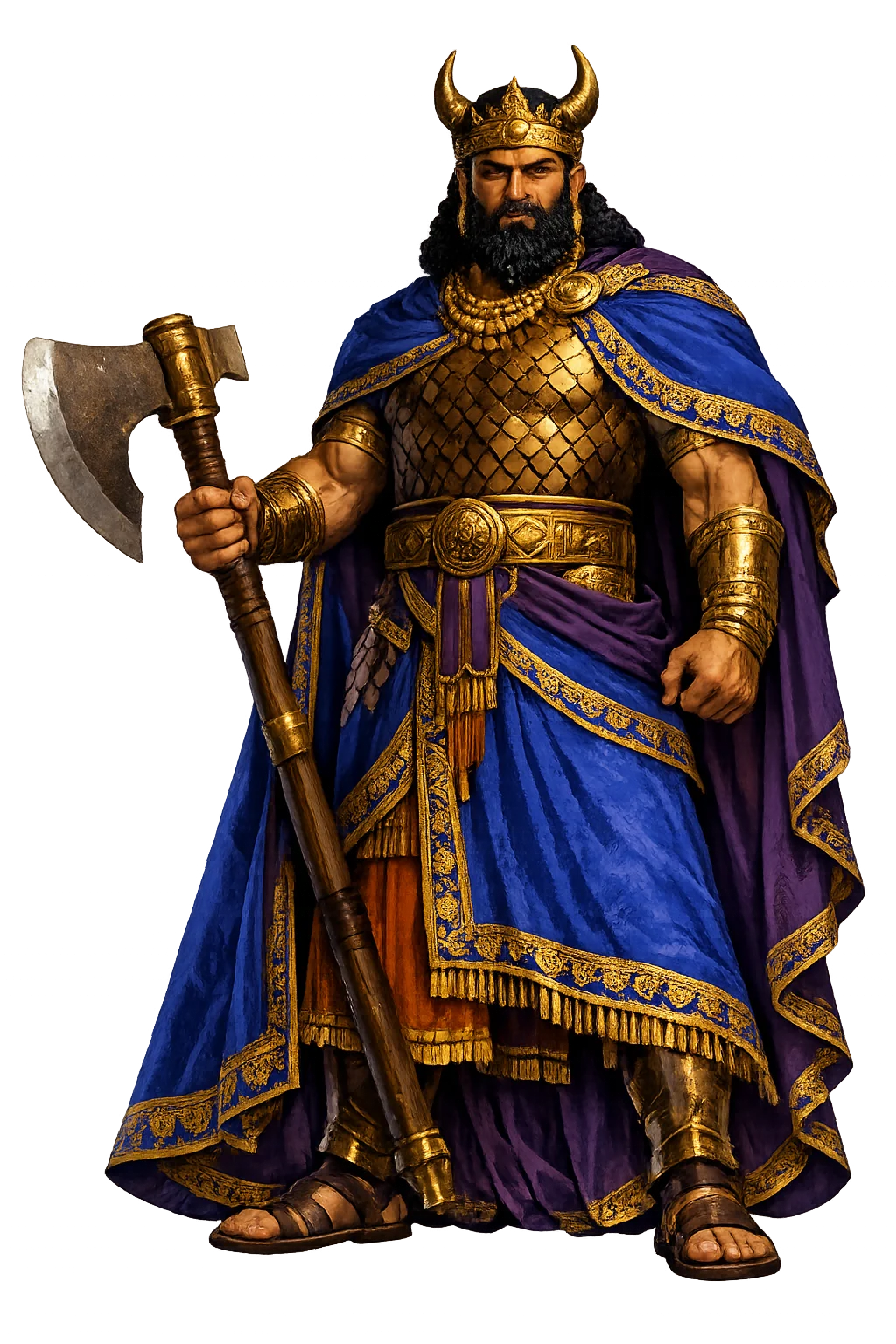
How Gilgameš was rebuilt, mark by mark
The workshop file for Gilgameš. Every rejected form is recorded here too — that is the point of keeping notes.
What We Found
The attestation runs through the tradition's own sources: 𒄑𒂆𒈦. Meaning: "The old man became young".
The figure behind the name: The Standard Babylonian epic, 'He who saw the deep', runs from the streets of Uruk to the waters of death.
What the Name Carried In
Enkidu Comes from the Wild. Uruk groans under its young king — Gilgameš harries his people 'like a wild bull on the rampage', claiming the wedding-night privilege no bridegroom can refuse — and the gods answer by fashioning his equal from clay: Enkidu, a wild man who runs with gazelles, eats grass, and wrecks the trapper's snares. The trapper's stratagem became proverbial: send Šamhat the prostitute, and let bread, beer, and seven days of loving make a man of him.
The Cedar Forest and Humbaba. Hungry for a name that will outlast him, Gilgameš proposes the impossible: the expedition to the Cedar Forest, sacred to Enlil and guarded by the monstrous Humbaba, whose roar is the storm-flood and whose mouth is fire. Enkidu knows that wilderness and begs off — he has walked it — but goes for his friend's sake.
A spelling that has to carry stories like these is not a label. It is equipment.
Where It Stood Before Us
The epic's text is archaeology's gift: the fullest copies are the twelve tablets from the library of Ashurbanipal at Nineveh (seventh century BCE), excavated in the nineteenth century and held by the British Museum, where George Smith read the flood tablet in 1872. Behind them lie Old Babylonian fragments (the Pennsylvania and Yale tablets), Middle Babylonian copies from Ugarit and Emar, translations from Hattusa in Anatolia, and, oldest of all, the Sumerian Bilgames poems from Nippur and Ur. The historical kernel is modest but real: the Sumerian King List names Gilgameš as fifth king of the First Dynasty of Uruk, and the vast walls of Uruk (Warka, Iraq) still stand where the epic says he built them. The bench inherits all of it — the web temple is the newest site, not the first.
What We Rejected
The plain ASCII gilgamesh — admissible as a fallback, never as the primary. A wrong accent would have been worse: the rulebook is explicit that a misplaced mark is worse than none.
What We Set Down
Gilgameš — The restoration preserves more than the ASCII form can express — stress, length, or a letter the Latin keyboard lost — which places it, mechanically, in Tier-1.
For the voice: 'gil-ga-MESH' — three even, heavy syllables; the final 'sh' is soft, like sand through fingers.
The temple stands at /gilgamesh/ — the notes above are public in its Scholarly Edition, sources and all.
At a Glance
- Restored name: Gilgameš
- ASCII form: gilgamesh
- Meaning: "The old man became young"
- Domain of influence: Hero, King of Uruk
- Pantheon: Mesopotamian
- Classification: Tier 1
- Original script: 𒄑𒂆𒈦
- Series: The Restoration Files, No. 174 of 546
The File Continues
The temple's founding dispatch tells the name's story; its Resonance File reads the myths into the industries; the blog index holds the whole archive.
Continue the series — previous file: Gefjun (read it here) · next file: Ginnungagap (read it here).
The Restoration Files are written from the same canonical record as the temples themselves: the lexicon, the lore catalog, the pattern atlas, and the cited scholarly sources. If a file ever disagrees with its temple, the temple is right — tell us, and the file will be corrected.