PuniCodex

Extended Lore

𒄑𒂆𒈦 Gilgameš

Etymology · Orthography · Cult · Iconography · Reception · Sources

Tier 1 Gilgameš.com
Gilgameš — Hero, King of Uruk
01

Quick Facts

Essential information about Gilgameš, Hero, King of Uruk

Original Script𒄑𒂆𒈦
Unicode RestorationGilgameš
Reconstructed Pronunciation/ɡil.ɡa.mɛʃ/
PantheonMesopotamian
DomainHero, King of Uruk
MeaningThe old man became young
ClassificationTier 1
Primary DomainGilgameš.com
Sacred SymbolsThe wild bull, The walls of Uruk, The cedar, The plant of youth, The deluge
02

Etymology & Word Family

From original script to Unicode restoration

Original Script 𒄑𒂆𒈦 Gilgameš — "The old man became young"
Unicode Restoration Gilgameš Restored stress, length, and script
Modern ASCII gilgamesh Plain-ASCII fallback

The name Gilgameš carries the orthographic signature of the mesopotamian tradition: 𒄑𒂆𒈦. Unicode restoration recovers what ASCII flattens.

03

Unicode Character Breakdown

Character-by-character philological analysis

CharacterUnicodeNameBlockPhonetic Role
GU+0047Latin Capital Letter GBasic LatinSame, capitalized
iU+0069Latin Small Letter IBasic LatinSame
lU+006CLatin Small Letter LBasic LatinSame
gU+0067Latin Small Letter GBasic LatinSame
aU+0061Latin Small Letter ABasic LatinSame
mU+006DLatin Small Letter MBasic LatinSame
eU+0065Latin Small Letter EBasic LatinSame
šU+0161Latin Small Letter S with CaronLatin Extended-ASpecial character
—N/ADropped characterMesopotamian orthographyDropped

The Tier 1 classification reflects how much of the original phonology this restoration preserves — stress and vowel length for Greek names, distinctive letters and diacritics for every other tradition.

04

Cult & Worship

How the sacred was kept — rites, sanctuaries, remains

The Cult

Gilgameš was venerated as a deified king at Uruk, the city he ruled, where Old Babylonian hymns address him as a judge of the netherworld and recipient of offerings. The Sumerian poems already treat him as semi-divine, and later tradition made his tomb a place of wonder — Herodotus and Arabic sources locate a supposed tomb in the walls of Uruk. No continuous living cult survives, but modern Assyriological pilgrimage and Kurdish ritual memory at Qadisiyeh keep his name present. The absence of a monumental temple is typical for Mesopotamian royal hero-cults, which were sustained by royal ancestor offerings and scribal commemoration rather than by a priesthood attached to a single sanctuary.

In the Earth

The epic's text is archaeology's gift: the fullest copies are the twelve tablets from the library of Ashurbanipal at Nineveh (seventh century BCE), excavated in the nineteenth century and held by the British Museum, where George Smith read the flood tablet in 1872. Behind them lie Old Babylonian fragments (the Pennsylvania and Yale tablets), Middle Babylonian copies from Ugarit and Emar, translations from Hattusa in Anatolia, and, oldest of all, the Sumerian Bilgames poems from Nippur and Ur. The historical kernel is modest but real: the Sumerian King List names Gilgameš as fifth king of the First Dynasty of Uruk, and the vast walls of Uruk (Warka, Iraq) still stand where the epic says he built them.

05

Iconography

How Gilgameš was imaged across the ages

The Image

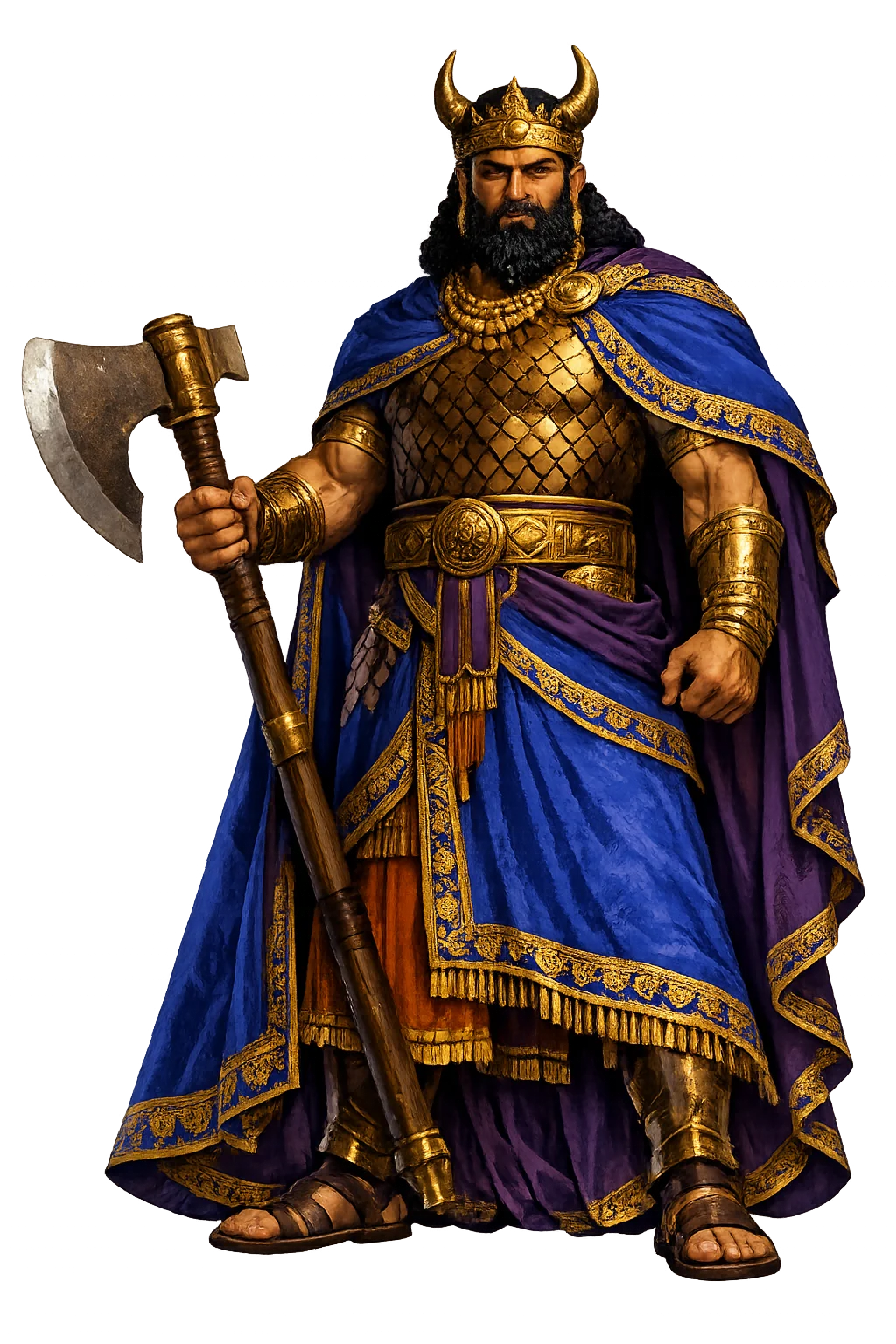
No certain ancient portrait of Gilgameš survives; Mesopotamian art preferred symbolic or royal imagery to narrative illustration of the epic. The figure as a muscular hero belongs to nineteenth- and twentieth-century reception — sculptural reliefs on modern Iraqi monuments, book illustrations, and graphic novels. The most famous visual anchor is the British Museum's eleventh tablet of the Nineveh recension, George Smith's Flood Tablet, which stands metonymically for the hero. In recent cinema and video games Gilgameš appears as an armored Mesopotamian king, an iconography invented by modern popular culture rather than inherited from antiquity.

06

Reception & Transformation

The name after its own age — transmission, translation, survival

Afterlives

The Gilgameš tradition migrated from Sumerian court poetry into Akkadian, then into Hittite, Hurrian, and possibly Elamite versions, becoming the first truly international epic of the ancient Near East. After the cuneiform line died out, the story survived only in scattered echoes — Berossus and perhaps the Alexander Romance — until Austen Henry Layard's excavations at Nineveh and George Smith's 1872 public reading of the flood tablet reintroduced it to the modern world. The first full translations in the early twentieth century struck writers and theologians alike: the flood account invited comparison with Genesis, while the friendship and mortality themes resonated with modern existentialism. Since then Gilgameš has become a staple of world-literature syllabi, opera libretti, manga, and video games, his name shorthand for Mesopotamian civilization itself.

Identifications Across Traditions

The epic itself was an international text: copies in Akkadian, Hittite, and Hurrian lay in the archives of Hattusa, and scribes from Assur to Ugarit learned it by heart. Its flood story adapts the older Atra-ḫasīs epic and stands, at a further remove, behind the biblical account of Noah — George Smith's reading of the eleventh tablet in 1872 caused a sensation for exactly that reason. Gilgameš lived on in the margins of later religions: a judge of the dead in Mesopotamian incantations and visions of the netherworld, and, astonishingly, a named giant in the Book of Giants known from Qumran and Manichaean fragments, where Humbaba's name survives as Ḥobabish. The Sumerian King List had already made him a god, and the learned tradition kept him 'two-thirds divine' long after Uruk's walls were rubble.

Modern Legacy

Rediscovered in the ruins of Nineveh, Gilgameš became the measure of how old literature is: every generation since 1872 has re-translated him, from scholarly editions to novels and graphic retellings. He anchors the modern study of the flood traditions, of heroic friendship, and of the wisdom genre. Uruk — Warka in Iraq, a UNESCO World Heritage site — still raises its walls where the epic begins and ends. To write Gilgameš with the caron is a small act of philological justice: the š is the sound of the epic's own language, and the ASCII 'sh' is a translator's patch.

07

The Meditation

What Gilgameš means — beyond the dictionary

The epic of Gilgameš begins with a wall and ends with a wall, and between them lies the whole education of a human being. At first the king believes what strong young kings believe: that the enemy is distance — the Cedar Forest, the far shore, the undying man beyond the sea. Each victory over distance only brings the real enemy closer, until it stands in his own bedchamber: the fact that he will die. The scorpion-men, the ale-wife, the ferryman, and the flood-hero all tell him the same thing in different voices, and he cannot hear it until the serpent takes the plant. Only then, weeping at the water's edge, does he become the hero of wisdom rather than of strength.

What he brings home is not immortality but an account: 'he who saw the deep' — the epic's first line names him by what he saw and reported, not by what he kept. The plant was for the body; the tale is for the city. And so the last gesture of the poem is a tour of masonry: here are the walls, the brickwork, the threshold. Four thousand years have proven the bargain fair. Uruk's walls are dust, but the tale has outlasted every cedar, every serpent, and every king who heard it and was, for a moment, less afraid.

08

Screen & Culture

Where Gilgameš echoes through film, television, and games — and how

09

Frequently Asked Questions

Common questions about Gilgameš, Hero, King of Uruk, and Unicode restoration

01How do you pronounce Gilgameš?

In reconstructed pronunciation, Gilgameš is /ɡil.ɡa.mɛʃ/ — approximately 'gil-ga-MESH' — three even, heavy syllables; the final 'sh' is soft, like sand through fingers.

02What does Gilgameš mean?

Gilgameš means The old man became young in the mesopotamian tradition.

03What are the symbols of Gilgameš?

Gilgameš is associated with The wild bull (His own title — the goring wild bull, son of Lugalbanda and the goddess Ninsun.), The walls of Uruk (His true immortality, named in the epic's first and last lines.), The cedar (The timber of the Cedar Forest, cut for the great door of Uruk.), The plant of youth ('The old man becomes young' — rejuvenation won from the sea's floor and lost to the serpent.), The deluge (The flood of Utnapishtim, the deep he alone among men saw and survived to tell.).

04Why restore Gilgameš in Unicode?

Plain ASCII gilgamesh strips the stress, length, and script that make the name specific. Unicode restoration returns the name to its original written dignity.

05What is the most important myth about Gilgameš?

“Enkidu Comes from the Wild” — the Tablets I–II story that anchors the mythology of Gilgameš, told in full on the lore page.

10

Scholarly Sources

The philological foundations of this restoration

Every claim on this page is grounded in established scholarship. The orthographic restorations follow disciplinary convention. The etymological chain follows the best available reference works. This is not invention — it is resurrection through scholarship.

◈

Lexicography & Philology

  • Black-Green
◎

Primary Texts

◉

Archaeology & Art History

  • Material evidence — iconography, inscriptions, and temple archaeology — for Gilgameš and related cults.
✦

Religious Studies

  • George, The Babylonian Gilgamesh Epic (2003)
  • Sumerian Bilgames poems (ETCSL c.1.8.1)
  • Hittite and Hurrian fragments from Hattusa (CTH 341)
  • Dalley, Myths from Mesopotamia
Return

The Surface Awaits

You have traced the name from its earliest attestation to its Unicode restoration. Now return to the myth. The story is where the name lives.

Back to Lore
Gilgameš mascot