
Why Gefjun belongs in your address bar
Every address bar is a choice. When you type Gefjun, you are not typing a novelty; you are restoring a name that the early DNS, built for English typewriters, could not carry. The plain ASCII form gefjon is a leftover of that constraint, not the name itself. This post is the long version of the restoration: where the name comes from, how the Younger Futhark tradition wrote it, how it is pronounced, what the myths and the material record preserve, and why its Unicode form now lives as a working domain. The claim throughout is simple — the original spelling is not decoration. It is the name.
At a Glance
- Restored name: Gefjun
- ASCII form: gefjon
- Meaning: "Giving"
- Domain of influence: Fertility, Agriculture
- Pantheon: Norse
- Classification: Tier 2
- Original script: ᚴᛁᚠᛁᚢᚾ (Younger Futhark)
Overview
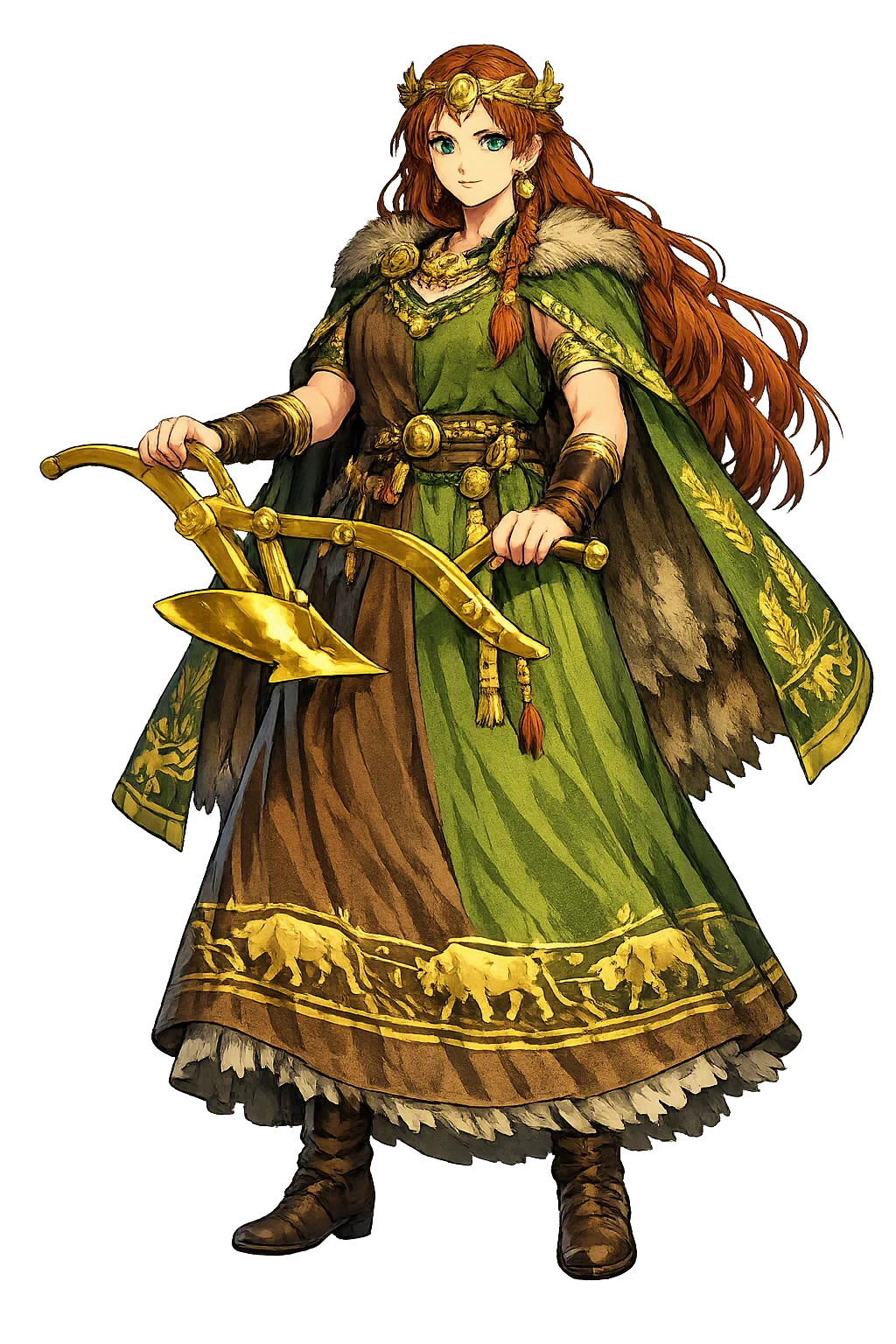
Gefjun (gefjon) — Fertility, Agriculture · Giver — is the ploughing goddess of the Norse tradition: the Æsir-born woman who accepted King Gylfi's wager of a plough-land — as much as four oxen could turn up in a day and a night — and answered it by tearing the island of Zealand out of Sweden and setting it in the sea.
The name is transparent Old Norse: Gefjun derives from gefa 'to give' — the giver. Snorri numbers her fourth among the ásynjur, with the single startling office that 'she is a maiden, and those who die maidens serve her'; the Poetic Edda gives her one speaking part, in Lokasenna, where she intervenes against Loki and is answered with a taunt about a fair lad and a bright necklace.
Her one great narrative opens the Prose Edda itself: four sons begotten on a giant of Jötunheimr, shape-changed into oxen, a ploughshare driven deep enough to tear the land loose, and a kingdom's worth of soil dragged west into the sea — leaving Lake Mälaren behind in Sweden as the mould the island was cast from. PuniCodex restores the name as Gefjun — already plain ASCII in normalized Old Norse, which places it in Tier 2 — and claims no domain for it: the plain-ASCII gefjun.com is held outside the collection and watched for release.
The Name
The name is attested in Old Norse as Gefjun (nominative; genitive Gefjunar). It derives transparently from the verb gefa 'to give' — the same word as English give and German geben — hence 'the giver, the giving one'. The name's closest divine relative is Gefn, listed in Gylfaginning among the bynames of Freyja and standing on the same root; the sources keep Gefjun and Gefn distinct, though scholars have long suspected a deeper connection.
The ASCII working form gefjon is a modern respelling of the ending as -jon; the manuscripts write only -jun. The Unicode restoration Gefjun is itself plain ASCII — normalized Old Norse puts no diacritic and no distinctive letter in this name — so the mechanical rule places it in Tier 2, an honest report about orthography rather than a judgment on the goddess.
The letter-by-letter transformation runs:
- g → G — Same, capitalized
- e → e — Same
- f → f — Same
- j → j — Same
- o → u — Normalized Old Norse -jun: the manuscripts write u, not o
- n → n — Same
The project holds no domain for this name. The plain-ASCII gefjun.com is registered to a third party outside the PuniCodex collection and is watched for release; this temple claims none.
The Original Script
The name is preserved in medieval Icelandic manuscripts in the Latin alphabet as Gefjun — Old Norse (North Germanic), attested 13th–14th c. CE in the Codex Regius (for Lokasenna) and the codices of the Prose Edda and Heimskringla, recording material centuries older. No runic attestation of the theonym survives; the manuscript form is the primary witness.
The scholarly rendering proceeds step by step:
- The name derives from gefa 'to give', with the agentive force 'the giving one'.
- Normalized Old Norse orthography writes the ending -jun: glide j plus short u. The manuscripts know no -jon; the English spelling 'Gefion' is a Latinized modernism.
- No diacritic and no distinctive letter occurs anywhere in the name — the restoration Gefjun is plain ASCII, which is why the mechanical tier rule classifies it Tier 2.
- Because the name is pure ASCII, the matching domain gefjun.com was registered long ago in the ordinary way; it is held by a third party outside the PuniCodex collection and watched for release, and this temple claims no domain at all.
Pronunciation
The reconstructed pronunciation of the name is /ˈɡev.jun/ — Old Norse Reconstruction.
Phoneme by phoneme:
- Ge- — Voiced velar stop [ɡ], as in English give, and short front [e], as in bed; the stressed first syllable, as in every Old Norse word
- -f- — The labiodental fricative, voiced toward [v] between the vowel and the glide, as in gefa itself
- -jun — Palatal glide [j], short close back [u], and dental [n]; the manuscripts write this ending -jun, never -jon
For the modern speaker, the closest approximation is: 'GEV-yoon' — the g hard, the e short, the second syllable like 'yoon' with a light v-glide before it.
Kindred and historical forms of the name:
- Old Norse — Gefjun, the ploughing goddess; from gefa 'to give'
- The root verb — gefa, 'to give', the same word as English give
- Freyja's byname — Gefn, 'the giver', from the same root
- Modern Icelandic — Gefjun, unchanged; older English books write the Latinized Gefion
Gefjun is Tier 2 because the restoration preserves nothing the ASCII alphabet cannot carry: no diacritic, no distinctive letter, no vowel length. The name's information survives transit whole — the only loss in the common English spelling 'Gefion' is historical accuracy.
Mythology
Gefjun's mythology is a single great deed with a small orbit of notices around it: the ploughing of Zealand, told twice — as myth in the Edda, as dynastic history in Heimskringla — and witnessed by one of the oldest skaldic stanzas we have.
The Plough-Land of King Gylfi (Gylfaginning 1)
Gylfi, king of the lands now called Sweden, gave a wandering beggar-woman, as reward for her entertainment, one plough-land in his realm — as much as four oxen could plough up in a day and a night. The woman was of the family of the Æsir, and her name was Gefjun. She took four oxen out of Jötunheimr — her own sons by a certain giant — and set them before the plough; the share went so deep and hard that it tore the land loose, and the oxen drew it out into the sea and westward until it stopped in a sound. There she set the land and named it Selund, Zealand. Where the land had been, the water filled in: the lake now called Lögrinn, Mälaren, whose bays correspond to Zealand's headlands.
The Völva and the Founding of Lejre (Ynglinga saga 5)
Heimskringla's version frames the making as history: Gefjun was a spákona, a seeress, and Óðinn sent her north across the sound to look for land. Gylfi met her and gave the plough-land; she went to Jötunheimr, bore four sons to a giant, changed them into oxen's likeness, and drew the land out westward opposite Óðinsvé, Odense. The saga then adds what the Edda omits: Gefjun settled on her new-made land and married Skjöldr, a son of Óðinn, and their seat was Hleiðra — Lejre, beside Roskilde, the royal seat of Denmark. The maker of the island stood at the root of its kings: Skjöldr is the eponym of the Skjöldungar, the Scyldings.
Eight Eyes and Four Heads (Bragi inn gamli)
Both Snorri and the saga close with the same four lines attributed to Bragi inn gamli Boddason, the ninth-century skald — the oldest datable witness to the myth. In the stanza's kennings, Gefjun gladly drew from Gylfi 'the wave-trove's free-hold' until smoke rose from the running sweat-beasts, and the oxen bore 'eight forehead-moons and four heads' as they carried off Denmark's increase. The story was already fixed, with fixed imagery, centuries before Snorri wrote.
Fourth Among the Ásynjur (Gylfaginning)
In Snorri's catalogue of the ásynjur, Gefjun stands fourth, after Frigg, Sága, and Eir, with one startling office: 'she is a maiden, and those who die maidens serve her.' The catalogue's maiden and the myth's giant-consort are never reconciled; Skáldskaparmál keeps her in the þulur of the ásynjur and licenses her name as a base-word in kennings for women.
The Necklace and the Fair Lad (Lokasenna 20–22)
Her single speaking part in the Poetic Edda comes at Ægir's feast: as Loki works his way down the bench of goddesses, Gefjun intervenes — why do you Æsir bandy bitter words in the hall? Óðinn rebukes her at once: she is mad to rouse Loki, for Loki knows the fates of all as well as Óðinn himself. Loki's answer is the only scandal the corpus attaches to her: a fair youth gave her a bright necklace, a sigli, and she wound her legs about him. Nothing answers the taunt; nothing repeats it.
Symbols & Iconography
The iconography of Gefjun is the iconography of her single great deed — the corpus gives her no temple regalia, but the ploughing fixed a set of attributes no retelling can omit:
- The plough — Creation by furrow: land made by turning earth, the oldest technology of order doing the work of a god
- The four oxen — Her sons by a giant of Jötunheimr, shape-changed into draught-beasts: giant strength yoked to a goddess's purpose; Bragi counts eight eyes and four heads
- The plough-land — The wager's unit, a day and a night's ploughing, stretched within its own terms until it holds an island
- The answering coasts — Zealand's headlands and the bays of Lake Mälaren, the two halves of one tear: the myth's own map, and its standing evidence
Archaeology & Evidence
Gefjun is a textual goddess whose evidence is a landscape. Her attestations are literary — the Codex Regius Lokasenna, Snorri's Gylfaginning, and the Ynglinga saga of Heimskringla — and no cult site, votive deposit, or runic inscription names her; the place-name claims sometimes advanced on her behalf are insecure. What the myth itself offers as evidence is the map: Zealand's headlands and the bays of Lake Mälaren, explained by the story as the two halves of a single tear.
Her one fixed point on the ground is Hleiðra — Lejre, near Roskilde — where the saga seats her marriage to Skjöldr. Excavations there since the 1980s have uncovered successive great-hall complexes of the Iron Age and Viking Age, confirming Lejre's real antiquity as a royal power centre behind the Skjöldung legends, though nothing found names the goddess herself. The oldest datable witness to the myth is not a stone but a stanza: Bragi's ninth-century verse, quoted by both Snorri and the saga. Her most famous monument is modern: Bundgaard's Gefion Fountain, unveiled in Copenhagen in 1908.
Realm & Domain
Gefjun is catalogued under Fertility, Agriculture — and the sources earn both terms with a single instrument: the plough.
Fertility
Her myth is a creation myth of the most fertile kind: land itself brought forth by a goddess and her giant-born sons. Scholars have long placed her among the fertility figures of the North, though the sources give her no cult and the classification rests on the myth's shape rather than on ritual evidence.
Agriculture
She is the only figure in the Norse corpus who works with a plough: the plough-land — a day and a night's ploughing by four oxen — is both the wager's unit and the myth's measure, and creation happens by furrow, not by thunder.
The Giver
The name's root, gefa 'to give', frames the whole story: Gylfi's gift of a plough-land is answered by a gift beyond measuring, and the byname Gefn carries the same root into Freyja's house.
Across Cultures
Gefjun's nearest relative lives inside the pantheon itself. Gylfaginning names Gefn — 'the giver' — among the bynames of Freyja, and both names stand on the same root, gefa; Simek treats Gefjun and Gefn as possibly once-connected figures whom the surviving sources keep distinct.
Beyond the North, scholars have long set her story among the land-measure foundation legends of the ancient world — tales in which a people explains how its territory was won by stretching a definition, Dido's ox-hide at Carthage being the classical case. The Norse variant stretches not a hide but a day's ploughing, and the unit it stretches is agricultural: the plough-land. Her other life is dynastic. Through Skjöldr she belongs to the origin-complex of the Danish kings — the same stratum that produced Beowulf's Scyld Scefing, the sheaf-child who founds the Scylding line in the poem's prologue, and Saxo's Skioldus. The handbooks read the marriage of Gefjun and Skjöldr as the point where myth and royal genealogy were deliberately joined: a plough-goddess at the root of a farming aristocracy's line.
Cultural Legacy
Gefjun's afterlife is monumental and national. The Gefion Fountain on Copenhagen's harbourfront — Anders Bundgaard's great bronze group, unveiled in 1908 as the Carlsberg Foundation's gift to the city — shows her exactly where the myth leaves her: driving the four oxen as they strain toward the sea. It is among the largest monuments in Copenhagen and the standard image of the goddess worldwide, and the story itself remains Denmark's foundation tale, the way Danish children learn why Zealand lies apart in the sea.
Her name has even left the planet: the main-belt asteroid 1272 Gefion, discovered in 1931, gives its name to the Gefion family of asteroids. In the North the name never became a common given name, and modern Heathenry keeps her chiefly as the goddess of the land itself — but in Denmark she needs no introduction, and her fountain is where Copenhagen meets its own creation story.
The Scholarly Record
The account of Gefjun given in this edition rests on the witnesses and reference works listed below. Gylfaginning supplies the great narrative and the catalogue entry; Ynglinga saga the dynastic frame and the Bragi stanza; Lokasenna the single speaking part; the lexica secure the name's etymology; the handbooks arbitrate Gefn, fertility, and reception.
- Snorri Sturluson, Edda, Gylfaginning 1 (the ploughing of Zealand) and the catalogue of the ásynjur; Skáldskaparmál (þulur; woman-kennings), ed. and trans. Anthony Faulkes (London: Everyman, 1987).
- The Poetic Edda, Lokasenna 20–22, trans. Carolyne Larrington, 2nd ed. (Oxford: Oxford University Press, 2014).
- Snorri Sturluson, Heimskringla, Ynglinga saga 5 (the völva, Skjöldr, Hleiðra; quoting Bragi inn gamli), trans. Lee M. Hollander (Austin: University of Texas Press, 1964).
- Cleasby, Richard, and Guðbrandur Vigfússon, An Icelandic-English Dictionary, 2nd ed. (Oxford: Clarendon Press, 1957), s.v. Gefjun, gefa.
- Zoëga, Geir T., A Concise Dictionary of Old Icelandic (Oxford: Clarendon Press, 1910), s.v. Gefjun, gefa, Gefn.
- de Vries, Jan, Altnordisches etymologisches Wörterbuch, 2nd ed. (Leiden: Brill, 1962), s.v. gefa, Gefjun.
- Simek, Rudolf, Dictionary of Northern Mythology, trans. Angela Hall (Cambridge: D. S. Brewer, 1993), s.v. Gefjun, Gefn.
- Lindow, John, Norse Mythology: A Guide to the Gods, Heroes, Rituals, and Beliefs (Oxford: Oxford University Press, 2001), s.v. Gefjun.
- Beowulf, prologue (Scyld Scefing), ed. and trans. R. M. Liuzza, 2nd ed. (Peterborough, ON: Broadview, 2013).
- Christensen, Tom, Lejre – Syn og Sagn (Roskilde: Roskilde Museum, 1991).
A Meditation
Gefjun is the patron of the answer that exceeds the wager. Gylfi sets the terms — four oxen, a day and a night — and keeps his word; she keeps it too, and ruins him within the terms. The myth is about measure outwitted by measure: the smallest unit of farmland, a plough-land, stretched until it holds an island and a royal house.
What she gives is not only the land but the lesson the name already carries: the giver decides the scale of the gift. Every telling of her is a reminder that the terms you set will be met — by someone cleverer at keeping them.
The Unicode Restoration
Gefjun is classified as Tier 2: the restoration needs no distinctive letters or diacritics its ASCII form would lose. The ASCII fallback gefjon still resolves everywhere, but it is the restored form that carries the name's full information. Across the 6 characters of the name, the restoration adjusts 1: 1 further adjustment (u). That is the whole thesis of this temple: the marks are the message.
Why This Restoration Matters
Restoring Gefjun is part of a larger effort to make the web multilingual by default. The PuniCodex project does not ask users to learn a new alphabet; it asks the infrastructure to respect the alphabets that already exist. Every section of this post — the script, the sound, the myths, the evidence — converges on the same point: the marks in Gefjun are information, and information deserves an address of its own. A single Unicode domain is a small proof, but it is a proof that scales: every name restored makes the next one easier, and every visit to the temple is a vote for the restored form.
Explore Further
This post is one doorway into the temple. The home page carries the full character breakdown and the ambient canvas; the lore page tells the myths in long form; the Scholarly Edition preserves the sources, pronunciation data, and revision history; and the patron wall supports the restoration directly. For the wider map, browse the Lexicon, explore the Pantheon, or return to the PuniCodex blog.
Related Names
Sources
The full scholarly apparatus — every citation, revision, and review — lives in the Scholarly Edition. Key references for this post:
- Snorri Sturluson, Edda, Gylfaginning 1 (the ploughing of Zealand) and the catalogue of the ásynjur, ed. and trans. Anthony Faulkes (London: Everyman, 1987).
- Cleasby, Richard, and Guðbrandur Vigfússon, An Icelandic-English Dictionary, 2nd ed. (Oxford: Clarendon Press, 1957), s.v. Gefjun, gefa.
- Lokasenna 20–22 (Poetic Edda), trans. Carolyne Larrington, The Poetic Edda, 2nd ed. (Oxford: Oxford University Press, 2014).
- Zoëga, Geir T., A Concise Dictionary of Old Icelandic (Oxford: Clarendon Press, 1910), s.v. Gefjun, gefa, Gefn.
- Lexicon authorities for this entry: Prose Edda, Cleasby-Vigfusson.