
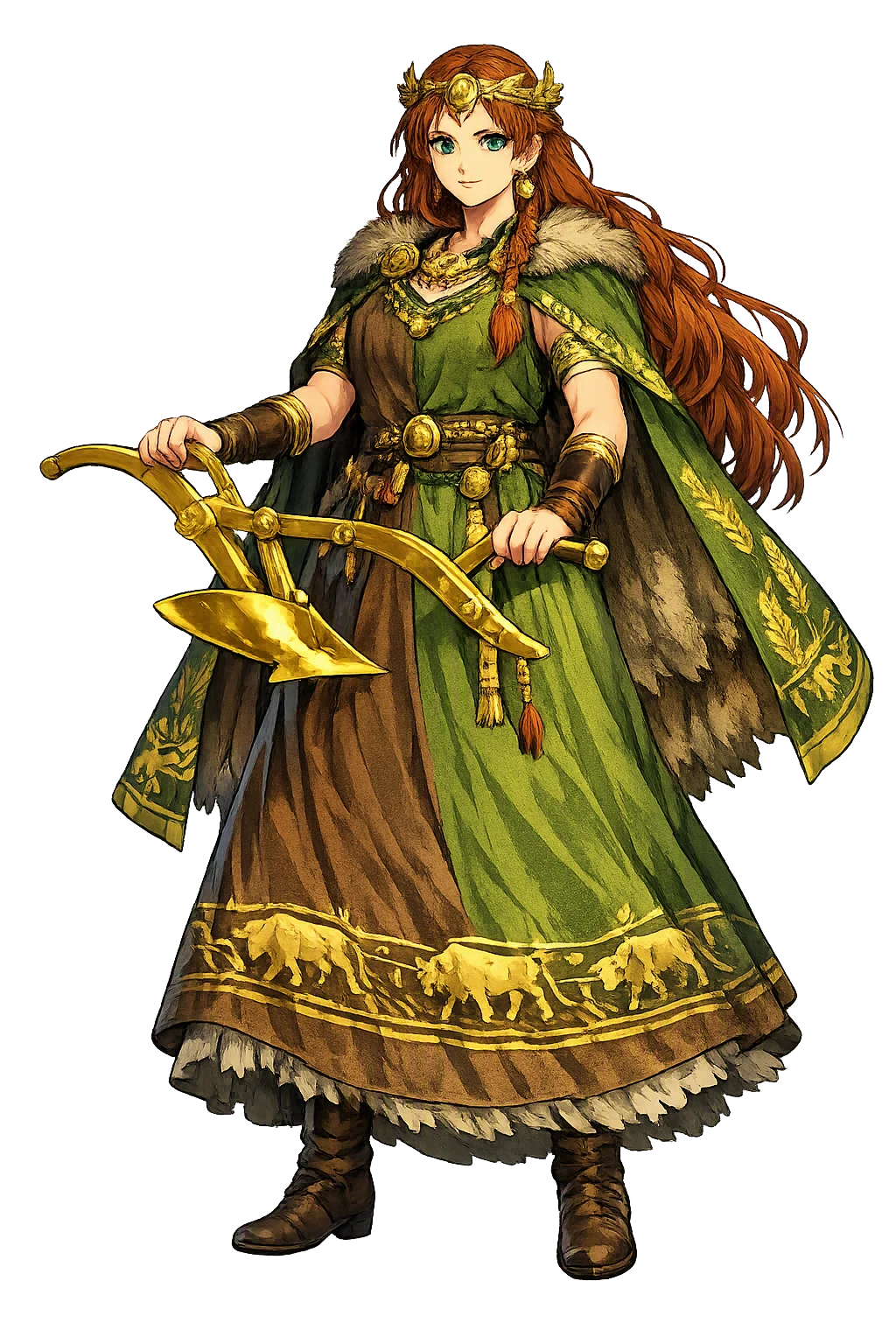
Why Gefjun belongs in the scholarly record
A name can be complete without carrying a single diacritic. Gefjun is a canonical scholarly spelling, not a damaged form waiting for decoration. This post follows the evidence behind that spelling: the scholarly record, the reconstructed sound, the myths, the material culture, and the reasons this particular romanization became the public reference. The plain ASCII letters already contain the whole form. The scholarly work is to prove their provenance, preserve their capitalization, and keep the name attached to its history.
At a Glance
- Canonical name: Gefjun
- ASCII form: gefjon
- Meaning: "Giving"
- Domain of influence: Fertility, Agriculture
- Pantheon: Norse
- Restoration: ASCII-equivalent form
- Reconstructed form: ᚴᛁᚠᛁᚢᚾ (Younger Futhark)
Overview
Gefjun (gefjon) — Fertility, Agriculture · Giving — belongs to the Norse tradition, where it is catalogued under the domain "Fertility, Agriculture". The name means "Giving".
Gefjun is the giver who made an island: the Æsir-born goddess who accepted King Gylfi's jest of a plough-land — as much as four oxen could turn in a day and a night — and answered it by begetting four sons on a giant, yoking them as oxen, and dragging the whole of Zealand out of Sweden into the sea.
PuniCodex records the canonical scholarly spelling Gefjun and serves its temple at its temple. The displayed form is ASCII-equivalent — a description computed from the displayed form itself. The plain ASCII form gefjon contains the same letters: no recovered diacritics or special encoding is claimed. The work here is consistent citation, capitalization, provenance, and cultural context.
The Name
The name is attested in Younger Futhark as ᚴᛁᚠᛁᚢᚾ. Etymologically it means "Giving".
The canonical spelling Gefjun matches the conventional scholarly romanization. The plain ASCII form gefjon contains the same letters, so no lost diacritics or encoding transition is claimed. The editorial work is to fix one reviewed reference spelling, preserve capitalization and provenance, and keep the original evidence visible. The displayed form is ASCII-equivalent — a description computed from the displayed form itself.
The letter-by-letter transformation runs:
- g → G — Same, capitalized
- e → e — Same
- f → f — Same
- j → j — Same
- o → u — Special character
- n → n — Same
The Original Script
The name is preserved in Younger Futhark as ᚴᛁᚠᛁᚢᚾ.
The scholarly transliteration is kifiun.
The rendering proceeds step by step:
- ᚴ (kaun) writes both /k/ and /g/ (and the ng cluster)
- ᛁ (ís) writes both /i/ and /e/
- ᚠ (fé) writes both /f/ and /v/
- The spelling kifiun is a normalized phonetic reconstruction; Younger Futhark does not distinguish voiced/voiceless stops or separate short and long vowels
The normalized Old Norse form is Gefjun — already plain Latin letters, with no diacritic and no distinctive character for the restoration to recover; in the Younger Futhark the name would have been carved roughly ᚴᛁᚠᛁᚢᚾ (k-i-f-i-u-n: the k-rune writes g, and the single i-rune covers both the vowel e and the glide j). Because the name is pure ASCII, its domain was registered in the ordinary way long ago: gefjun.com is held by a third party outside the PuniCodex collection and is watched for release — no form of the name is currently owned, and this temple claims none.
Pronunciation
The reconstructed pronunciation of the name is /ˈɡev.jun/ — Old Norse Reconstruction.
Phoneme by phoneme:
- Ge- — Voiced velar stop [ɡ], as in English 'give', and short front [e], as in 'bed'; the stressed first syllable, as in all Old Norse words.
- -f- — The labiodental fricative, voiced toward [v] between the vowel and the glide — Old Norse f softens in voiced company, as in gefa itself.
- -jun — Palatal glide [j], short close back [u], and dental [n]; the manuscripts write this ending -jun, never -jon.
For the modern speaker, the closest approximation is: 'GEV-yoon' — the g hard as in 'give', the e short as in 'bed', the second syllable like 'yoon' with a light v-glide before it; stress the first syllable, as in modern Icelandic Gefjun.
Kindred and historical forms of the name:
- Old Norse — Gefjun, the ploughing goddess; from gefa, 'to give'.
- The root verb — gefa, 'to give' — the same word as English give and German geben.
- Freyja's byname — Gefn, 'the giver' — the name's closest divine relative, from the same root.
- Modern Icelandic — Gefjun, unchanged; older English books write the Latinized Gefion.
Old Norse Gefjun derives transparently from gefa, 'to give': Cleasby-Vigfusson enter the goddess under that root, and Zoëga glosses the name as the giver. The restoration Gefjun is plain ASCII — the normalized Old Norse spelling carries no diacritic and no distinctive letter — so the mechanical rule places the name in a plain restoration. The working ASCII form 'gefjon' respells the ending with an o; the manuscripts know only Gefjun.
Mythology
Gefjun has one of the few land-creation myths in the whole Norse corpus, and it opens the Prose Edda itself: the ploughing of Zealand. Around that single great deed the sources add a catalogue entry, a dynastic marriage, and one sharp exchange in verse.
The Plough-Land of King Gylfi (Gylfaginning 1)
When Snorri opens Gylfaginning, before Gylfi ever reaches Ásgarðr, he tells how the king was first tricked out of a piece of his kingdom. Gylfi gave a wandering beggar-woman, as reward for the entertainment she gave him, one plough-land in his realm — as much as four oxen could plough up in a day and a night. But the woman was of the family of the Æsir, and her name was Gefjun. She took four oxen out of Jötunheimr — her own sons, begotten on a certain giant — and set them before the plough. The share went so deep and hard that it tore the land loose, and the oxen drew it out into the sea and westward until it stopped in a sound. There Gefjun set the land and named it Selund, Zealand. And where the land had been taken from, the water filled in: that is now the lake called Lögrinn, Mälaren, and the bays of the lake, Snorri says, correspond to the headlands of Zealand. The myth lets its hearers read their own map as the scar of a wager — geography kept as evidence of a goddess out-negotiated by no one.
The Völva and the Founding of Lejre (Ynglinga saga 5)
Heimskringla tells the same making as dynastic history. Gefjun, the saga says, was a spákona, a seeress, and Óðinn sent her north across the sound to look for land. King Gylfi met her and gave her one plough-land. She went to Jötunheimr, bore four sons to a giant there, changed them into the likeness of oxen, yoked them, and drew the land out into the sea westward, opposite Óðinsvé — Odense. Then the saga adds what the Edda leaves out: Gefjun settled on the land she had made and married Skjöldr, a son of Óðinn, and their seat was Hleiðra — Lejre, beside Roskilde, the royal seat of Denmark. The goddess who made the island also stood at the root of its kings: Skjöldr is the eponym of the Skjöldungar, the Scyldings whose line Beowulf opens by praising.
Eight Eyes and Four Heads (Bragi inn gamli)
Both Snorri and the saga close the account with the same four lines, attributed to Bragi inn gamli Boddason, the ninth-century skald — the oldest datable witness to the story. In the verse's kennings, Gefjun gladly drew from Gylfi 'the wave-trove's free-hold' until smoke rose from the running sweat-beasts, and the oxen bore 'eight forehead-moons and four heads' as they carried off Denmark's increase. Eight eyes and four heads: the poet counts the team for us. The making of Zealand was already a fixed story, with fixed imagery, centuries before Snorri wrote it down. The verse matters beyond its antiquity: it fixes the story’s legal core in skaldic memory — a land transacted as a wager, celebrated by the court poets as the founding bargain of the Danish realm, and remembered in fixed kennings long after the kings who told it were dust. When a ninth-century poet counts a goddess’s oxen by their eyes, the myth is already scripture: quoted, not invented, by everyone who came after.
Fourth Among the Ásynjur (Gylfaginning 35)
In Gylfaginning's catalogue of the ásynjur, Gefjun stands fourth, after Frigg, Sága, and Eir, and Snorri gives her a single, startling office: 'she is a maiden, and those who die maidens serve her.' The sentence sits unresolved beside the Zealand story — the maiden of the catalogue is the giant's consort of the myth — and the tradition never reconciled the two. Skáldskaparmál keeps her in the þulur, the metrical name-lists of the ásynjur, where her name is licensed as a base-word in kennings for women: a skald praising a woman could reach for Gefjun as readily as for any goddess. The unresolved contradiction is the point: the catalogue’s maiden and the myth’s consort stand side by side, and the tradition declines to choose between them.
The Necklace and the Fair Lad (Lokasenna 19–21)
Gefjun speaks once in the Poetic Edda, and it costs her. In Lokasenna, as Loki works his way down the bench of goddesses at Ægir's feast, Gefjun intervenes: why, she asks, do you Æsir bandy bitter words here in the hall? Óðinn's rebuke is immediate — she is mad, he says, to rouse Loki, for Loki knows the fates of all as well as Óðinn himself. Then Loki turns on her with the only scandal the corpus attaches to her name: a fair youth once gave her a bright necklace, a sigli, and she wound her legs about him. The taunt echoes the necklace-stories of the other goddesses, and the poem moves on; nothing in the corpus answers it, and nothing repeats it.
Symbols & Iconography
The iconography associated with Gefjun concentrates in a small set of recurring attributes, each a compressed statement about the name:
- The plough — Creation by furrow: land made by turning earth — the oldest technology of order doing the work of a god
- The four oxen — Giant strength yoked to a goddess's purpose: brute force given direction
- The plough-land — The wager's unit — a day and a night's ploughing, stretched within its own terms until it holds an island
- The answering coasts — Zealand's headlands and Mälaren's bays: the two halves of one tear, the myth's own map
Archaeology & Evidence
Gefjun is a textual goddess whose evidence is a landscape. Her attestations are literary — the Codex Regius Lokasenna, Snorri's Gylfaginning, and the Ynglinga saga of Heimskringla — and no cult site, votive deposit, or runic inscription names her; the place-name claims sometimes advanced are insecure. What the myth itself offers as evidence is the map: Zealand's headlands and the bays of Lake Mälaren, which the story explains as the two halves of a single tear. Her one fixed point on the ground is Hleiðra — Lejre, near Roskilde — where the saga seats her marriage to Skjöldr; excavations there since the 1980s have uncovered successive great-hall complexes of the Iron Age and Viking Age, confirming Lejre's real antiquity as a royal power centre, though nothing found names the goddess. The oldest datable witness to the myth is not a stone but a stanza: Bragi's ninth-century verse, quoted by both Snorri and the saga. Her most famous monument is modern: Bundgaard's Gefion Fountain in Copenhagen, unveiled 1908.
Realm & Domain
Gefjun is the giver who made an island: the Æsir-born goddess who accepted King Gylfi's jest of a plough-land — as much as four oxen could turn in a day and a night — and answered it by begetting four sons on a giant, yoking them as oxen, and dragging the whole of Zealand out of Sweden into the sea.
The Four Oxen
Her sons by a giant of Jötunheimr, shape-changed into draught-beasts — Bragi counts them: eight eyes and four heads.
The Plough
Driven so deep and hard that it tore the bedrock: the instrument by which a piece of Sweden became an island.
Zealand (Selund)
The land she set in the sound and named — drawn west, Ynglinga saga says, until it lay opposite Odense.
Lake Mälaren
The mould the island was cast from: water filled the wound, and the lake's bays answer Zealand's headlands.
Across Cultures
Gefjun's nearest relative lives inside the pantheon itself. Gylfaginning names Gefn — 'the giver' — among Freyja's bynames, and both names stand on the same root, gefa; Simek treats the two as possibly once-connected figures, distinct in the surviving sources. Beyond the North, scholars have long set her story among the land-measure foundation legends of the ancient world — the type of tale in which a people explains how its territory was won by stretching a definition, Dido's ox-hide at Carthage being the classical case — with the difference that Gefjun stretches not a hide but a day's ploughing, and the unit she stretches is agricultural. Her other life is dynastic: through Skjöldr she belongs to the origin-complex of the Danish kings, the same stratum that produced Beowulf's Scyld Scefing and Saxo's Skioldus. The handbooks read the marriage as the point where myth and royal genealogy were deliberately joined — a plough-goddess at the root of a farming aristocracy's line.
Kindred figures in the PuniCodex cross-tradition index include Anāhitā, Auðhumla, Ọbalúayé, Bꜣstt, Cernunnos, and Cōātlīcue, each linked through earth / mother / fertility.
Cultural Legacy
Gefjun's afterlife is monumental and national. The Gefion Fountain on Copenhagen's harbourfront — Anders Bundgaard's great bronze group, unveiled in 1908 as the Carlsberg Foundation's gift to the city — shows her exactly where the myth leaves her: driving the four oxen as they strain toward the sea. It is among the largest monuments in Copenhagen and the standard image of the goddess worldwide, and the story itself remains Denmark's foundation tale, the way Danish children learn why Zealand lies apart in the sea. Her name has even left the planet: the main-belt asteroid 1272 Gefion, discovered in 1931, gives its name to the Gefion family of asteroids. The name never became a common given name in the North, but in Denmark it needs no introduction.
The Scholarly Record
The account of Gefjun given in this edition rests on the witnesses and reference works listed below. Lexica and etymological dictionaries secure the form and meaning of the name; the literary and religious texts supply the narrative evidence.
- Snorri Sturluson, Prose Edda: Gylfaginning 1 (the ploughing of Zealand) and the ásynjur catalogue; Skáldskaparmál (þulur; woman-kennings).
- Poetic Edda: Lokasenna 19–21 (Gefjun's intervention, Óðinn's rebuke, Loki's taunt).
- Snorri Sturluson, Heimskringla: Ynglinga saga 5 (the völva, Skjöldr, Hleiðra), quoting Bragi inn gamli.
- Beowulf, prologue (Scyld Scefing and the Scylding line).
- Cleasby–Vigfusson and Zoëga, s.vv. Gefjun, gefa.
- Simek, Dictionary of Northern Mythology; Lindow, Norse Mythology: A Guide — s.v. Gefjun, Gefn.
A Meditation
Gefjun is the patron of the answer that exceeds the wager. Gylfi sets the terms — four oxen, a day and a night — and keeps his word; she keeps it too, and ruins him within the terms. The myth is about measure outwitted by measure: the smallest unit of farmland, a plough-land, stretched until it holds an island and a royal house. What she gives is not only the land but the lesson the name already carries: the giver decides the scale of the gift. Every telling of her is a reminder that the terms you set will be met — by someone cleverer at keeping them.
The Canonical Spelling
Gefjun is the canonical spelling used by this temple. The plain ASCII form gefjon contains the same letters, so there are no lost diacritics to recover and no special encoding transition to explain. What the temple preserves is the reviewed reference form: capitalization, conventional romanization, original evidence, and a stable place to inspect them. The value here is not added decoration; it is fidelity to the attested record.
Why This Record Matters
Recording Gefjun accurately is part of a larger effort to make the web more faithful to the names it carries. This spelling needs no recovered marks; it needs a defensible chain of evidence. The script, sound, myths, and material record converge on the same point: the canonical form is information, and information deserves an address of its own. The temple keeps that address connected to the scholarship that justifies it.
Explore Further
This post is one doorway into the temple. The home page carries the full character breakdown and the ambient canvas; the lore page tells the myths in long form; the Scholarly Edition preserves the sources, pronunciation data, and revision history; and the patron wall supports the restoration directly. For the wider map, browse the Lexicon, explore the Pantheon, or return to the PuniCodex blog.
Related Names
Sources
The full scholarly apparatus — every citation, revision, and review — lives in the Scholarly Edition. Key references for this post:
- An Icelandic-English Dictionary, 2nd ed. with supplement, 1874.
- Poetic Edda (Eddukvæði), ed. Neckel-Kuhn; trans. Carolyn Larrington, Oxford World's Classics (2014), 1270.
- Snorri Sturluson, Prose Edda, trans. Anthony Faulkes, Everyman / Viking Society for Northern Research, 1220.
- Snorri Sturluson, Prose Edda: Gylfaginning 1 (the ploughing of Zealand) and the ásynjur catalogue; Skáldskaparmál (þulur; woman-kennings).
- Poetic Edda: Lokasenna 19–21 (Gefjun's intervention, Óðinn's rebuke, Loki's taunt).
- Snorri Sturluson, Heimskringla: Ynglinga saga 5 (the völva, Skjöldr, Hleiðra), quoting Bragi inn gamli.
- Beowulf, prologue (Scyld Scefing and the Scylding line).
- Lexicon authorities for this entry: Prose Edda, Cleasby-Vigfusson.