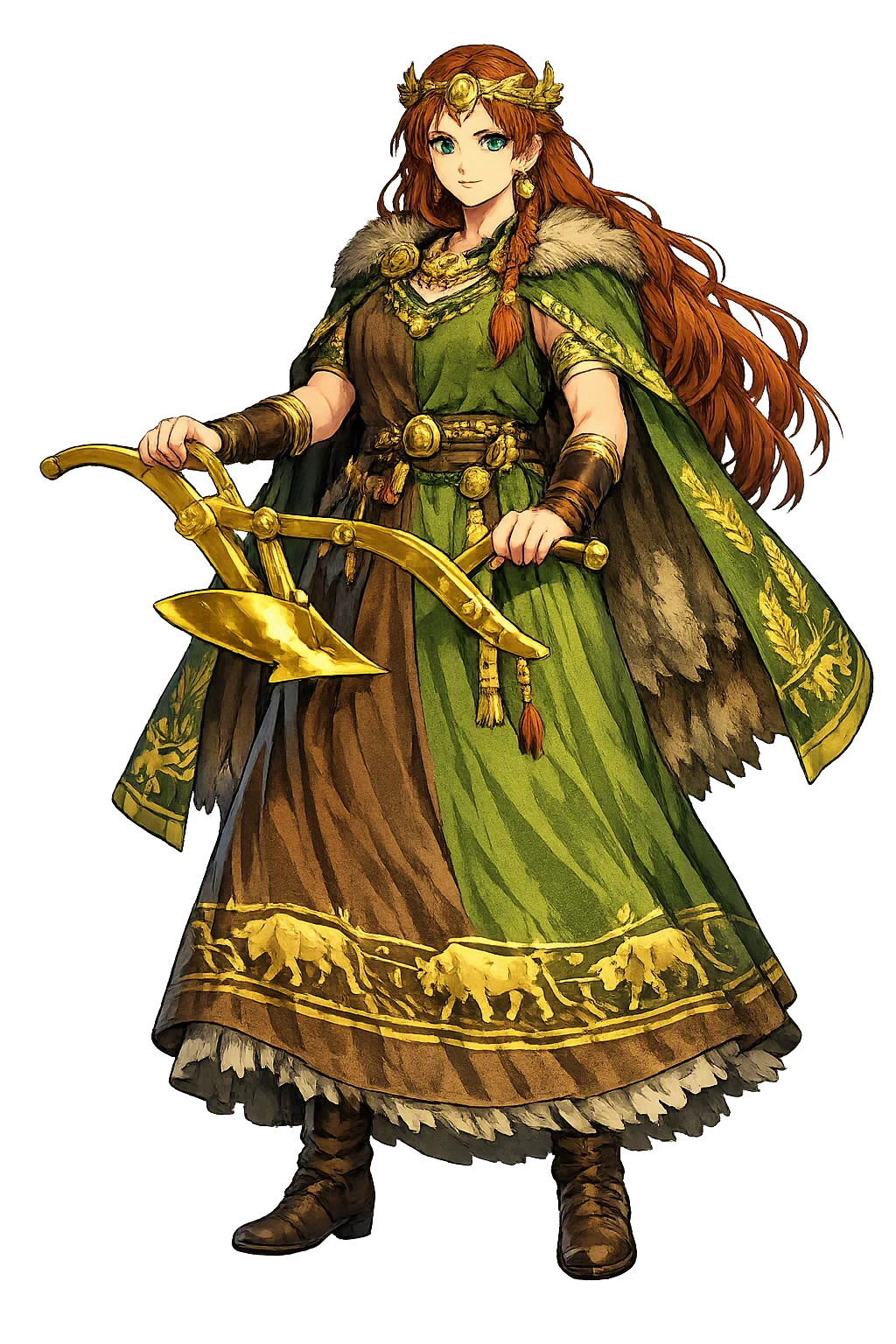
Stories of Gefjun
Gefjun has one of the few land-creation myths in the whole Norse corpus, and it opens the Prose Edda itself: the ploughing of Zealand. Around that single great deed the sources add a catalogue entry, a dynastic marriage, and one sharp exchange in verse.
When Snorri opens Gylfaginning, before Gylfi ever reaches Ásgarðr, he tells how the king was first tricked out of a piece of his kingdom. Gylfi gave a wandering beggar-woman, as reward for the entertainment she gave him, one plough-land in his realm — as much as four oxen could plough up in a day and a night. But the woman was of the family of the Æsir, and her name was Gefjun. She took four oxen out of Jötunheimr — her own sons, begotten on a certain giant — and set them before the plough. The share went so deep and hard that it tore the land loose, and the oxen drew it out into the sea and westward until it stopped in a sound. There Gefjun set the land and named it Selund, Zealand. And where the land had been taken from, the water filled in: that is now the lake called Lögrinn, Mälaren, and the bays of the lake, Snorri says, correspond to the headlands of Zealand. The myth lets its hearers read their own map as the scar of a wager — geography kept as evidence of a goddess out-negotiated by no one.
Heimskringla tells the same making as dynastic history. Gefjun, the saga says, was a spákona, a seeress, and Óðinn sent her north across the sound to look for land. King Gylfi met her and gave her one plough-land. She went to Jötunheimr, bore four sons to a giant there, changed them into the likeness of oxen, yoked them, and drew the land out into the sea westward, opposite Óðinsvé — Odense. Then the saga adds what the Edda leaves out: Gefjun settled on the land she had made and married Skjöldr, a son of Óðinn, and their seat was Hleiðra — Lejre, beside Roskilde, the royal seat of Denmark. The goddess who made the island also stood at the root of its kings: Skjöldr is the eponym of the Skjöldungar, the Scyldings whose line Beowulf opens by praising.
Both Snorri and the saga close the account with the same four lines, attributed to Bragi inn gamli Boddason, the ninth-century skald — the oldest datable witness to the story. In the verse's kennings, Gefjun gladly drew from Gylfi 'the wave-trove's free-hold' until smoke rose from the running sweat-beasts, and the oxen bore 'eight forehead-moons and four heads' as they carried off Denmark's increase. Eight eyes and four heads: the poet counts the team for us. The making of Zealand was already a fixed story, with fixed imagery, centuries before Snorri wrote it down. The verse matters beyond its antiquity: it fixes the story’s legal core in skaldic memory — a land transacted as a wager, celebrated by the court poets as the founding bargain of the Danish realm, and remembered in fixed kennings long after the kings who told it were dust. When a ninth-century poet counts a goddess’s oxen by their eyes, the myth is already scripture: quoted, not invented, by everyone who came after.
In Gylfaginning's catalogue of the ásynjur, Gefjun stands fourth, after Frigg, Sága, and Eir, and Snorri gives her a single, startling office: 'she is a maiden, and those who die maidens serve her.' The sentence sits unresolved beside the Zealand story — the maiden of the catalogue is the giant's consort of the myth — and the tradition never reconciled the two. Skáldskaparmál keeps her in the þulur, the metrical name-lists of the ásynjur, where her name is licensed as a base-word in kennings for women: a skald praising a woman could reach for Gefjun as readily as for any goddess. The unresolved contradiction is the point: the catalogue’s maiden and the myth’s consort stand side by side, and the tradition declines to choose between them.
Gefjun speaks once in the Poetic Edda, and it costs her. In Lokasenna, as Loki works his way down the bench of goddesses at Ægir's feast, Gefjun intervenes: why, she asks, do you Æsir bandy bitter words here in the hall? Óðinn's rebuke is immediate — she is mad, he says, to rouse Loki, for Loki knows the fates of all as well as Óðinn himself. Then Loki turns on her with the only scandal the corpus attaches to her name: a fair youth once gave her a bright necklace, a sigli, and she wound her legs about him. The taunt echoes the necklace-stories of the other goddesses, and the poem moves on; nothing in the corpus answers it, and nothing repeats it.
The Four Oxen, the Wager of King Gylfi, and the Making of Zealand
Gefjun is the giver who made an island: the Æsir-born goddess who accepted King Gylfi's jest of a plough-land — as much as four oxen could turn in a day and a night — and answered it by begetting four sons on a giant, yoking them as oxen, and dragging the whole of Zealand out of Sweden into the sea.
Her sons by a giant of Jötunheimr, shape-changed into draught-beasts — Bragi counts them: eight eyes and four heads.
Driven so deep and hard that it tore the bedrock: the instrument by which a piece of Sweden became an island.
The land she set in the sound and named — drawn west, Ynglinga saga says, until it lay opposite Odense.
The mould the island was cast from: water filled the wound, and the lake's bays answer Zealand's headlands.
From the original script to the living URL
ᚴᛁᚠᛁᚢᚾ
The name in its original Norse form. Gefjun (ᚴᛁᚠᛁᚢᚾ) is attested in the source tradition — “Giving”. Its original diacritics and script distinctions carry the full phonetic and orthographic weight of the source tradition.
gefjon
The plain gefjon form is identical to the Unicode restoration. Because this name is already written in Latin letters, no diacritics, stress, or script information were lost — only capitalization differs.
Gefjun
The Unicode restoration does not need to recover lost marks for Gefjun. Its value is canonical spelling and consistent cataloguing, not the reconstruction of erased orthography. The domain is readable as-is to both DNS and humanity.
Gefjun.com
This restoration is written entirely in ASCII letters — no Punycode encoding stands between Gefjun and the DNS. The domain reads identically to machines and to human eyes.
Owned, ideal, and ASCII forms of Gefjun
Gefjun
Restores ᚴᛁᚠᛁᚢᚾ. The full Unicode restoration. gefjun.com is not in the PuniCodex collection — it is watched for release; if it drops, this temple upgrades to an owned flagship.
gefjon
Flattens ᚴᛁᚠᛁᚢᚾ. The plain ASCII fallback — what DNS and legacy systems see.
How Gefjun was spoken
How Gefjun travels from ancient script to the modern URL
The lore you have read is the living myth. Extended Lore opens the scholarly vault beneath it: the cult and its material remains, a history of the image, the name after antiquity, a meditation on what the name still means, and the full scholarly apparatus — etymology, orthography, sources.
Enter Extended Lore