
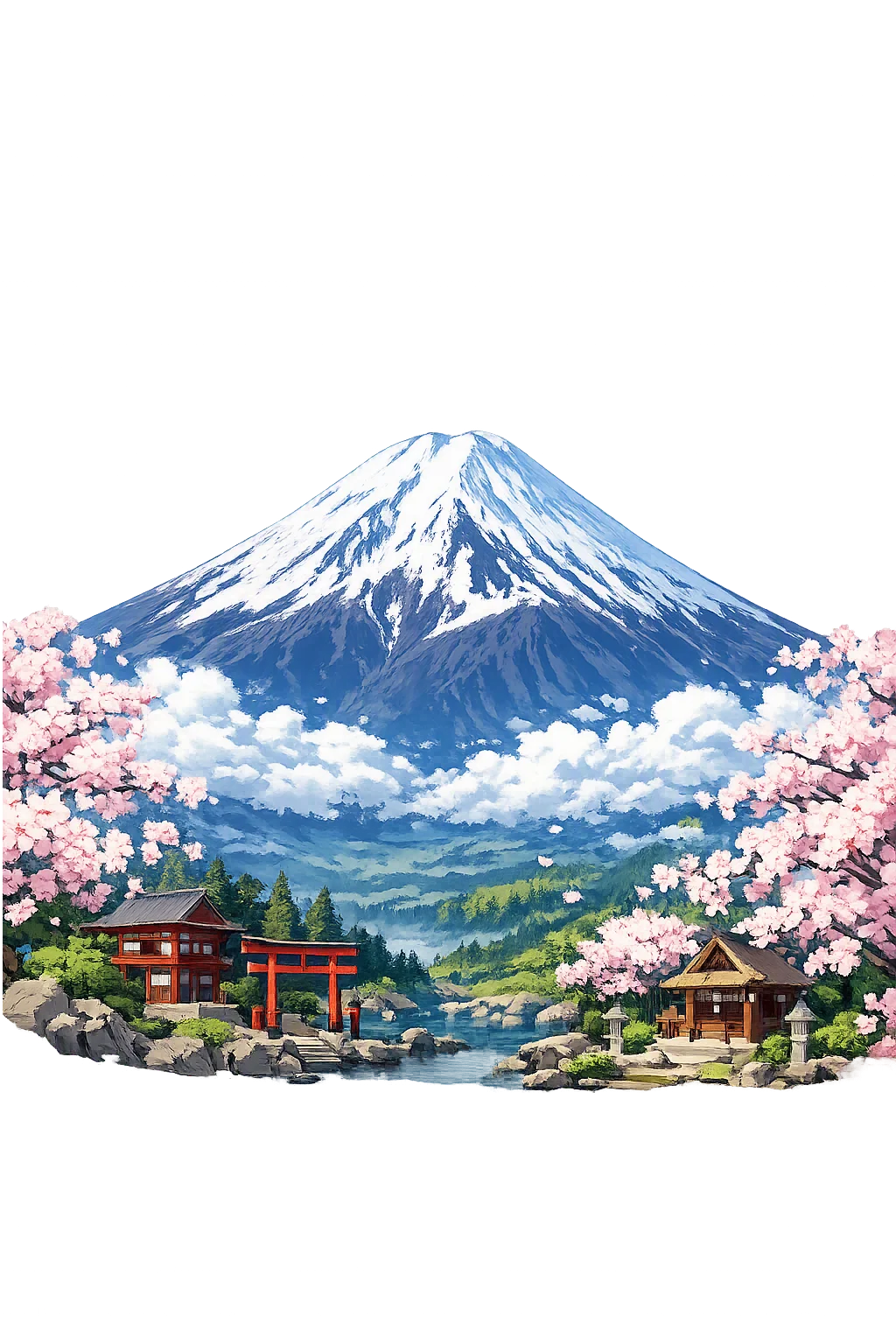
Fuji: the stories first, then the spelling
Before the spelling, the story. Fuji earns its restoration the old way — through what was actually told.
The Stories That Carry the Name
The Name and Its Power. Folk etymology explains the name as fushi, 'without equal,' or fuji, 'inexhaustible' — both appropriate to a mountain with no rival on the horizon. In the early chronicles the peak's deity was treated as female, a kami of fire, and in the medieval period she was identified with Sengen (Asama-no-kami) and with Konohanasakuya-hime, the blossom princess of the Kojiki, whose marriage to the heavenly grandson Ninigi bound heaven's line to the earth. When Fuji smoked or rumbled, the interpretation was immediate: the goddess of the volcano was stirring, and the province looked to its Sengen shrines.
Fuji as Lotus Mandala. In the medieval imagination Fuji was not climbed so much as entered. Buddhist exegetes mapped the mountain as a lotus mandala, its ridges the lotus petals, its crater the heart of the world; ascending it was circumambulation and pilgrimage at once. In the sixteenth century the ascetic Hasegawa Kakugyō is credited with founding the Fuji-kō confraternities, and by the Edo period tens of thousands of pilgrims climbed in white robes reciting sutras, carrying miniature shrines up the stations and building fujizuka — small replica Fujis — in the cities, so that those who could not travel could still 'climb' the mountain.
The Floating World's Mountain. Between about 1830 and 1850 the ukiyo-e masters fixed Fuji's image for the world. Hokusai's Thirty-Six Views of Mount Fuji placed the same snow-cap behind the Great Wave, a lumberyard, a tea-house balcony, a thunderstorm — proving the mountain was a measuring stick for every human activity. Hiroshige answered with travel series in which Fuji appears at a roadside halt, over a river, beyond a station bell.
And Here Is What the Spelling Preserves
Against those stories, the attestation: 富士, as Kojiki and Nihon Shoki (references to the mountain's kami and the Konohanasakuya line) and H. Byron Earhart, Mount Fuji: Icon of Japan (2011) record. The name means "Wealthy warrior".
At a Glance
- Restored name: Fuji
- ASCII form: fuji
- Meaning: "Wealthy warrior"
- Domain of influence: Sacred Mountain
- Pantheon: Japanese
- Classification: Tier 2
- Original script: 富士
- Series: The Restoration Files, No. 162 of 548
The Name Travels
Fuji is a palimpsest of religious traditions. Shinto's Sengen shrines honor the mountain's volcanic kami — under the honji suijaku logic of the medieval centuries, a local kami read as the trace of a universal Buddha.
The Address It Earned
The temple of Fuji stands at /fuji/ — lore, scholars, patterns — because a name carrying this much story deserves more than a parking page. One decisive feature survives — a single, honest mark — which places the restoration in Tier-2: exact, and exactly labeled.
The Sources Are Open
The myths above are retold from the temple's record; the primary voices are in the Sacred Texts: Kojiki and Nihon Shoki. Nothing in this file outranks them.
The File Continues
Read the founding dispatch for the name's full story, the Resonance File for the archetype at work — or the whole archive in one sitting.
Continue the series — previous file: Frigg (read it here) · next file: Fūjin (read it here).
The Restoration Files are written from the same canonical record as the temples themselves: the lexicon, the lore catalog, the pattern atlas, and the cited scholarly sources. If a file ever disagrees with its temple, the temple is right — tell us, and the file will be corrected.