PuniCodex

Extended Lore

富士 Fuji

Etymology · Orthography · Cult · Iconography · Reception · Sources

Tier 2 Fuji
Fuji — Sacred Mountain
01

Quick Facts

Essential information about Fuji, Sacred Mountain

Original Script富士
Unicode RestorationFuji
Reconstructed Pronunciation/ɸɯː.dʑi/
PantheonJapanese
DomainSacred Mountain
MeaningWealthy warrior
ClassificationTier 2
Primary DomainFuji
Sacred SymbolsSnow-capped cone, Torii and shrine markers, Crater and rising sun, Pilgrim's staff
02

Etymology & Word Family

From original script to Unicode restoration

Original Script 富士 Fuji — "Wealthy warrior"
Unicode Restoration Fuji Canonical scholarly spelling — ASCII-identical
Modern ASCII fuji Plain-ASCII fallback

The name Fuji reaches the modern world through scholarly transliteration of the japanese tradition. Because the conventional spelling uses only Latin letters, its Unicode and ASCII forms coincide — the tradition it carries is in the name itself, not in diacritics.

03

Unicode Character Breakdown

Character-by-character philological analysis

CharacterUnicodeNameBlockPhonetic Role
FU+0046Latin Capital Letter FBasic LatinSame, capitalized
uU+0075Latin Small Letter UBasic LatinSame
jU+006ALatin Small Letter JBasic LatinSame
iU+0069Latin Small Letter IBasic LatinSame

The Tier 2 classification here reflects fidelity to the attested tradition, not recovered diacritics: every character of Fuji already survives in ASCII. What the restoration preserves is the canonical spelling itself — the form scholarship standardised.

04

Cult & Worship

How the sacred was kept — rites, sanctuaries, remains

The Cult

Fuji's cult is the Sengen cult, and its head is Fujisan Hongū Sengen Taisha at Fujinomiya on the mountain's southwest flank — shrine of Asama-no-Ōkami, identified with Konohanasakuya-hime, and head of a nationwide family of some 1,300 Asama (Sengen) shrines that keep watch on volcanic peaks. Its present main hall, a Tokugawa rebuilding of 1604, is the cult's chief monument, and imperial envoys have carried offerings there since the ninth century. The ritual year turns on 1 July, the Yamabiraki, when the Yoshida trailhead opens and the great Sengen festival is held; the old pilgrim routes — Yoshida and Subashiri on the east, Murayama on the south — begin at Sengen shrines, and their station lodges fed and housed the climbers in white who walked through the night to greet the goraikō, the sunrise, from the crater rim. Women were barred from the sacred heights until the Meiji state lifted the prohibition in the early 1870s; the summit itself remains a Sengen sanctuary, the deity's inner shrine.

In the Earth

Fuji is ringed by Sengen shrines, of which Fujisan Hongū Sengen Taisha in Fujinomiya — its present main hall a 1604 Tokugawa rebuilding — is the head of the cult. The 2013 World Heritage listing protects twenty-five component sites: Yamamiya and Murayama Sengen shrines on the old pilgrim approaches, the Yoshida and Subashiri trailheads with their station lodges and boundary markers, the lava tree-molds of Aokigahara's Sea of Trees, and the summit crater with its own Sengen sanctuary. The Hōei eruption of 1707 left a cinder cone on the flank and tephra beds as far as Edo, recorded in contemporary paintings and official memoranda. Every summer's climbers walk, step for step, a route fixed by the Fuji-kō confraternities four centuries ago.

05

Iconography

How Fuji was imaged across the ages

The Image

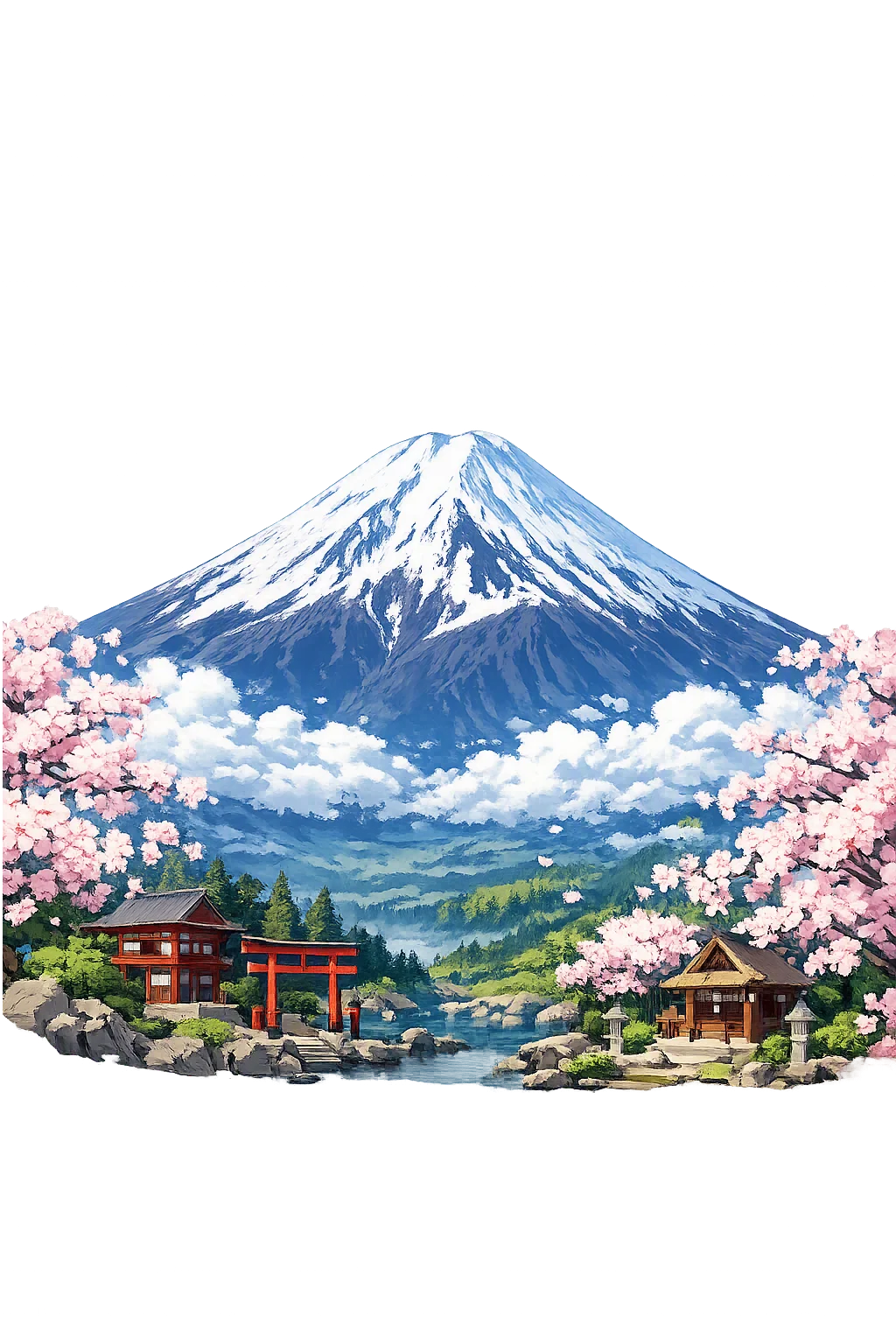
Fuji is the rare deity whose true image is a skyline. No ancient cult statue survives, because there was nothing to statue: the kami's body is the cone, capped with snow from October to June. Medieval picture scrolls of the Bamboo-Cutter tale (Taketori emaki) gave the mountain its first narrative frame, showing the fire-rat robe burning on its summit, and medieval Fuji mandalas mapped the sacred geography in paint. The eight peaks of the crater rim were read as an eight-petaled lotus — the mountain as living mandala — and Edo-period Rinpa painters, Sōtatsu and his followers, brushed the cone across gold-leaf screens for palace and villa. Confraternity houses displayed painted Fujis as objects of devotion in their own right. The town print shops then finished the work: the snow-cap silhouette, recognizable from a hundred paces, became one of the most reproduced landscape images on earth.

06

Reception & Transformation

The name after its own age — transmission, translation, survival

Afterlives

Fuji's journey to world-icon began in verse. Yamabe no Akahito, the great Man'yōshū poet of the eighth century, gave the mountain its classic lyric — coming out of Tago bay to find pure snow fallen on the lofty peak — and the Tale of the Bamboo-Cutter (early tenth century) bound it into fiction as the burning-place of the fire-rat robe, the mountain where an immortal garment met fire. Early-modern wordplay sealed the etymology: Fuji punned as fushi, 'no death,' and Edo confraternity catechisms made the volcano a sermon on imperishability. The nineteenth century carried the image west: after the ports opened, the print shops' Fuji — Hiroshige's travel series above all — fed the Japonisme craze, van Gogh copied Hiroshige's rain-soaked bridge in 1887, and Rilke's 'Der Berg' (1907) answered a Hokusai print in German verse. The modern mountain keeps both lives: a sacred calendar on its slopes, and the most recognized silhouette in Japanese art below.

Identifications Across Traditions

Fuji is a palimpsest of religious traditions. Shinto's Sengen shrines honor the mountain's volcanic kami — under the honji suijaku logic of the medieval centuries, a local kami read as the trace of a universal Buddha. Buddhist Fuji-kō confraternities climbed the mountain as a living mandala; Shugendō mountain ascetics used its slopes for training; and medieval exegetes mapped its ridges onto a lotus. The Meiji state, separating Shinto from Buddhism, promoted Fuji as a national emblem — the purest form of Japan itself — and the image followed the armies abroad and the recovery at home. After more than three centuries of dormancy, the 1707 Hōei eruption reminded the capital that the sacred mountain is still alive: the goddess under the snow has never signed a truce.

Modern Legacy

Fuji was inscribed as a UNESCO World Heritage site in 2013 — 'Fujisan, sacred place and source of artistic inspiration' — and remains Japan's most photographed and climbed mountain, some three hundred thousand climbers each summer ascending through the night to greet the goraikō, the honored arrival of the sunrise. Its image sits on banknotes and passports and in a hundred million phone galleries; school songs still teach children that it is the noblest mountain in the world. The pilgrimage endures in secular costume — the white robes are rental gear now, the sutras are headlamps — but the shape of the act is unchanged: to reach the summit before dawn and watch the sun rise out of the Pacific, as pilgrims have done since the mountain was a goddess.

07

The Meditation

What Fuji means — beyond the dictionary

Fuji asks us to look at what endures. Cities rise and fall, governments change, but the mountain remains, altering only its cap of snow with the seasons. It is a natural fact that became a national dream.

Yet the dream works because the fact refuses to cooperate with it: Fuji is a volcano, not a monument, and its 1707 eruption fell ash on Edo like a reminder that the symbol can still act. That tension — perfect form over restless fire — is the mountain's real teaching. A culture that fixes its eye on one unchanging thing buys itself a measuring stick for everything that changes; and the thing it chooses had better be beautiful, because it will be looked at, in longing, for a thousand years. Fuji is.

08

Frequently Asked Questions

Common questions about Fuji, Sacred Mountain, and Unicode restoration

01How do you pronounce Fuji?

In reconstructed pronunciation, Fuji is /ɸɯː.dʑi/ — approximately 'FOO-jee' — the first syllable is breezy, with lips nearly touching; the second is quick.

02What does Fuji mean?

Fuji means Wealthy warrior in the japanese tradition.

03What are the symbols of Fuji?

Fuji is associated with Snow-capped cone (The visual form that has made Fuji a universal symbol of Japan — perfect geometry over restless fire), Torii and shrine markers (The network of Sengen shrines, of which Fujisan Hongū Sengen Taisha is the head, that manages the mountain's cult), Crater and rising sun (The summit caldera and the dawn viewed from it — the goraikō, the honored arrival of the sun, central to pilgrimage), Pilgrim's staff (The walking stick and stamped robe of those who climbed the sacred slopes, from Fuji-kō confraternities to today).

04Why restore Fuji in Unicode?

Fuji is written entirely in ASCII letters, so its restoration is about canonical fidelity rather than recovered diacritics: the temple fixes the name in its scholarly standard spelling, attested in the source tradition, instead of leaving it to drift.

05What is the most important myth about Fuji?

“The Name and Its Power” — the Name lore story that anchors the mythology of Fuji, told in full on the lore page.

09

Scholarly Sources

The philological foundations of this restoration

Every claim on this page is grounded in established scholarship. The orthographic restorations follow disciplinary convention. The etymological chain follows the best available reference works. This is not invention — it is resurrection through scholarship.

◈

Lexicography & Philology

  • Lexical and philological sources for Fuji.
◎

Primary Texts

  • Kojiki
  • Nihon Shoki
  • Kojiki and Nihon Shoki (references to the mountain's kami and the Konohanasakuya line)
◉

Archaeology & Art History

  • Material evidence — iconography, inscriptions, and temple archaeology — for Fuji and related cults.
✦

Religious Studies

  • H. Byron Earhart, Mount Fuji: Icon of Japan (2011)
  • Hokusai, Thirty-Six Views of Mount Fuji (c. 1830–32)
  • UNESCO World Heritage listing, 'Fujisan, sacred place and source of artistic inspiration' (2013)
Return

The Surface Awaits

You have traced the name from its earliest attestation to its Unicode restoration. Now return to the myth. The story is where the name lives.

Back to Lore
Fuji mascot