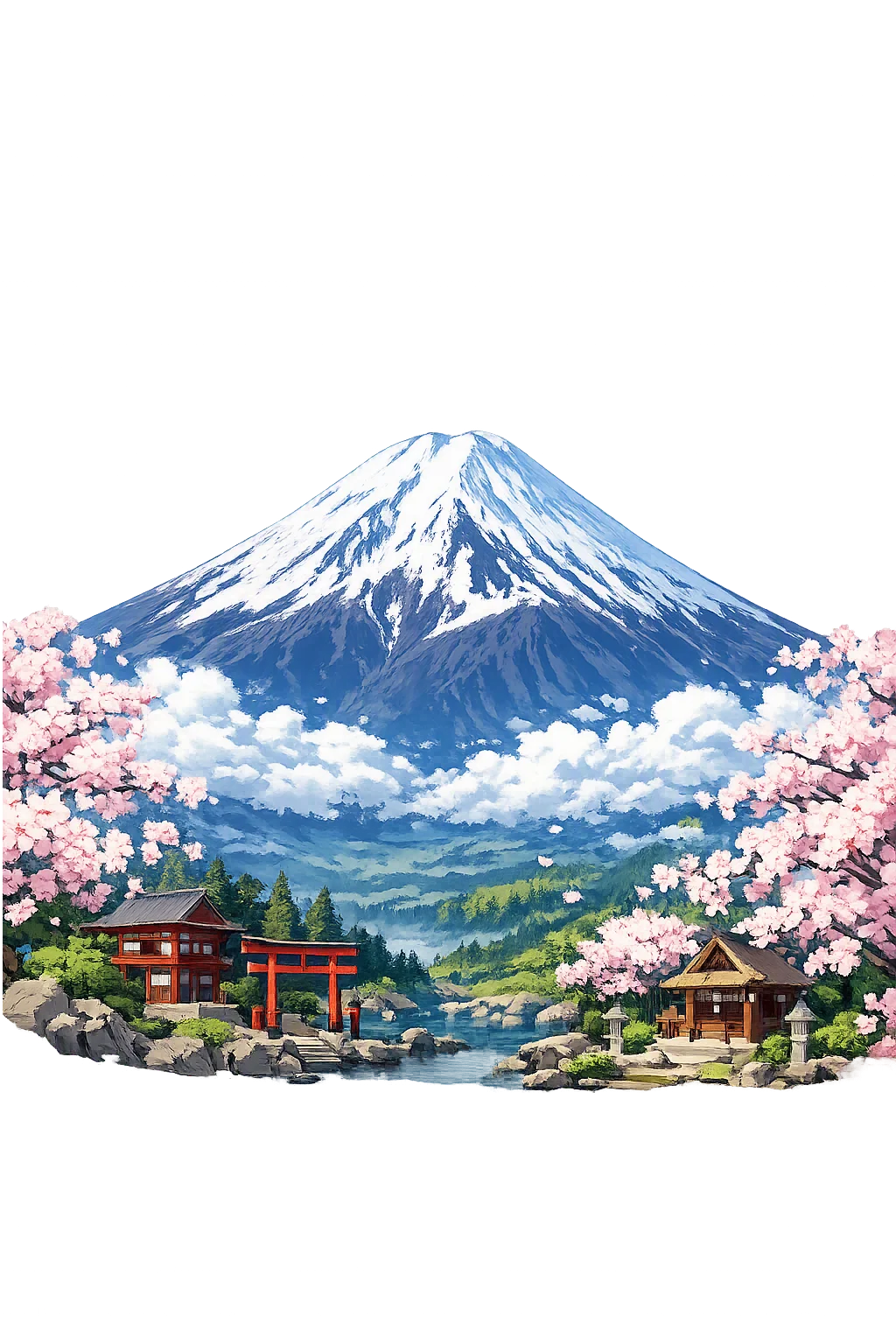
Stories of Fuji
Fuji generates story because it cannot be ignored: a volcano that sleeps for centuries at a time, a goddess of fire hidden under snow, and an image so constant that a whole civilization has measured its seasons, its festivals, and its art against one unchanging silhouette.
Folk etymology explains the name as fushi, 'without equal,' or fuji, 'inexhaustible' — both appropriate to a mountain with no rival on the horizon. In the early chronicles the peak's deity was treated as female, a kami of fire, and in the medieval period she was identified with Sengen (Asama-no-kami) and with Konohanasakuya-hime, the blossom princess of the Kojiki, whose marriage to the heavenly grandson Ninigi bound heaven's line to the earth. When Fuji smoked or rumbled, the interpretation was immediate: the goddess of the volcano was stirring, and the province looked to its Sengen shrines. The shrine cult kept the mountain's divinity local and specific — not an abstraction like 'nature,' but a named power with festivals, priests, and a genealogy reaching back to the age of the gods. The mountain's own name became the nation's shorthand for what is highest, purest, and most alone.
In the medieval imagination Fuji was not climbed so much as entered. Buddhist exegetes mapped the mountain as a lotus mandala, its ridges the lotus petals, its crater the heart of the world; ascending it was circumambulation and pilgrimage at once. In the sixteenth century the ascetic Hasegawa Kakugyō is credited with founding the Fuji-kō confraternities, and by the Edo period tens of thousands of pilgrims climbed in white robes reciting sutras, carrying miniature shrines up the stations and building fujizuka — small replica Fujis — in the cities, so that those who could not travel could still 'climb' the mountain. Some confraternities worshipped the crater itself as the Pure Land. The practice reveals the mountain's genius as an image: Fuji is endlessly reproducible, and every reproduction is still Fuji — a mandala you can ascend with your feet, a paradise with a weather problem.
Between about 1830 and 1850 the ukiyo-e masters fixed Fuji's image for the world. Hokusai's Thirty-Six Views of Mount Fuji placed the same snow-cap behind the Great Wave, a lumberyard, a tea-house balcony, a thunderstorm — proving the mountain was a measuring stick for every human activity. Hiroshige answered with travel series in which Fuji appears at a roadside halt, over a river, beyond a station bell. The prints used the newly imported Prussian blue so lavishly that the pigment itself became a fashion, and when Japan opened, these images were among the first things the West saw and imitated. The lesson of the series is visual relativism: Fuji never changes, but every viewpoint is a different picture. The mountain became the constant against which a whole floating world arranges and rearranges itself — and the proof that a sacred image, printed a hundred thousand times, loses none of its sanctity.
On the twenty-third day of the eleventh month of 1707 — mid-December by the modern calendar — Fuji woke. The Hōei eruption blew ash downwind for weeks, darkening the sky over Edo itself, where official memoranda and ink paintings measured the fall in handspans and the city coughed through a winter of grey snow. The eruption opened vents on the southeastern flank and built the cinder cone still called Hōei-zan, but no lava flow reached the villages, and no death was recorded. Contemporaries read the smoke as the mountain kami's displeasure; modern seismologists read it as a warning clock — more than three centuries quiet, but the magma plumbing intact beneath a sacred cone. Either way the meaning is the same: Fuji is worshipped precisely because it is not safe — a goddess who sleeps with one eye open over forty million people, and whose last performance is remembered in ash that fell on the shogun's capital.
Volcano, Pilgrimage, and National Symbol
Fuji is more than a mountain. For over a thousand years it has been a volcano kami, a Buddhist mandala, and the defining image of Japan — a nearly perfect cone rising alone above the clouds, watched from every road. Pilgrims climb it, poets praise it, and artists have made its snow-capped form one of the most reproduced images on earth.
As a living volcano, Fuji has been feared and worshipped as a source of both destruction and fertility.
For centuries pilgrims climbed to the summit, where shrines and lodges marked the path.
Its image identifies Japan in art, currency, passports, and global imagination.
Hokusai's Thirty-Six Views made Fuji an icon of world art.
From the original script to the living URL
富士
The name in its original Japanese form. Fuji (富士) is attested in the source tradition — “Wealthy warrior”. Its original diacritics and script distinctions carry the full phonetic and orthographic weight of the source tradition.
fuji
The plain fuji form is identical to the Unicode restoration. Because this name is already written in Latin letters, no diacritics, stress, or script information were lost — only capitalization differs.
Fuji
The Unicode restoration does not need to recover lost marks for Fuji. Its value is canonical spelling and consistent cataloguing, not the reconstruction of erased orthography. The domain is readable as-is to both DNS and humanity.
Fuji.com
This restoration is written entirely in ASCII letters — no Punycode encoding stands between Fuji and the DNS. The domain reads identically to machines and to human eyes.
Owned, ideal, and ASCII forms of Fuji
Fuji
Restores 富士. The full Unicode restoration. fuji.com is not in the PuniCodex collection — it is watched for release; if it drops, this temple upgrades to an owned flagship.
How Fuji was spoken
How Fuji is preserved in writing
A bespoke provenance study for Fuji is being prepared by the PUNICODEX scholarly team.
Contribute scholarly provenance →The lore you have read is the living myth. Extended Lore opens the scholarly vault beneath it: the cult and its material remains, a history of the image, the name after antiquity, a meditation on what the name still means, and the full scholarly apparatus — etymology, orthography, sources.
Enter Extended Lore