
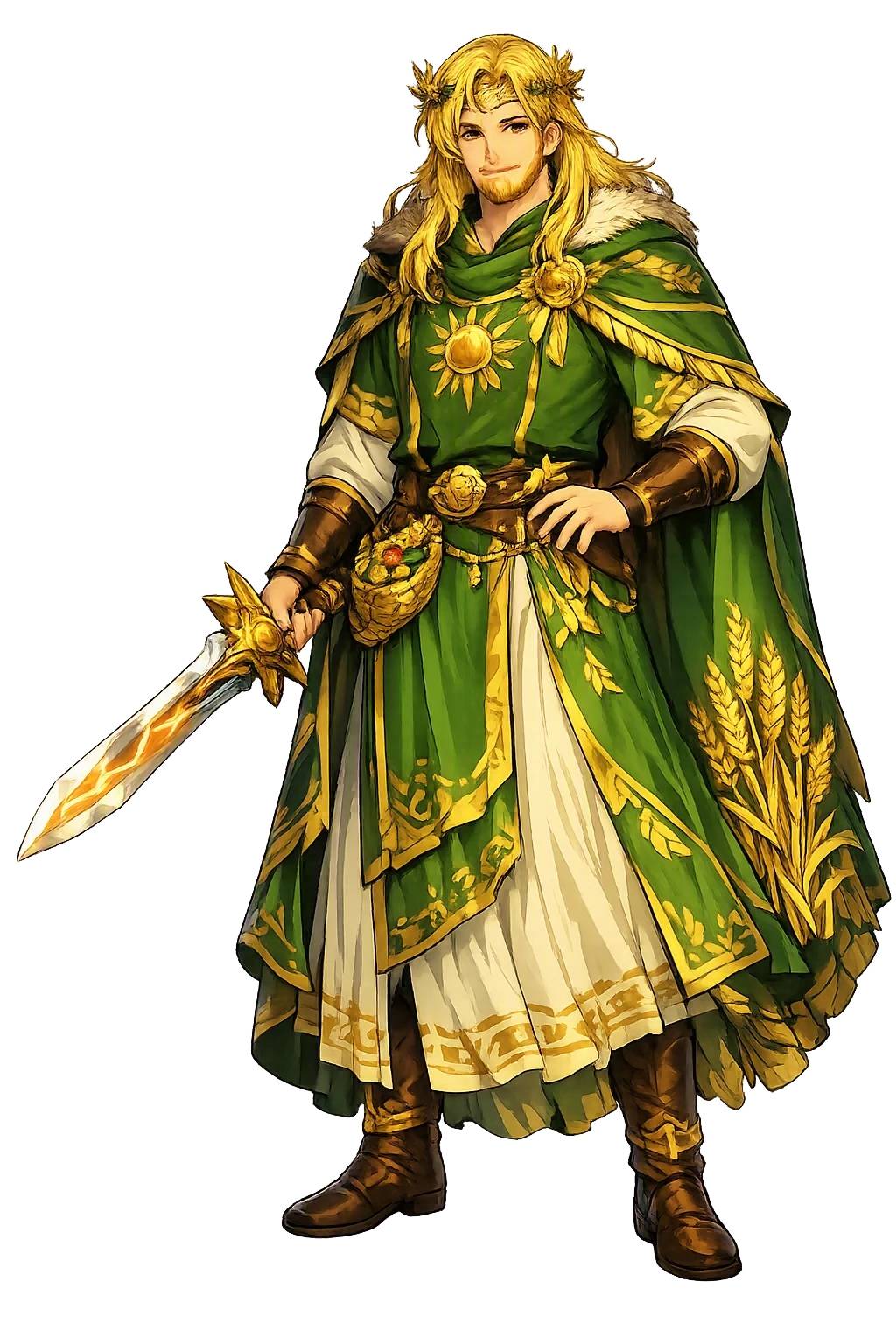
The many faces of Freyr
No important name has only one face. Freyr appears as a figure of myth, a scholarly reconstruction, a piece of material culture, a memory carried across languages, and — most recently — a Unicode domain. This post looks at each face in turn: the name and its roots, the Younger Futhark original, the reconstructed pronunciation, the mythological record, the symbols and sanctuaries, the cross-cultural afterlife, and the engineering that lets the restored spelling resolve in a browser. Taken together, those faces explain why freyr was never going to be enough — and why the restored form is worth a domain of its own.
At a Glance
- Restored name: Freyr
- ASCII form: freyr
- Meaning: "Lord (from *frawjaz)"
- Domain of influence: Fertility, Sunshine, Rain
- Pantheon: Norse
- Classification: Tier 2
- Original script: ᚠᚱᛅᚢᚱ (Younger Futhark)
Overview
Freyr (freyr) — Fertility, Sunshine, Rain · Lord — is the Vanir god who became the Æsir's own lord of the growing world: son of Njǫrðr, brother of Freyja, ruler of rain and sunshine and the fruit of the earth, the god Snorri says it is good to call on for ár ok frið — harvest and peace.
Old Norse Freyr descends from Proto-Germanic frawjaz ‘lord’ — the same word as Gothic frauja and Old English frēa — and forms a title-pair with Freyja ‘lady’. His mythology is the corpus's clearest economy of sacrifice: the self-wielding sword given to Skírnir as the price of Gerðr's love, the improvised antler that killed the giant Beli, and the fatal absence of that sword when he faces Surtr at Ragnarök. To the Swedes of Heimskringla he is also the euhemerized King Freyr of Uppsala, the peace-years king of the Yngling line.
PuniCodex restores the name as Freyr — identical to the ASCII input, because normalized Old Norse writes no diacritic in this name. The mechanical rule therefore places it in Tier 2: nothing distinctive is lost in transit, a statement about orthography, never about the god's standing. The plain-ASCII domain freyr.com is registered to a third party outside the collection and is watched for release; the project claims no domain for this temple.
The Name
The name is attested in normalized Old Norse as Freyr (nominative; genitive Freys). It is not a personal name in the ordinary sense but the common noun for a master: Proto-Germanic frawjaz ‘lord’, the ancestor of Gothic frauja — Ulfilas's word for the Lord — and the Old English poetic frēa ‘lord’ of kings and of God. Its feminine counterpart is Freyja ‘the Lady’, from frawjōn; the siblings are, etymologically, simply ‘the Lord’ and ‘the Lady’. The final -r is the Old Norse nominative masculine ending.
The name also travels under older bynames. Lokasenna names him Ingunar-Freyr, and Ynglingatal and the Skáldskaparmál tradition give Yngvi-Freyr — the element scholars connect, with due caution, to the Ing of the Old English Rune Poem and the Inguaeones of Tacitus.
The letter-by-letter transformation runs:
- f → F — Same, capitalized
- r → r — Same
- e → e — Same
- y → y — Same
- r → r — Same
Because the restoration preserves nothing the ASCII form loses — no diacritic, no thorn or eth, no length mark — the name is classified Tier 2 by the project's mechanical rule. The plain-ASCII domain freyr.com is registered to a third party outside the collection and is watched for release; the project claims no domain for this temple.
Etymology & Roots
The recorded derivation reads: Lord (from *frawjaz)
The reconstructed proto-form is *frawjaz (proto-indo-european), glossed as "Lord".
The reconstruction is classed as attested.
The Original Script
The name is preserved in medieval Icelandic manuscripts in the Latin alphabet as Freyr — Old Norse (North Germanic), attested 13th c. CE in the Codex Regius of the Poetic Edda and the sister codices of the Prose Edda, recording material centuries older. Before the Latin bookhand, Old Norse names were carved in the younger futhark; no runic attestation of this theonym survives, so the manuscript form is the primary witness, with a normalized runic rendering standing in for the Viking-Age shape.
The scholarly rendering proceeds step by step:
- The word is the common noun freyr ‘lord’, from Proto-Germanic frawjaz, with the nominative singular ending -r.
- The diphthong ey descends from older au (still visible in a normalized younger-futhark carving, ᚠᚱᛅᚢᛦ frauR); the manuscripts' ey is the smoothed Old Icelandic form.
- Normalized Old Norse writes the name in plain ASCII — no diacritic, no thorn or eth — so the Unicode restoration Freyr is letter-for-letter the manuscript form, capitalized.
- Because the name is pure ASCII, its domain was registered decades ago in the ordinary way: freyr.com is held by a third party outside the PuniCodex collection and is watched for release; no form of the name is currently owned, and this temple claims none.
Pronunciation
The reconstructed pronunciation of the name is /ˈfrœy.r̩/ — Old Norse Reconstruction.
Phoneme by phoneme:
- Fr- — Voiceless labiodental [f] and trilled [r], a common Old Norse onset cluster
- -ey- — The falling diphthong /œy/, born by umlaut and monophthong-smoothing from an older au; it sits between the ‘oy’ of English boy and the ‘ay’ of day, and survives in modern Icelandic as /ei/ (Icelanders say ‘FRAY-ir’)
- -r — The syllabic trill [r̩] of the nominative masculine ending, carrying its own light beat
For the modern speaker, the closest approximation is: ‘FRAY-ur’ — one syllable for the diphthong, then the light final trill.
Kindred and historical forms of the name:
- Proto-Germanic — frawjaz, ‘lord’
- Younger Futhark (normalized) — ᚠᚱᛅᚢᛦ, frauR, the Viking-Age carving, keeping the older au before it smoothed to ey
- Gothic — frauja, ‘lord’, the Gospels' word for the Lord
- Old English — frēa, the poetic ‘lord’ of Beowulf's kings
- Modern Icelandic — Freyr, the name's unbroken living form
Freyr is Tier 2 because the restoration is orthographically complete as it stands: normalized Old Norse writes this name in plain ASCII, and there is nothing for the ASCII alphabet to lose.
Mythology
Freyr's surviving mythology is built on a single economy — what the lord of plenty gives away — told across the two Eddas and the kings' sagas with unusual coherence.
The Tooth-Gift (Grímnismál 5)
The gods gave Álfheimr to Freyr as a tooth-gift — the present made to a child when its first tooth appears. The detail is the Edda's way of saying the elf-realm has always been his; Snorri pairs it with the fixed formula of his office: rule over rain, sunshine, and the fruit of the earth, and the governing of men's prosperity.
The Price of Gerðr (Skírnismál)
Seated in Hliðskjálf, Óðinn's all-seeing high seat, Freyr looked north into Jǫtunheimr and saw Gerðr, daughter of the giant Gymir, whose white arms lit sky and sea as she walked from hall to bower. The longing that followed was a sickness: he would not eat, sleep, or speak. Njǫrðr sent the servant Skírnir to bargain the cause out of him, and Skírnir named his price for the wooing-errand — Freyr's horse and his sword, the one that fights by itself if he is wise who wields it. Freyr paid both on the spot. Skírnir rode through the magic flame, broke Gerðr's refusal with gifts, runes, and threats, and won her promise to meet Freyr in the grove Barri nine nights hence. The poem closes on the waiting god: ‘Long is one night, longer is two — how shall I endure three?’
The Gifts of the Dwarfs (Skáldskaparmál)
Two of the six treasures of the gods are Freyr's. Skíðblaðnir, the best of ships, was made by the sons of Ívaldi — big enough for all the Æsir with their war-gear, always granted a fair wind, foldable into a pouch. Gullinbursti, the golden-bristled boar, came from the same wager between Loki and the smith Brokkr that produced Þórr's hammer. Úlfr Uggason's Húsdrápa, carved on a hall's panels in Iceland about 983 and quoted by Snorri, remembers Freyr riding the boar to Baldr's funeral; Gylfaginning gives him a chariot drawn by Gullinbursti for the same journey.
Swordless Against Surtr (Vǫluspá 52–53; Gylfaginning 51)
The Edda keeps the ledger. In Lokasenna, Týr throws the old bargain in Freyr's face: with gold you bought Gymir's daughter and sold your sword — when Muspell's sons ride through the dark wood you will not know what to fight with. Gylfaginning recalls that Freyr once killed the giant Beli with a hart's antler and could have slain him with his fist; but at Ragnarök improvisation ends. Freyr goes against Surtr, and his death, Snorri says, comes the harder because he lacks the good sword he gave Skírnir. Vǫluspá's seeress watches the shining lord fall before the fire.
The King Who Would Not Die (Ynglinga saga 10–13)
Heimskringla's euhemerized Freyr is king of the Swedes at Uppsala after Njǫrðr: he built the great temple, gathered the land-rents and the wealth of Uppsala into his own hand, and in his days began the Fróði-peace, the peace-years of good seasons the Swedes credited to their king. When he died, his men concealed it: they set him in a mound with three holes, told the people he lived, and for three years the tribute — gold, silver, copper — was poured down into the mound while the peace held. Afterwards the Swedes still would not burn him; they called him the god of the world and sacrificed to him for peace and good seasons.
Symbols & Iconography
The iconography of Freyr is the richest of any Vanir god — a full set of attributes fixed by the Eddas and the cult reports alike:
- Gullinbursti — The golden-bristled boar forged by Brokkr and Sindri, faster than any horse through air and water, its bristles lighting night to day; Freyr rode it — or drove behind it — to Baldr's pyre
- Skíðblaðnir — The best of ships, built by the sons of Ívaldi: fair wind at every hoisting, room for all the Æsir armed, and it folds like cloth into a pouch
- The self-wielding sword — The blade that fights by itself for the wise, surrendered to Skírnir as the price of the errand to Gerðr
- The hart's antler — The improvised weapon with which he killed the giant Beli bare-handed; the sign of the swordless god
- Álfheimr — The realm of the elves, given him by the gods as a tooth-gift in the first days
- The phallus — The cult attribute Adam of Bremen reports at Uppsala and the Rällinge statuette displays: fertility written on the body of the god
Archaeology & Evidence
Freyr is one of the few Norse gods with a plausible cult-image in the ground. The Rällinge statuette — a small seated bronze of the Viking Age, found in 1904 at Rällinge, Lunda parish, Södermanland, Sweden — shows a cross-legged, bearded, unmistakably ithyphallic figure and has been identified as Freyr since its discovery; it matches Adam of Bremen's description of the Uppsala Fricco with striking economy.
Uppsala itself anchors the cult landscape: Adam describes the great temple, its golden chain, and its triad of Thor, Wodan, and Fricco around 1075, and the royal mounds of Gamla Uppsala still stand where Ynglinga saga sets King Freyr's own mound and the Uppsala auðr. The theophoric place-name record — hundreds of Frøy-/Frö- names, weighted to groves and fields — is the strongest indirect witness of a working fertility cult. Against all this, the runic corpus is silent: no surviving inscription invokes the god by name. The literary witnesses are the Codex Regius poems (Skírnismál, Grímnismál, Lokasenna, Vǫluspá) and the quotation of Úlfr Uggason's Húsdrápa (c. 983) in Skáldskaparmál, which proves the boar-riding Freyr was already a fixture of pre-Christian hall decoration a generation before the conversion of Iceland.
Realm & Domain
Freyr is the god of the peace-years: the Vanir lord whose portfolio Snorri fixes in a single sentence — rain and sunshine, the fruit of the earth, the prosperity of men — and whom the Swedes remembered as the king in whose days the Fróði-peace began.
Harvest
‘He rules over rain and sunshine, and therewith the fruit of the earth’; it is good to call on him for harvest — ár. The golden-bristled boar and the elf-realm tooth-gift belong to the same shining, growing world.
Prosperity
Snorri adds: ‘he also governs the prosperity of men’. The euhemerized tradition turns that portfolio into economics — King Freyr gathers the land-rents and the Uppsala auðr, the wealth of Uppsala, into his own hand, and his mound swallows three years of tribute.
Kingship
Yngvi-Freyr stands at the fountainhead of the Ynglings, the dynasty of Uppsala from which medieval Norway's and Sweden's kings traced their lines; his reign is the North's canonical portrait of sacral kingship, the king as guarantee of season and peace.
Across Cultures
Freyr's name is a title, and titles travel farther than theonyms. His Proto-Germanic frawjaz ‘lord’ is Gothic frauja — the word Ulfilas's Bible uses for the Lord — and the Old English poetic frēa, the ‘lord’ of Beowulf's kings; his sister Freyja is the same word in the feminine.
The older debate runs through his bynames. Lokasenna calls him Ingunar-Freyr; Ynglingatal and Snorri derive the Yngling dynasty from Yngvi-Freyr. Since Grimm, scholars have connected that Ing-element with the Inguaeones of Tacitus's Germania 2 — the peoples descended from Mannus through Ing — and with the Ing of the Old English Rune Poem, ‘first among the East Danes seen by men’ before he went east over the wave. The equation Ing = Yngvi = Freyr is argued, not proven; Simek counsels caution, and the manuscripts do not settle it. What the outside world saw plainly is recorded by Adam of Bremen: at Uppsala the Swedes called the god Fricco, granted him pacem voluptatemque — peace and pleasure — and set him ithyphallic between Thor and Wodan, a Germanic Priapus inside a triad of his own. Within the corpus his closest kin are Njǫrðr his father and Freyja his twin in title — the Vanir triad of wealth, sea, and season.
Cultural Legacy
Freyr never left the North. His cult geography survives on the map in hundreds of theophoric place-names — Frøysland, Frøsvoll, Frösåker, Fröslunda and their kin across Norway and Sweden — the densest fertility-god landscape in Scandinavian onomastics, many compounded with ‘grove’, ‘field’, and ‘meadow’. The name itself lives on as a Scandinavian given name: Freyr in Iceland, Frej in Denmark and Sweden.
His historical afterlife is the Yngling one: medieval Norwegian and Swedish royal genealogies traced their lines through the Ynglings of Uppsala to Yngvi-Freyr, making the peace-years king the dynastic ancestor of two kingdoms, and Snorri's portrait became the North's standing image of the good reign — the king whose death the realm refused to admit. Modern Heathen and Ásatrú communities keep him at the centre of harvest and fertility blóts under the old formula ár ok frið, and the golden boar runs through modern jewellery, fantasy, and games as the sun-animal of the Vanir.
The Scholarly Record
The account of Freyr given in this edition rests on the witnesses and reference works listed below. The Poetic Edda supplies the mythic narrative; the Prose Edda and Heimskringla the systematic and euhemerized portraits; Adam of Bremen the outside report on the living cult; the lexica and handbooks secure the name's etymology and the scholarly debates.
- The Poetic Edda, trans. Carolyne Larrington, 2nd ed. (Oxford: Oxford University Press, 2014): Skírnismál (the wooing of Gerðr); Grímnismál 5 (Álfheimr); Lokasenna 42–43 (the sword sold; Ingunar-Freyr); Vǫluspá 52–53 (Freyr against Surtr); Vafþrúðnismál 38–39 (the Vanir hostage).
- Snorri Sturluson, Edda, ed. and trans. Anthony Faulkes (London: Everyman, 1987): Gylfaginning 23–24, 37, 44, 49, 51; Skáldskaparmál (the dwarfs' gifts; Úlfr Uggason's Húsdrápa).
- Snorri Sturluson, Heimskringla: Ynglinga saga 10–13; Þjóðólfr of Hvin, Ynglingatal, trans. Alison Finlay and Anthony Faulkes, 2nd ed. (London: Viking Society for Northern Research, 2014).
- Adam of Bremen, Gesta Hammaburgensis ecclesiae pontificum IV.26–27, trans. Francis J. Tschan (New York: Columbia University Press, 1959).
- Cleasby, Richard, and Guðbrandur Vigfússon, An Icelandic-English Dictionary, 2nd ed. (Oxford: Clarendon Press, 1957), s.v. Freyr; Zoëga, Geir T., A Concise Dictionary of Old Icelandic (Oxford: Clarendon Press, 1910), s.v. Freyr.
- de Vries, Jan, Altnordisches etymologisches Wörterbuch, 2nd ed. (Leiden: Brill, 1962), s.v. Freyr, Freyja; de Vries, Altgermanische Religionsgeschichte, 2nd ed., 2 vols. (Berlin: de Gruyter, 1956–57).
- Simek, Rudolf, Dictionary of Northern Mythology, trans. Angela Hall (Cambridge: D. S. Brewer, 1993), s.v. Freyr, Ing, Inguaeones.
- Orchard, Andy, Dictionary of Norse Myth and Legend (London: Cassell, 1997), s.v. Freyr.
- Lindow, John, Norse Mythology: A Guide to the Gods, Heroes, Rituals, and Beliefs (Oxford: Oxford University Press, 2001), s.v. Freyr, Skírnismál, Ragnarök.
- Gordon, E. V., An Introduction to Old Norse, 2nd ed. rev. A. R. Taylor (Oxford: Clarendon Press, 1957).
- Tacitus, Germania 2 (the Inguaeones), ed. and trans. J. B. Rives (Oxford: Clarendon Press, 1999).
A Meditation
Freyr is the god who teaches what lordship costs. His name is not a name at all but the word ‘Lord’ itself — every king and every master borrowing his title for as long as the peace holds. And the peace holds only by giving: the sword for the bride, the tribute for the mound, the life for the world at Ragnarök.
The Edda's arithmetic is merciless — the self-wielding sword is the one thing that cannot be given away and kept — but Freyr gives it anyway, for love, in a single scene, without a regret the poems record. The tradition honours him not for the fight he loses but for the peace-years he bought while he could: rain and sunshine in their season, the fruit of the earth, the prosperity of men. The lord of plenty is the god of the gift you cannot take back.
The Unicode Restoration
Freyr is classified as Tier 2: the restoration needs no distinctive letters or diacritics its ASCII form would lose. The ASCII fallback freyr still resolves everywhere, but it is the restored form that carries the name's full information. That is the whole thesis of this temple: the marks are the message.
Why This Restoration Matters
Myth, script, sound, cult, legacy, domain: the faces of Freyr add up to a single argument — that a name is a record, and records deserve fidelity. The PuniCodex restoration keeps that record in working order: the temple presents it, the Scholarly Edition footnotes it, the lexicon catalogs it, and the domain makes it addressable. freyr will always exist as a fallback. But fallback is not identity. Freyr is the name; everything else is a convenience.
Explore Further
This post is one doorway into the temple. The home page carries the full character breakdown and the ambient canvas; the lore page tells the myths in long form; the Scholarly Edition preserves the sources, pronunciation data, and revision history; and the patron wall supports the restoration directly. For the wider map, browse the Lexicon, explore the Pantheon, or return to the PuniCodex blog.
Related Names
Sources
The full scholarly apparatus — every citation, revision, and review — lives in the Scholarly Edition. Key references for this post:
- Snorri Sturluson, Edda, Gylfaginning 23–24 (the Vanir; Freyr's rule over rain, sunshine, and the fruit of the earth), ed. and trans. Anthony Faulkes (London: Everyman, 1987).
- Skírnismál; Lokasenna 42; Vǫluspá 52–53 (Poetic Edda), trans. Carolyne Larrington, The Poetic Edda, 2nd ed. (Oxford: Oxford University Press, 2014).
- Snorri Sturluson, Heimskringla, Ynglinga saga 10–13, trans. Alison Finlay and Anthony Faulkes, 2nd ed. (London: Viking Society for Northern Research, 2014).
- Cleasby, Richard, and Guðbrandur Vigfússon, An Icelandic-English Dictionary, 2nd ed. (Oxford: Clarendon Press, 1957), s.v. Freyr; Zoëga, Geir T., A Concise Dictionary of Old Icelandic (Oxford: Clarendon Press, 1910), s.v. Freyr.
- Lexicon authorities for this entry: Cleasby-Vigfusson, Zoëga.