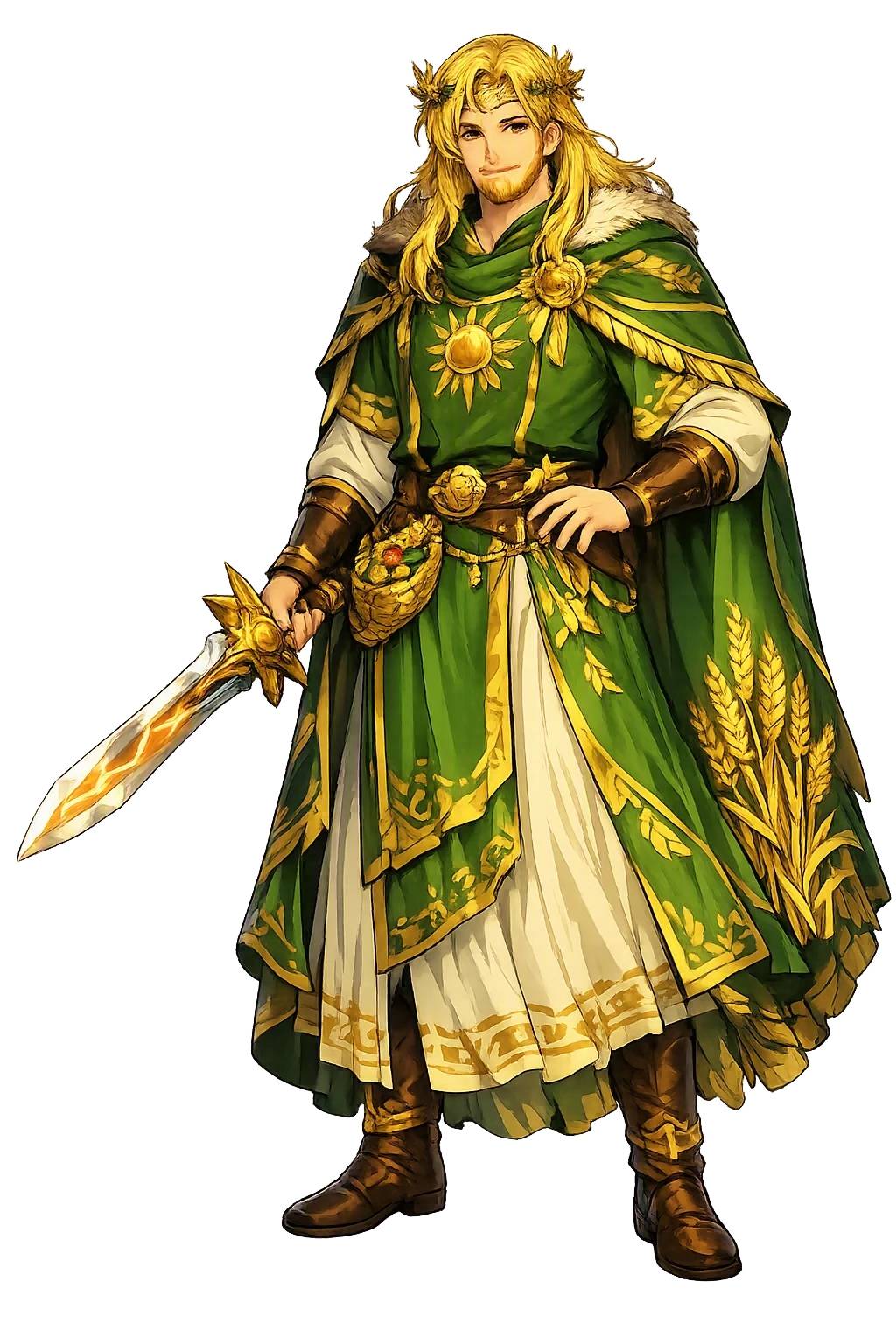
Stories of Freyr
Freyr's myths turn on a single economy: what the lord of plenty gives away. He gives Skírnir his sword for love of Gerðr, gives his peace-years to the Swedes, and gives his life at Ragnarök — swordless, facing the fire, because the price was paid long before.
The Prose Edda's portrait is the tradition's fixed formula. Freyr is the most glorious of the Æsir, son of Njǫrðr and brother of Freyja; 'he rules over rain and sunshine, and therewith the fruit of the earth; it is good to call on him for harvest and peace — ár ok frið — and he governs the prosperity of men' (Snorri, Gylfaginning 24). His seat in the pantheon came by hostage: when the Æsir and the Vanir made peace, Njǫrðr and Freyr were given to the Æsir in exchange, and the old gods of fertility entered the younger gods' city (Vafþrúðnismál 38–39; Ynglinga saga ch. 4). Grímnismál 5 adds the deed that seats him: Álfheimr, the world of the elves, was given to Freyr by the gods in ancient days as a tooth-gift — the present made to a child at its first tooth. The Vanir hostage thus became the Æsir's own lord of the growing world: the one god whose wealth is measured in good years.
Freyr had seated himself in Hliðskjálf, Óðinn's high seat that overlooks all worlds, and looked north into Jǫtunheimr — and saw a maiden walking from her father's hall to her bower, whose white arms lit the sky and the sea. From that sight he took a longing so deep he could neither sleep nor speak, and Njǫrðr sent his servant Skírnir to learn what ailed him. Freyr confessed: Gerðr, daughter of the giant Gymir, had bound his heart. Skírnir bargained for the errand: give me your sword — the one that fights by itself for him who is wise — and your horse that will not shy at the magic flame. Freyr gave both. Skírnir rode over wet mountains to Gymir's courts, broke Gerðr's refusal with gifts, runes, and threats, and won her promise: nine nights hence, in the grove called Barri, she would grant Freyr her love (Skírnismál; Gylfaginning 37). The poem ends on the waiting god's own arithmetic: 'Long is one night, longer is two — how shall I endure three?' The myth names the cost before the prize is ever seen: the best of swords, traded away up front — and Ragnarök will come to collect.
Two of the six treasures of the gods belong to Freyr. Skíðblaðnir, the best of ships, was made by the dwarfs called the sons of Ívaldi: large enough to carry all the Æsir with their weapons, always granted a fair wind the moment its sail is hoisted, and yet so cunningly built that it folds together like a cloth and goes into a pouch. Gullinbursti, the golden-bristled boar, was forged by Brokkr and Sindri in the same wager that made Mjǫllnir: it can run through air and water faster than any horse, and its bristles shine so brightly that night turns to day wherever it fares. When Baldr was burned, Úlfr Uggason's Húsdrápa — carved on an Icelandic hall's panels around 983 — remembered Freyr riding to the pyre on the boar; Snorri gives him a chariot drawn by Gullinbursti for the same journey.
The Edda keeps the ledger. Lokasenna's Týr throws the bargain in Freyr's face: with gold you bought Gymir's daughter and sold your sword — when Muspell's sons ride through the dark wood, wretch, you will not know what to fight with. Gylfaginning recalls that Freyr once killed the giant Beli bare-handed, striking him down with a hart's antler, and could have slain him with his fist — but at Ragnarök improvisation runs out. When Surtr comes out of the south with fire, Freyr goes against him, and his death, Snorri says, comes the harder because he lacks the good sword he gave Skírnir. Vǫluspá's seeress watches it happen: the shining lord of the gods falls before the black one, and the earth sinks into the sea behind him. The god of the peace-years dies of the one gift he could not take back.
Snorri's other Freyr is the euhemerized king of the Swedes. Freyr — also named Yngvi, whence the Ynglings took their name — succeeded Njǫrðr at Uppsala, built the great temple there, gathered all the wealth and land-rents of the realm into his own hand, and in his days began the Fróði-peace, the famous peace-years of good seasons and plenty, so that the Swedes credited their harvests to their king. He was so beloved that when he fell sick and died, his men would not burn him: they built him a great mound with three holes, told the people he lived, and for three years the Swedes poured the tribute — gold, silver, copper — down into the mound while the peace held. When at last the truth was known, the Swedes still refused to burn him; they called him the god of the world and sacrificed to him ever after for peace and good seasons. It is the clearest portrait the North kept of sacral kingship: the king as a weather-guarantee, worth more dead than any successor alive.
Fertility, Sunshine, Rain
Freyr is the Vanir god the Æsir received in the hostage-exchange and never gave back: son of Njǫrðr, brother of Freyja, lord of Álfheimr, the ruler of rain and sunshine and the fruit of the earth — the god Snorri says it is good to call on for harvest and peace, and who governs the wealth of men.
The golden-bristled boar the dwarfs Brokkr and Sindri forged, whose bristles light the night as it runs faster than any horse through air and water.
The best of all ships, built by the sons of Ívaldi: fair wind whenever the sail is raised, room for all the Æsir armed — and it folds like cloth into a pouch.
The sword that fights by itself for the wise — the price Freyr paid for Gerðr, and the blade he will miss when Surtr comes.
The realm of the elves, given to Freyr as a tooth-gift — a god's first present, and the seat of the lord of the shining world.
From the original script to the living URL
ᚠᚱᛅᚢᚱ
The name in its original Norse form. Freyr (ᚠᚱᛅᚢᚱ) is attested in the source tradition — “Lord (from *frawjaz)”. Its original diacritics and script distinctions carry the full phonetic and orthographic weight of the source tradition.
freyr
The plain freyr form is identical to the Unicode restoration. Because this name is already written in Latin letters, no diacritics, stress, or script information were lost — only capitalization differs.
Freyr
The Unicode restoration does not need to recover lost marks for Freyr. Its value is canonical spelling and consistent cataloguing, not the reconstruction of erased orthography. The domain is readable as-is to both DNS and humanity.
Freyr.com
This restoration is written entirely in ASCII letters — no Punycode encoding stands between Freyr and the DNS. The domain reads identically to machines and to human eyes.
Owned, ideal, and ASCII forms of Freyr
Freyr
Restores ᚠᚱᛅᚢᚱ. The full Unicode restoration. freyr.com is not in the PuniCodex collection — it is watched for release; if it drops, this temple upgrades to an owned flagship.
How Freyr was spoken
How Freyr travels from ancient script to the modern URL
The lore you have read is the living myth. Extended Lore opens the scholarly vault beneath it: the cult and its material remains, a history of the image, the name after antiquity, a meditation on what the name still means, and the full scholarly apparatus — etymology, orthography, sources.
Enter Extended Lore