
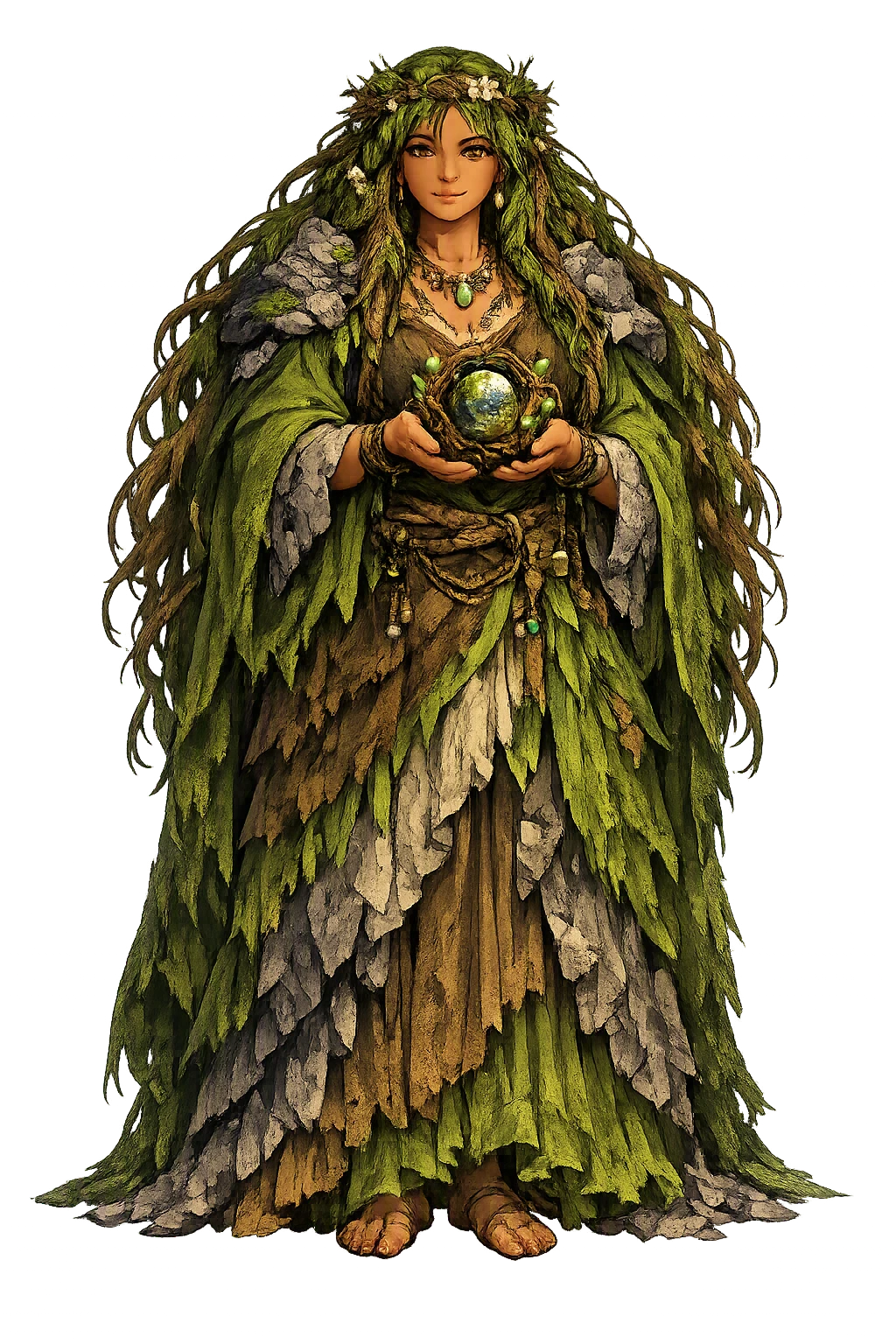
The appointments Fjǫrgyn made — and who is keeping them
Take Fjǫrgyn's stories in sequence. They are not episodes; they are appointments — and the modern trades are keeping them.
At a Glance
- Temple: Fjǫrgyn
- Pantheon: Norse
- Domain of influence: Earth, Mother of Thor
- Pattern seats: 5
- Sectors touched: Energy & Natural World · Culture & Entertainment · Society & Spirit · Home & Lifestyle
- Strongest seat: Agriculture, Food & Harvest
- Series: The Resonance Files, No. 157 of 548
The Cycle, Read Forward
Agriculture, Food & Harvest — through The Famous Son of Fjǫrgyn
Völuspá's seeress, counting the doom of the gods, says that “then comes the famous son of Fjǫrgyn” — Þórr marching to his last battle with the World-Serpent. The manuscripts do not agree on the mother's name: Hauksbók reads Fjǫrgyn, while the Codex Regius reads Hlóðyn, and editors have long treated the two as interchangeable names for the same earth-goddess.
The atlas states the seat in one line: Earth herself and mother of Þórr; the soil that every farm works is her body. The story above is the long version of the same sentence. Industries do not invent their archetypes; they inherit them and call them best practice.
Mythic Name Restoration — through “There Fjǫrgyn Will Find Thor”
In the flyting across the fjord between Þórr and the disguised Óðinn, Þórr announces his plan to press east, and Óðinn answers with the only verse that lets the earth-goddess act: “Keep to the left of the road until you reach Verland; there Fjǫrgyn will find Þórr, her son, and she will teach him the ways of kinship to Óðinn's lands” (Hárbarðsljóð 56, trans. Lindow).
The atlas states the seat in one line: Old Norse earth and mother of Þórr; the ǫ and length marks distinguish her from later forms. The story above is the long version of the same sentence. Industries do not invent their archetypes; they inherit them and call them best practice.
Global Pantheon Brands — through The Father of Frigg
The masculine twin Fjǫrgynn plays the other side of the family drama. When Loki turns his venom on Frigg in the flyting, his opening gibe is genealogical: “Be silent, Frigg — you are Fjǫrgynn's daughter, and have ever been most eager for men” (Lokasenna 26).
The atlas states the seat in one line: Earth personified; the ǫ and final length mark the Old Norse restoration. The story above is the long version of the same sentence. The trade thinks it is optimizing a process. It is re-enacting a charter.
Mining & Natural Resources — through The Mountain Beneath the Earth
The etymology the older handbooks proposed — a link to fjor, “life,” or to fura, “fir” — has been superseded. Modern comparative work (Kroonen, Etymological Dictionary of Proto-Germanic; West, Indo-European Poetry and Myth) traces Fjǫrgyn to Proto-Germanic *fergunja, “mountain” or “mountainous forest,” cognate with Gothic fairguni, Old English firgen (as in Firgenhǫæg, “mountain-slope”), and the Old High German name of the Ore Mountains, Firgunnea.
The atlas states the seat in one line: Earth and land; the mother of Þórr is the ground from which every ore and field is cut. The story above is the long version of the same sentence. That is the cycle working: story becomes duty, duty becomes trade.
The Theme That Runs the Cycle
Fjǫrgyn appears briefly in the Eddas, but her appearances are weighty: she is the mother of the most popular god and the earth that hears every oath.
The Method, Stated Plainly
None of this is numerology. A seat exists only where the match can be argued from the deity’s documented domains and deeds — weighted, published, and falsifiable. The derivation, the weights, and the challenge process are public on the methodology page. If a seat in this file reads wrong, the atlas itself tells you how to prove it — and the correction becomes part of the record.
For the Ones Who Work There
If you work in agriculture, food & harvest, mythic name restoration, or any trade this temple holds a seat in, this is the honest version of what a placement means: your industry beside the story it has been re-telling all along — on the temple floor itself, before an audience that came specifically to read it. The patron tier and the advertising terms describe the mechanics; the resonance above describes the fit.
The File Continues
One of 548 Resonance Files — the series where the pantheon goes to work. Read the founding dispatch for the name, the Restoration File for the spelling, or the whole archive end to end.
Continue the series — previous: Fionn (read it) · next: Forseti (read it).
The Resonance Files are argued from the same canonical record as the pattern atlas itself: the lexicon, the lore catalog, and the cited sources. Every seat can be challenged at the methodology page — and the challenge is the point.