PuniCodex

Extended Lore

ᚠᛁᚢᚱᚴᚢᚾ Fjǫrgyn

Etymology · Orthography · Cult · Iconography · Reception · Sources

Tier 1 Fjǫrgyn.com
Fjǫrgyn — Earth, Mother of Thor
01

Quick Facts

Essential information about Fjǫrgyn, Earth, Mother of Thor

Original Scriptᚠᛁᚢᚱᚴᚢᚾ
Unicode RestorationFjǫrgyn
Reconstructed Pronunciation/ˈfjɔr.gyn/
PantheonNorse
DomainEarth, Mother of Thor
MeaningEarth (Fjǫrgyn)
ClassificationTier 1
Primary DomainFjǫrgyn.com
Sacred SymbolsThe fertile field, Oak or fir, The oath-ring or stone, Thor's hammer
02

Etymology & Word Family

From original script to Unicode restoration

Proto-germanic *fergunja mountain, wood, earth
Original Script ᚠᛁᚢᚱᚴᚢᚾ Fjǫrgyn — "Earth (Fjǫrgyn)"
Unicode Restoration Fjǫrgyn Restored stress, length, and script
Modern ASCII fjorgyn Plain-ASCII fallback

Old Norse Fjǫrgyn, byname of Jǫrð and mother of Thor; related to Proto-Germanic *fergunja "mountain, woodland".

03

Unicode Character Breakdown

Character-by-character philological analysis

CharacterUnicodeNameBlockPhonetic Role
FU+0046Latin Capital Letter FBasic LatinSame, capitalized
jU+006ALatin Small Letter JBasic LatinSame
ǫU+01EBLatin Small Letter O with OgonekLatin Extended-BO with ogonek: nasalized vowel
rU+0072Latin Small Letter RBasic LatinSame
gU+0067Latin Small Letter GBasic LatinSame
yU+0079Latin Small Letter YBasic LatinSame
nU+006ELatin Small Letter NBasic LatinSame

The Tier 1 classification reflects how much of the original phonology this restoration preserves — stress and vowel length for Greek names, distinctive letters and diacritics for every other tradition.

04

Cult & Worship

How the sacred was kept — rites, sanctuaries, remains

The Cult

No cult of Fjǫrgyn is independently attested. She appears in the poetry as a name — Þórr's mother in Hárbarðsljóð 56, and a reading of Völuspá 56 preserved in Hauksbók — and as oath-furniture in Lokasenna 26, where the earth beneath the quarrelling gods is invoked as the silent witness. That oath is the closest the sources come to her worship: the ground sworn by. Whether she ever possessed her own sanctuary, festival, or votaries the record cannot say — and probably she did not, being a byname of the earth rather than a goddess apart from it.

In the Earth

Fjǫrgyn is a textual figure with no independent archaeological record. No inscription names her, and no image can be securely identified with her. Her witnesses are the Eddic poems and Snorri's Prose Edda, supported by the wider Germanic and Indo-European pattern of an earth-goddess paired with a sky-god.

05

Iconography

How Fjǫrgyn was imaged across the ages

The Image

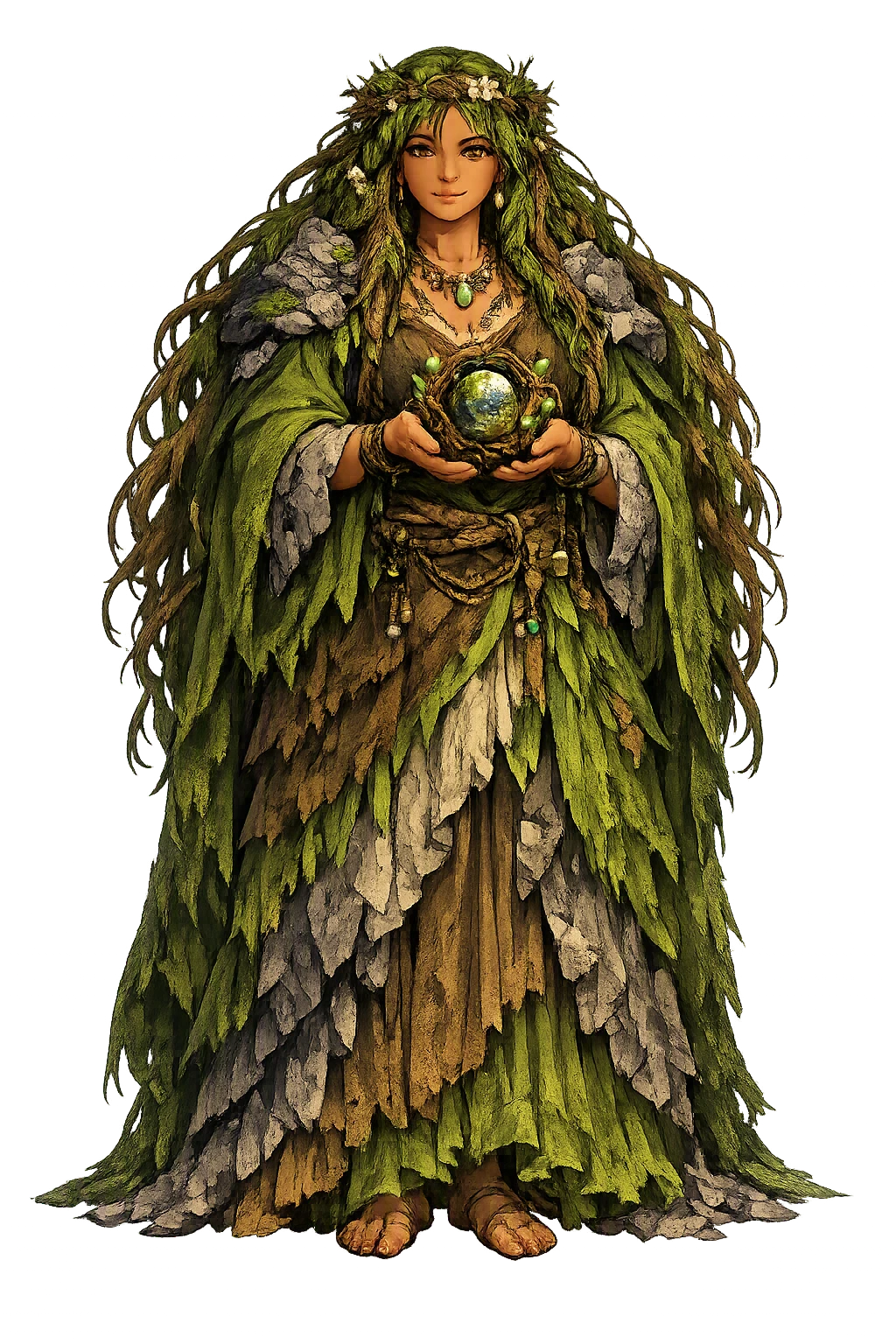
No image of Fjǫrgyn survives or can be identified: she is a name spoken in verse, not a body carved in wood or stone. What the name itself contributes is her only attribute — the mountain. It descends from Proto-Germanic *fergunja, a mountain-range, cognate with Gothic fairguni and Old High German Firgunnea, an old name of the Erzgebirge; so where Jǫrð is the flat and fertile ground, Fjǫrgyn is the rising mass of the land. The skalds who needed her image used the simplest possible one: Fjǫrgyn's son, the thunderer walking heavy on the earth.

06

Reception & Transformation

The name after its own age — transmission, translation, survival

Afterlives

Fjǫrgyn's reception is a philological one, and it runs on a manuscript crux. Völuspá 56 calls the thunderer Hlóðyn's glorious son in the Codex Regius, but Hauksbók reads Fjǫrgyn's son — a two-word variant that keeps her name in every critical edition and in every argument about whether she and Jǫrð are one. The Prose Edda adds the masculine shadow Fjǫrgynn, Frigg's father, and the dictionaries made the pair citable: Cleasby–Vigfússon set the entries side by side, and Kroonen's Etymological Dictionary of Proto-Germanic (2013), s.v. *fergunja-, anchored the name in the word for mountain. The nineteenth-century translations — Thorpe's of 1866, then the corpus editions of Vigfússon and Powell — carried the form into English, where the handbooks, from de Vries to Simek and Lindow, still file her between goddess and byname: the Norse earth's second name.

Identifications Across Traditions

Fjǫrgyn is almost certainly the same figure as Jǫrð under a different name, or a closely related byname of the Norse earth-goddess. The pairing of sky-god and earth-goddess — Óðinn with Fjǫrgyn/Jǫrð — is an Indo-European commonplace, parallel to Zeús and Gaîa/Gē, the Vedic Dyáuṣ and Pṛthivī, and the Irish Donn and the land. In later Scandinavian folklore, the earth continued to be invoked in oaths and childbirth, preserving the old goddess under the name of the land itself.

Modern Legacy

Fjǫrgyn survives chiefly as a name in handbooks of Norse mythology and in poetic lists of the earth. Modern Heathen practice sometimes distinguishes her from Jǫrð as a more forested or vital aspect of the land, while scholars generally treat her as a byname. Her importance lies in her son: every invocation of Þórr as "Fjǫrgyn's son" remembers that the thunderer is born of the earth. Restoring Fjǫrgyn keeps the ǫ and the gy that mark the name as Old Norse, not modern Scandinavian.

07

The Meditation

What Fjǫrgyn means — beyond the dictionary

Fjǫrgyn is the earth under another name — or perhaps the earth in one of her moods. Where Jǫrð is the broad land, Fjǫrgyn may be the living, tree-bearing, oath-witnessing earth. She is mother to the storm, and that pairing is one of the oldest images in Indo-European religion: the sky meets the land, and from their union comes the god who protects both.

To speak her name is to remember that the ground is not dead matter. It hears oaths. It brings forth grain and oak. It endures. In an age that often treats the earth as a resource, Fjǫrgyn is the old voice that says the land has always been a goddess, and that divinity is owed to the soil beneath our feet.

08

Frequently Asked Questions

Common questions about Fjǫrgyn, Earth, Mother of Thor, and Unicode restoration

01How do you pronounce Fjǫrgyn?

In reconstructed pronunciation, Fjǫrgyn is /ˈfjɔr.gyn/ — approximately 'FYOR-guin' — the first syllable carries the stress; the final syllable has a rounded 'u' sound followed by a light 'n'.

02What does Fjǫrgyn mean?

Fjǫrgyn means Earth (Fjǫrgyn) in the norse tradition.

03What are the symbols of Fjǫrgyn?

Fjǫrgyn is associated with The fertile field (The earth that bears crops and supports the weight of gods and men), Oak or fir (The tree of life connected to her name and to Þórr's lightning), The oath-ring or stone (The earth invoked as witness to binding vows), Thor's hammer (The weapon of the son she bore to Óðinn).

04Why restore Fjǫrgyn in Unicode?

Plain ASCII fjorgyn strips the stress, length, and script that make the name specific. Unicode restoration returns the name to its original written dignity.

05What is the most important myth about Fjǫrgyn?

“The Famous Son of Fjǫrgyn” — the Völuspá 56 story that anchors the mythology of Fjǫrgyn, told in full on the lore page.

09

Scholarly Sources

The philological foundations of this restoration

Every claim on this page is grounded in established scholarship. The orthographic restorations follow disciplinary convention. The etymological chain follows the best available reference works. This is not invention — it is resurrection through scholarship.

◈

Lexicography & Philology

  • Cleasby-Vigfusson
◎

Primary Texts

  • Poetic Edda
  • Prose Edda
  • Poetic Edda: Völuspá 56 (Hauksbók reads 'son of Fjǫrgyn'; Codex Regius reads Hlóðyn)
  • Poetic Edda: Hárbarðsljóð 56 (Fjǫrgyn named as Þórr’s mother)
  • Poetic Edda: Lokasenna 26 (Frigg “Fjǫrgynn’s daughter”)
  • Snorri Sturluson, Prose Edda: Gylfaginning 9 and Skáldskaparmál 19 (Fjǫrgynn, father of Frigg)
◉

Archaeology & Art History

  • Material evidence — iconography, inscriptions, and temple archaeology — for Fjǫrgyn and related cults.
✦

Religious Studies

  • Kroonen, Guus, Etymological Dictionary of Proto-Germanic (Brill, 2013), s.v. *fergunja-
  • Simek, Dictionary of Northern Mythology; Lindow, Norse Mythology: A Guide, s.v. Fjǫrgyn
Return

The Surface Awaits

You have traced the name from its earliest attestation to its Unicode restoration. Now return to the myth. The story is where the name lives.

Back to Lore
Fjǫrgyn mascot