
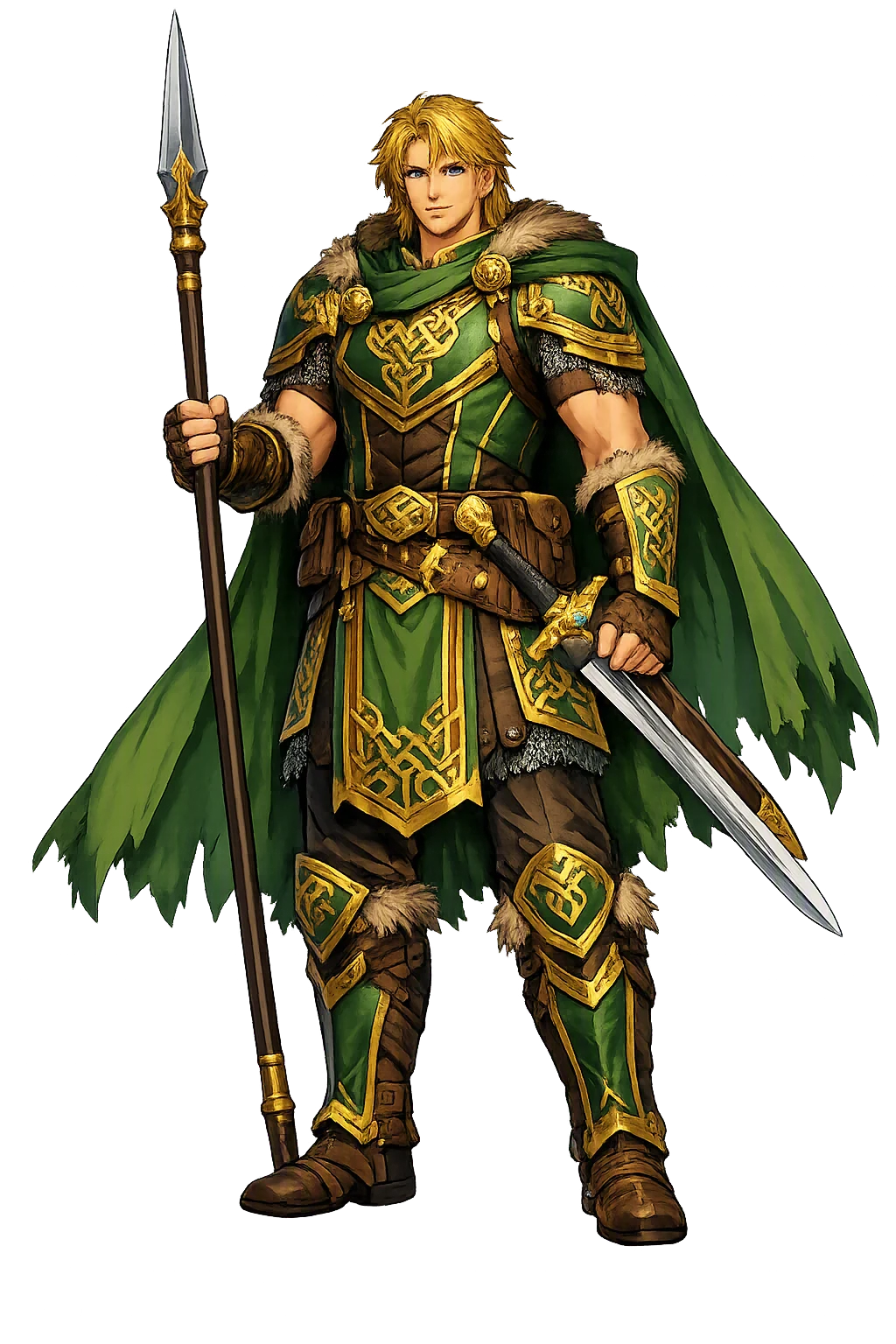
Fionn — the one true spelling, and the forms that fail it
Evidence dossier 156 — Fionn. Every exhibit catalogued, every ruling stated with its grounds.
At a Glance
- Canonical form: Fionn
- Original script: —
- Pantheon: Celtic
- Convention: the tradition’s own scholarly transliteration standard
- False forms on record: 0
- Contested forms: none attested
- Series: The Canonical Register, No. 156 of 548
The Evidence
Exhibit 1 — the attestation. The tradition's record preserves this name in its romanized scholarly form: Fionn — no older script survives to transcribe, so the canonical content is the exactness of the spelling itself.
Exhibit 2 — the flattened form. The plain form fionn differs from the canonical Fionn only by convention of display — case, not content. It is acceptable everywhere: in legacy systems, in plain-text citation, in the DNS itself. What is not acceptable is what follows in the register: respellings that change the letters, not just their case.
Exhibit 3 — the physical record. Fionn is a textual hero: no ogham stone names him, and his cycle survives in the great Irish codices — the Acallam in the Book of Lismore and its sister manuscripts, the Boyhood Deeds and the Fenian lays across the Laud and Book of Leinster traditions. His landscape, by contrast, is real and visitable. The salmon of knowledge was caught in the Boyne, the river that bends around Brú na Bóinne — the Newgrange passage-tomb complex (c. 3200 BCE) that the myths make the síd of Óengus, Diarmaid's protector. Tara, the royal seat Aillén burned every Samain, is the hill of Teamhair in County Meath, an Iron Age ceremonial complex of earthworks and standing stones. Ben Bulben, where the boar killed Diarmaid, stands over Sligo as the tales describe it. The Fenian cycle is unusual among Irish corpora for how densely it maps onto ground that can still be walked.
Exhibit 4 — the continuing record. Fionn became, for a century, the most famous Celt in Europe. James Macpherson's Fragments of Ancient Poetry (1760) and Fingal (1762) presented 'Ossian' — Oisín — as the bard of a northern Homer, with Fingal his mighty father; the poems swept the continent, were carried by Napoleon and quoted by Goethe, and set off a running war over their authenticity in which Samuel Johnson demanded the manuscripts and Macpherson never produced them.
The Convention's Own History
Every tradition in this register has its own scholarly transliteration standard, built by its own specialists over decades or centuries, and the register follows each on its own terms: the tradition’s own standard. The principle that unifies them is the one the whole project stands on: a name is evidence, and evidence is not negotiable — not for keyboards, not for convenience, not for anyone.
The Protocol's Position
Can the canonical form live in the address bar? Almost always, yes. IDNA 2008 admits every mark this register defends — the DNS stores them as `xn--` punycode and modern browsers render them natively. The real frictions are practical, not legal: some registrars stock only part of the IDN space, so a theoretically valid name can be temporarily unbuyable; and stacked combinations (an acute riding a macron) remain awkward to type on mobile keyboards even where the protocol accepts them.
The project's answer is a ranked ladder, not a compromise: the full restoration first, then attested fallbacks in descending order of completeness. The ladder's lowest rung, plain ASCII, is a vehicle for legacy systems — sanctioned, but never presented as the scholarly form.
The Verdict
Case closed on Fionn: canonical, cited, and defended. The keyboard form fionn is the same name in another register of display — always acceptable. The register's files remain open: if a source surfaces that changes any line of this entry, the entry changes. Until then, the temple at /fionn/ holds the canonical form.
The docket for this ruling: no false forms on the docket; no contested forms attested; the attestation rests on 11 cited sources — Macgnímartha Finn (The Boyhood Deeds of Fionn), ed. and trans. Kuno Meyer — the birth, the salmon of knowledge, the slaying of Aillén at Tara, Acallam na Senórach, ed. Whitley Stokes, Irische Texte IV (1900); trans. Ann Dooley and Harry Roe, Tales of the Elders of Ireland (Oxford, 1999) — Oisín and Caílte before Patrick; the Fenian memory, Tóruigheacht Dhiarmada agus Ghráinne (The Pursuit of Diarmaid and Gráinne), ed. Nessa Ní Shéaghdha, Irish Texts Society 48 (1967).
The Register Continues
The register holds 548 entries like this one — each temple with its own ruling. Read the temple's founding dispatch for the story, its Restoration File for the philology, its Resonance File for the industries, or the whole archive end to end.
Continue the register — previous entry: Fenrir (read it) · next entry: Fjǫrgyn (read it).
The Canonical Register is written from the same canonical record as the lexicon itself. If a false form is missing from this page, it is because the evidence does not support calling it false — or because we have not seen it yet. Show us, with a citation, and the register will answer.