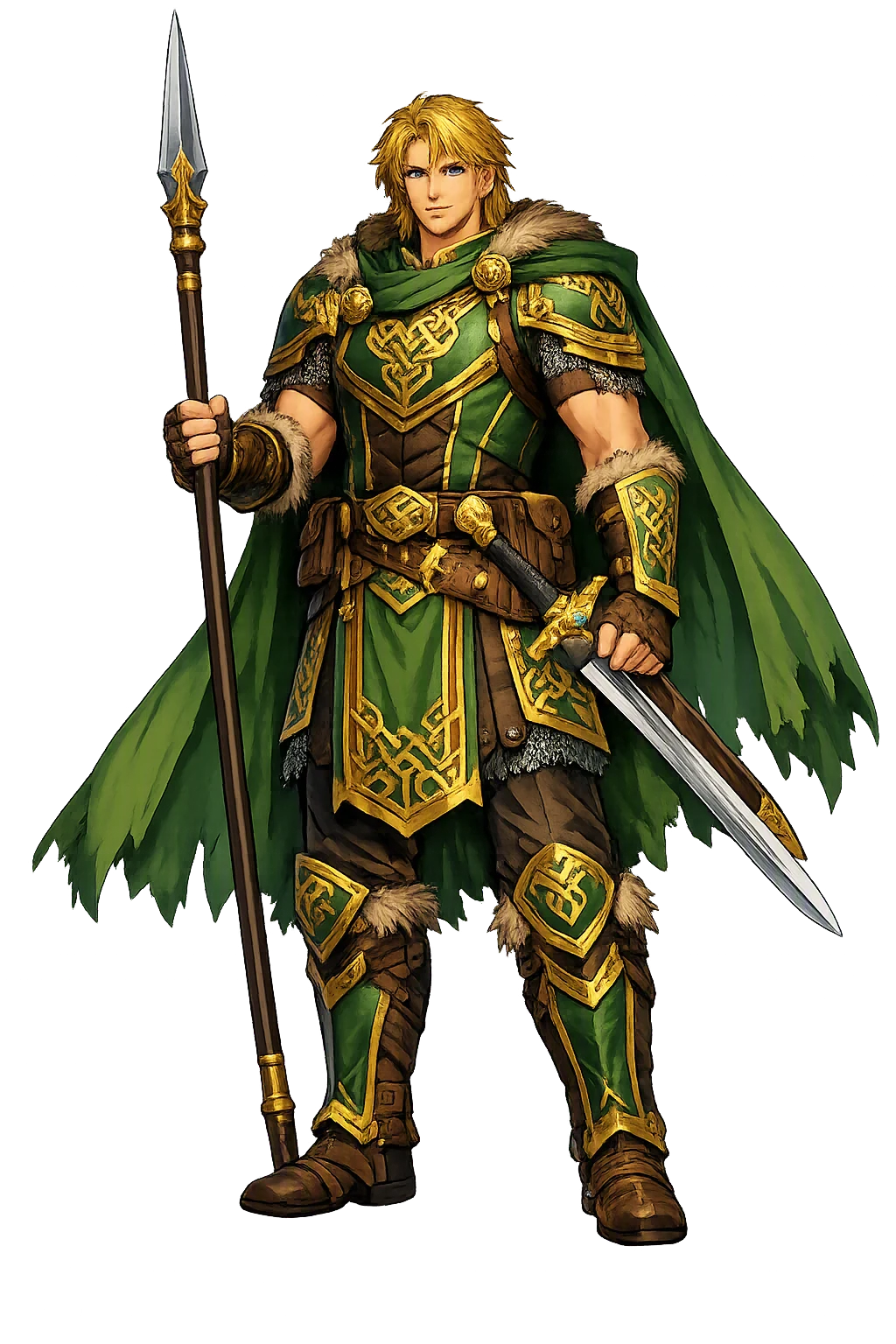
Stories of Fionn
Fionn's cycle is the fullest hero-corpus Ireland kept: the Boyhood Deeds that make him wise, the Fenian lays and ballads that make him captain, and the two late romances — the pursuit of Diarmaid and the lay of Oisín — that make him tragic.
Fionn's father was Cumhall mac Trénmhóir, captain of the Fianna, who abducted Muirne, daughter of the druid Tadg, when her father refused her. Tadg's appeal brought the king's army, and Cumhall fell at the battle of Cnucha to Goll mac Morna, head of the rival Clann Morna. Muirne bore the child in danger and gave him to two women to rear in secret: Bodbmall the druidess and Liath Luachra the warrior-woman, who raised him in the wild places away from his father's enemies. When the boy grew strong he went openly to his grandfather Tadg and exacted the blood-price for Cumhall — the hill of Allen, Almhain, which would become the Fianna's seat. The women they hid him from gave the world the name by which the manuscripts remember him: the boy they raised was named Demne; the name the world would keep was still swimming in the Boyne.
Demne came to learn poetry from Finn Éces, Finn the poet, who had waited seven years on the Boyne for the salmon of knowledge — the fish that had fed on the nuts of the nine hazels dropping into the well of Segais, so that all the knowledge of the world was in its flesh. When at last the salmon was caught, the poet set the boy to cook it and forbade him to taste any part of it. A blister rose on the fish's skin; Demne pressed it down with his thumb, burned himself, and thrust the thumb into his mouth — and the knowledge was his. Finn Éces asked the boy his name, heard 'Demne', and told him: Finn is your name now, for it was Finn who was prophesied to eat this salmon. The boy ate what remained, and ever after needed only to chew his thumb to know what was hidden.
Every Samain night for twenty-three years, Aillén of the three tongues came out of síd Finnachaidh and burned Tara: he played his timpán so sweetly that every man in the fortress fell asleep, and then he breathed fire over the hall. Fionn came to Tara on Samain, and Fíacha mac Conga, who had served his father, gave him a magic spear and the instruction: hold its naked point to your forehead, and you will not sleep. So Fionn sat wakeful while the court slept around him, and when Aillén turned back for the síd, Fionn cast the spear through him. For that deed Conn Cétchathach restored to him his father's treasure and made him head of the Fianna — and Goll mac Morna, his father's killer, accepted the peace and became the most loyal of his captains.
In his age Fionn was betrothed to Gráinne, daughter of Cormac mac Airt, but at the feast she gave a sleeping-draught to the company and laid a geis — the bond no Fenian could refuse — on Diarmaid Ó Duibhne to take her away. Diarmaid bore a ball seirce, a love-spot on his forehead that no woman could see without loving him, and Gráinne had seen it. For sixteen years the Fianna hunted the pair the length of Ireland, with Óengus of the Brug shielding Diarmaid where he could, until the tale came to the boar-hunt on Ben Bulben: the beast was Diarmaid's own foster-brother, transformed, and it was fated to be his death. Diarmaid killed the boar and took its venom in the doing. Fionn could heal any wound with water carried in his two cupped hands — he had the gift since the salmon — and twice he brought the water from the well and let it slip through his fingers, remembering Gráinne; when Óscar's reproach sent him back the third time, Diarmaid was dead.
Fionn's son Oisín was taken across the sea by Niamh of the Golden Hair, daughter of the king of Tír na nÓg, the Land of Youth, riding behind her on a white horse that never touched water. What he counted as three years in that country were three hundred years in Ireland. Homesick, he was lent the horse to visit and warned on no account to set foot on Irish soil; he found the Fianna gone and their names become legend, and as he stooped from the saddle to help men shift a stone, the girth broke. Oisín touched the ground, and three hundred years fell on him at once. The medieval Acallam na Senórach frames the whole Fenian memory on this survival: the old, blind Oisín and Caílte mac Rónáin traveling Christian Ireland with Saint Patrick, naming every hill and ford and telling how they were won — the Fianna kept alive as long as one man could still remember them.
The Salmon of Knowledge, the Burning of Tara, and the Long Chase of the Fianna
Fionn mac Cumhaill is the great captain of the Fianna, the war-band of young hunters and fighters who held the marches of Ireland between the king's peace and the wild: the boy who burned his thumb on the Salmon of Knowledge and swallowed all wisdom with it, the youth who saved Tara from fire on Samain night, and the aging leader who spent sixteen years pursuing Diarmaid and Gráinne across the country he had sworn to protect.
An eo fis — the fish that fed on the nuts of the nine hazels over the well of Segais; whoever ate it would know all things.
Burned on the salmon's blister and sucked by reflex — afterward Fionn could chew his thumb and the imbas, the great knowledge, would come.
The birga Fíacha mac Conga put in his hand at Tara: held with its point to the forehead, its enchantment kept a man awake against Aillén's music.
His two great hounds, born of his own transformed kin — the chase made family, and the Fianna's swiftest trackers.
From the original script to the living URL
Fionn
The name survives in scholarly transliteration. Fionn is the standard Celtic romanisation, documented in academic sources — “Fair, white”. Because the spelling uses only Latin letters, the form is the same in both ASCII and Unicode.
No indigenous writing system is securely attested for individual celtic names. The form shown is a modern scholarly transliteration.
fionn
The plain fionn form is identical to the Unicode restoration. Because this name is already written in Latin letters, no diacritics, stress, or script information were lost — only capitalization differs.
Fionn
The Unicode restoration does not need to recover lost marks for Fionn. Its value is canonical spelling and consistent cataloguing, not the reconstruction of erased orthography. The domain is readable as-is to both DNS and humanity.
Fionn.com
This restoration is written entirely in ASCII letters — no Punycode encoding stands between Fionn and the DNS. The domain reads identically to machines and to human eyes.
Owned, ideal, and ASCII forms of Fionn
Fionn
The full Unicode restoration. fionn.com is not in the PuniCodex collection — it is watched for release; if it drops, this temple upgrades to an owned flagship.
How Fionn was spoken
How Fionn is preserved in writing
No indigenous writing system is securely attested for individual celtic names. The form shown is a modern scholarly transliteration.
Contribute scholarly provenance →The lore you have read is the living myth. Extended Lore opens the scholarly vault beneath it: the cult and its material remains, a history of the image, the name after antiquity, a meditation on what the name still means, and the full scholarly apparatus — etymology, orthography, sources.
Enter Extended Lore