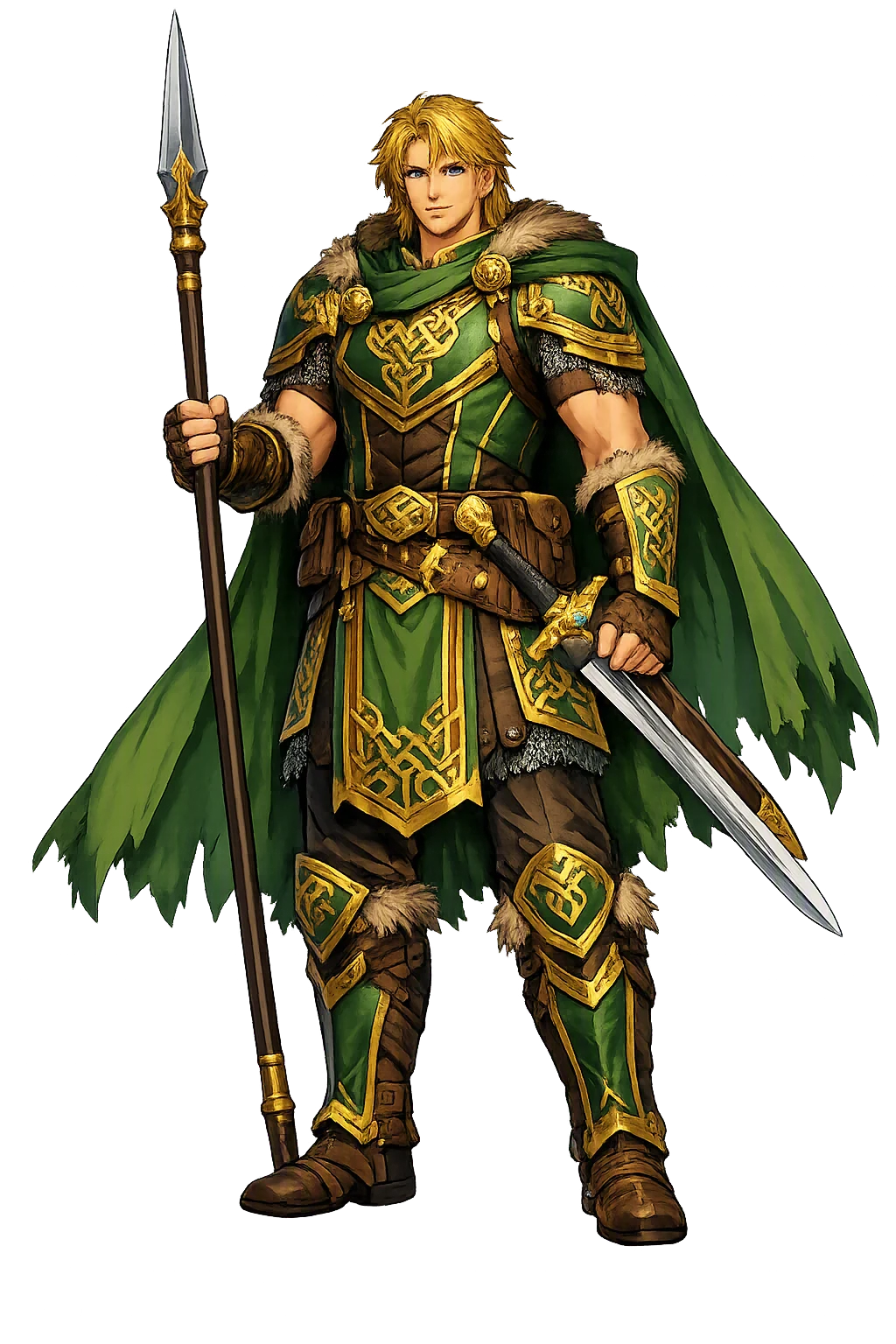
PuniCodex

Extended Lore

Fionn

Etymology · Phonology · Orthography · Cultural Legacy · Primary Sources

Tier 2 Fionn
Fionn — Hunter, Seer, Leader
01

Quick Facts

Essential information about Fionn, Hunter, Seer, Leader

Scholarly TransliterationFionn
Unicode RestorationFionn
Reconstructed Pronunciation/ˈfʲiːn̪ˠ/
PantheonCeltic
DomainHunter, Seer, Leader
MeaningFair, white
ClassificationTier 2
Primary DomainFionn
Sacred SymbolsThe salmon of knowledge, The thumb, The magic spear, The hounds Bran and Sceólang, Ben Bulben
02

Etymology & Word Family

From original script to Unicode restoration

Scholarly Transliteration Fionn Fionn — "Fair, white"
Unicode Restoration Fionn Restored stress, length, and script
Modern ASCII fionn Plain-ASCII fallback

Fionn is Tier 2 by the mechanical rule: the normalized Irish form is already plain ASCII — no diacritic, no distinctive letter for the ASCII alphabet to lose. The manuscripts write Find, the modern language writes Fionn, and both are Latin letters; the capital alone distinguishes the temple form from the input. The hero's standing in the tradition is beside the point.

03

Unicode Character Breakdown

Character-by-character philological analysis

CharacterUnicodeNameBlockPhonetic Role
FU+0046Latin Capital Letter FBasic LatinSame, capitalized
iU+0069Latin Small Letter IBasic LatinSame
oU+006FLatin Small Letter OBasic LatinSame
nU+006ELatin Small Letter NBasic LatinSame

The Tier 2 classification reflects how much of the original phonology this restoration preserves — stress and vowel length for Greek names, distinctive letters and diacritics for every other tradition.

04

Cultural Significance

From ancient cult to modern Unicode

Ancient Domain

Fionn mac Cumhaill is the great captain of the Fianna, the war-band of young hunters and fighters who held the marches of Ireland between the king's peace and the wild: the boy who burned his thumb on the Salmon of Knowledge and swallowed all wisdom with it, the youth who saved Tara from fire on Samain night, and the aging leader who spent sixteen years pursuing Diarmaid and Gráinne across the country he had sworn to protect.

Fionn in Later Traditions

Fionn's deepest kin are onomastic and Insular. His name descends from Proto-Celtic *windos, 'white, fair', and the handbooks have long set him beside the Welsh Gwyn ap Nudd — 'white son of Nudd', the Otherworld huntsman of Welsh tradition — as two regional developments of a Celtic figure built on the same word: the fair one who rides between this world and the wild. The more famous comparison is with the Norse corpus: like Sigurðr, who tasted the blood of Fáfnir's heart and understood the speech of birds, Fionn receives a whole mode of knowledge through a single accidental taste — the parallel is a commonplace of the comparative literature, though the two traditions grew the motif independently. Within Ireland his nearest mirror is [[cuchulainn|Cú Chulainn]], the Ulster Cycle's solitary champion set against Fionn's communal war-band: the two heroes divide the Irish heroic imagination between them.

Modern Legacy

Fionn became, for a century, the most famous Celt in Europe. James Macpherson's Fragments of Ancient Poetry (1760) and Fingal (1762) presented 'Ossian' — Oisín — as the bard of a northern Homer, with Fingal his mighty father; the poems swept the continent, were carried by Napoleon and quoted by Goethe, and set off a running war over their authenticity in which Samuel Johnson demanded the manuscripts and Macpherson never produced them. The Celtic Revival reclaimed the genuine cycle: Lady Gregory's Gods and Fighting Men (1904) brought the Fenian tales into modern English, and Irish scholarship — Meyer's Fianaigecht, Murphy's Duanaire Finn, Dooley and Roe's Acallam translation — rebuilt the cycle from its real witnesses. In Ireland the name never faded: Fianna Éireann named the warrior-band after him, the political tradition borrowed Fianna Fáil, 'the war-band of Ireland', Finn is once again a living given name, and Tír na nÓg remains the Irish idiom for youth that outlasts its bargain.

Unicode Restoration as Cultural Act

Restoring Fionn in a domain name is more than orthographic accuracy. It is a statement that the internet should recognize the full range of human writing — not only the ASCII keyboard.

05

Frequently Asked Questions

Common questions about Fionn, Hunter, Seer, Leader, and Unicode restoration

01How do you pronounce Fionn?

In reconstructed pronunciation, Fionn is /ˈfʲiːn̪ˠ/ — approximately 'FEEN' — one syllable; the f is slender and light, the vowel a long ee, the final nn broad against the teeth. 'Fionn mac Cumhaill' runs roughly 'FEEN mak KOO-il'..

02What does Fionn mean?

Fionn means Fair, white in the celtic tradition.

03What are the symbols of Fionn?

Fionn is associated with The salmon of knowledge (Wisdom caught in a single instant — meant for another, given by chance, and never returned), The thumb (Imbas forosnai, the knowledge that illuminates — knowing held in the body, summoned by the bite), The magic spear (The discipline to stay awake when the whole court is lulled — vigilance as a weapon), The hounds Bran and Sceólang (The bond of hunter and hunted bound into one kinship — the wild running at the leader's heel), Ben Bulben (The boar's mountain in Sligo, where the long pursuit of Diarmaid ended and the water slipped through Fionn's fingers).

04Why restore Fionn in Unicode?

Plain ASCII fionn strips the stress, length, and script that make the name specific. Unicode restoration returns the name to its original written dignity.

05What is the most important myth about Fionn?

Fionn's father was Cumhall mac Trénmhóir, captain of the Fianna, who abducted Muirne, daughter of the druid Tadg, when her father refused her. Tadg's appeal brought the king's army, and Cumhall fell at the battle of Cnucha to Goll mac Morna, head of the rival Clann Morna. Muirne bore the child in danger and gave him to two women to rear in secret: Bodbmall the druidess and Liath Luachra the warrior-woman, who raised him in the wild places away from his father's enemies. The boy they hid was named Demne; the name the world would keep was still swimming in the Boyne.

06

Scholarly Sources

The philological foundations of this restoration

Every claim on this page is grounded in established scholarship. The orthographic restorations follow disciplinary convention. The etymological chain follows the best available reference works. This is not invention — it is resurrection through scholarship.

Lexicography & Philology

  • Acallam na Senórach
  • MacKillop

Primary Texts

  • The Immram Brain (Voyage of Bran); Tochmarc Étaíne; Cóir Anmann; medieval Irish saga literature.

Archaeology & Art History

  • Material evidence — iconography, inscriptions, and temple archaeology — for Fionn and related cults.
  • Fionn is a textual hero: no ogham stone names him, and his cycle survives in the great Irish codices — the Acallam in the Book of Lismore and its sister manuscripts, the Boyhood Deeds and the Fenian lays across the Laud and Book of Leinster traditions. His landscape, by contrast, is real and visitable. The salmon of knowledge was caught in the Boyne, the river that bends around Brú na Bóinne — the Newgrange passage-tomb complex (c. 3200 BCE) that the myths make the síd of Óengus, Diarmaid's protector. Tara, the royal seat Aillén burned every Samain, is the hill of Teamhair in County Meath, an Iron Age ceremonial complex of earthworks and standing stones. Ben Bulben, where the boar killed Diarmaid, stands over Sligo as the tales describe it. The Fenian cycle is unusual among Irish corpora for how densely it maps onto ground that can still be walked.

Religious Studies

  • Macgnímartha Finn (The Boyhood Deeds of Fionn), ed. and trans. Kuno Meyer — the birth, the salmon of knowledge, the slaying of Aillén at Tara
  • Acallam na Senórach, ed. Whitley Stokes, Irische Texte IV (1900); trans. Ann Dooley and Harry Roe, Tales of the Elders of Ireland (Oxford, 1999) — Oisín and Caílte before Patrick; the Fenian memory
  • Tóruigheacht Dhiarmada agus Ghráinne (The Pursuit of Diarmaid and Gráinne), ed. Nessa Ní Shéaghdha, Irish Texts Society 48 (1967)
  • Duanaire Finn (The Poem-Book of Fionn), ed. Eoin MacNeill and Gerard Murphy, Irish Texts Society — the Fenian lays
  • Michael Comyn, Laoi Oisín ar Thír na nÓg (The Lay of Oisín in the Land of Youth, 18th c.) — Oisín and Niamh of the Golden Hair
  • Dictionary of the Irish Language (eDIL), s.v. find — 'fair, white'
  • Vendryes, Lexique étymologique de l'irlandais ancien, s.v. find — Proto-Celtic *windos
  • MacKillop, Dictionary of Celtic Mythology, s.v. Finn mac Cumaill
  • Ó hÓgáin, Dáithí, Fionn mac Cumhaill: Images of the Gaelic Hero (1988)
  • Nagy, Joseph Falaky, The Wisdom of the Outlaw: The Boyhood Deeds of Finn in Gaelic Narrative Tradition (1985)
  • Koch, ed., Celtic Culture: A Historical Encyclopedia, s.v. Finn mac Cumaill
Return

The Surface Awaits

You have traced the name from its earliest attestation to its Unicode restoration. Now return to the myth. The story is where the name lives.

Back to Lore
Fionn mascot