
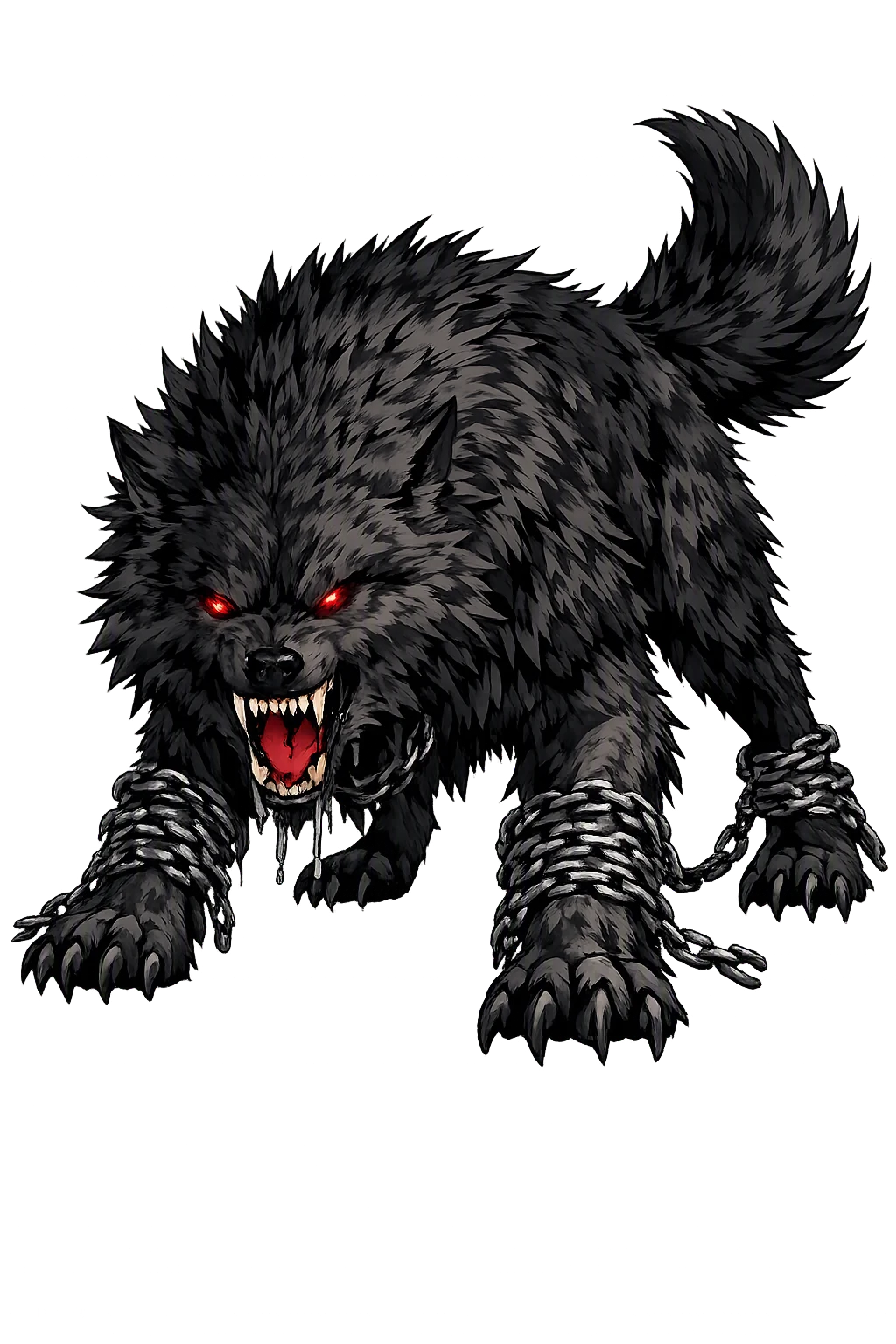
The canonical register: Fenrir
A letter to a colleague, 31 July 2026 — on the name Fenrir, and on the forms that keep failing it.
Your note said, roughly: surely the marks are a nicety. Permit me to use Fenrir to show they are not.
First, the attestation. The attested form is ᚠᛁᚾᚱᛁᚱ, from the tradition's own record. The canonical transliteration is Fenrir.
Say it aloud as the sources heard it: 'FEN-reer' — a short e as in 'fen', both r's trilled, and the final nominative -r sounded as a light syllabic trill, as in Icelandic. The marks are what carry that sound to a reader who has never heard it spoken.
On the plain form — and I want to be precise, because you pushed on this. The plain form fenrir differs from the canonical Fenrir only by convention of display — case, not content. It is acceptable everywhere: in legacy systems, in plain-text citation, in the DNS itself. What is not acceptable is what follows in the register: respellings that change the letters, not just their case.
One more thing, because it always surprises: the name did not stay home. Fenrir's closest relative inside his own corpus is the hound Garmr, who breaks his chain before Gnipahellir at Ragnarök and fights Týr to mutual death: Vǫluspá's refrain 'now Garmr howls loud' announces the end, and scholars from Lindow onward have debated whether Garmr is a doublet of the bound wolf or a second beast of the same kennel. The chase-wolves of the sky — Skǫll, who pursues the sun, and Hati Hróðvitnisson, who will take the moon — belong to the same apocalyptic pack, and Vafþrúðnismál gives Fenrir himself the sun-swallowing role, a distribution of doom the sources never fully harmonize.
And it never stopped working. Fenrir is the North's most famous monster, and his afterlife runs on two tracks. The scholarly track never stopped: the binding of the wolf was a set-piece of the Victorian Norse revival — the Kearys' Heroes of Asgard (1857) made the fetters and the pledge of Týr's hand a children's classic — and every handbook since has treated Gleipnir's six impossibles as the Edda's signature riddle-image.
The Convention's Own History
The Poetic Edda survives essentially in one manuscript — the Codex Regius, c. 1270 — and normalized Old Norse spelling descends from what that manuscript and its siblings actually write. Þ and ð are not decorations: they are letters of the alphabet the skalds used (and English later abandoned), and ǫ is a nasal vowel the normalization preserves because the sources carry it. The register's rule is the manuscript's rule: spell the names the way the tradition that sang them wrote them down.
Where Protocol Meets Practice
The technical answer is simple: the canonical marks are legal IDNA 2008 characters, encoded as punycode under `xn--`. The practical answer is messier: legal does not mean stocked (registrar inventory is partial), and stocked does not mean typeable (stacked diacritics defeat mobile keyboards).
So the register's rule is a hierarchy of attested forms — full restoration, circumflex, macron-only, attested variant, and finally plain ASCII for the systems that cannot carry marks. Every rung is defensible because every rung is attested. The forms this register rules against are not rungs; they are errors, and errors do not get rungs.
Write back when you have checked the sources; they are better company than I am.
— The Register
The Verdict
Fenrir is the canonical form: attested, checkable, and enforced across the temple, the lexicon, the cards, the APIs, and this register. The plain form fenrir shares that standing — the two are the same name in every system. The false forms above are documented so that no reader has to take the temple's word on faith — the violations are stated, the sources are named, and the register stands open to challenge on every line.
The temple of Fenrir stands at /fenrir/.
The docket for this ruling: no false forms on the docket; no contested forms attested; the attestation rests on 6 cited sources — Snorri Sturluson, Prose Edda: Gylfaginning 34–35 (the binding of the wolf) and 51 (Ragnarök), trans. Faulkes, Poetic Edda: Vafþrúðnismál 46–47, 53 (Fenrir and the sun; Óðinn's doom), trans. Larrington, Poetic Edda: Vǫluspá (the Ragnarök stanzas; the Ironwood brood), Grímnismál 17, Lokasenna 38, Hyndluljóð 40.
The Register Continues
The register holds 548 entries like this one — each temple with its own ruling. Read the temple's founding dispatch for the story, its Restoration File for the philology, its Resonance File for the industries, or the whole archive end to end.
Continue the register — previous entry: Fáfnir (read it) · next entry: Fionn (read it).
The Canonical Register is written from the same canonical record as the lexicon itself. If a false form is missing from this page, it is because the evidence does not support calling it false — or because we have not seen it yet. Show us, with a citation, and the register will answer.