
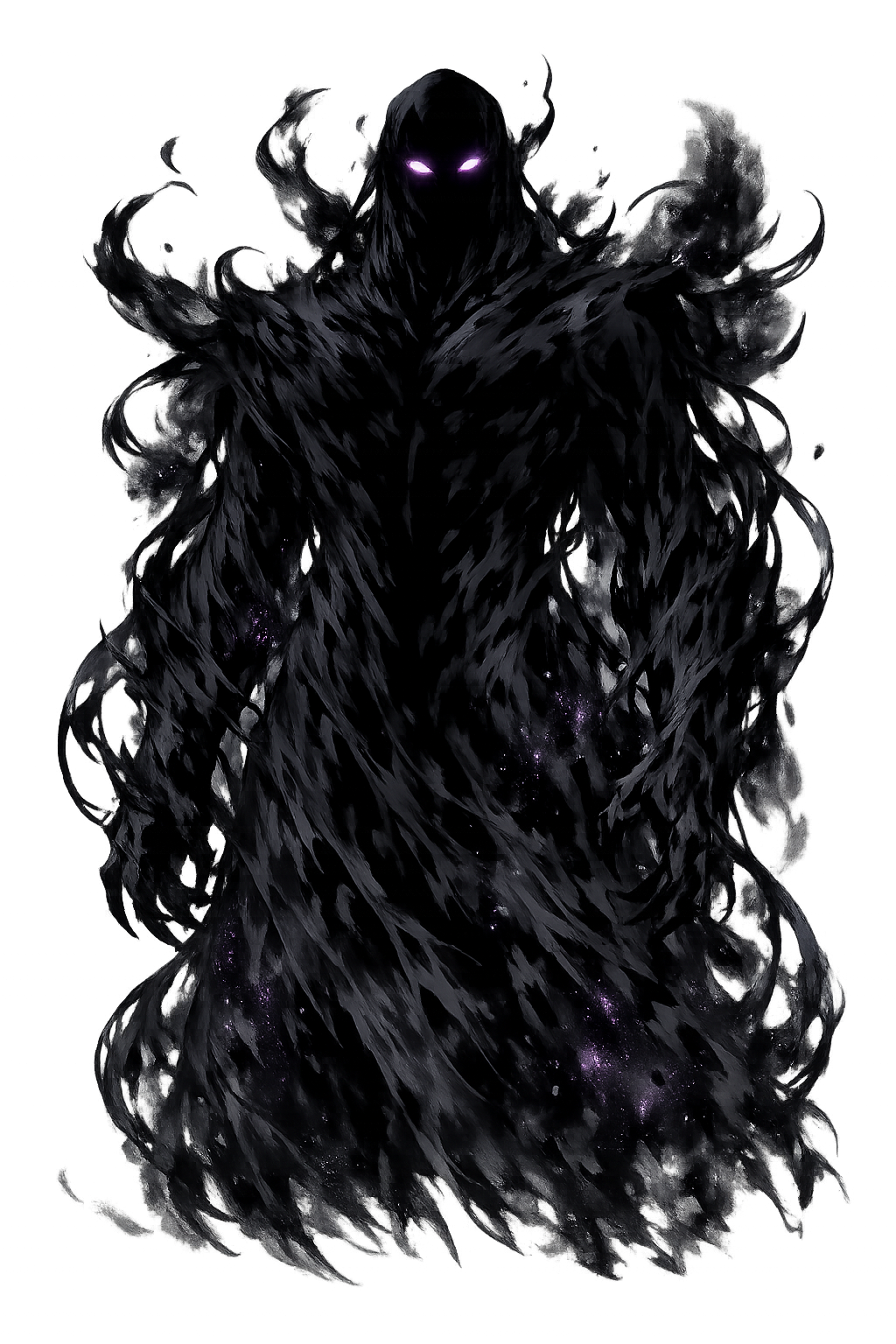
Érebos: the stories first, then the spelling
Before the spelling, the story. Érebos earns its restoration the old way — through what was actually told.
The Stories That Carry the Name
The Second Primordial. Hesiod opens the Theogony with a sequence that has no author and no maker: first Cháos came to be — the gaping void, the yawn — then broad-bosomed Gaia, then dim Tártaros in the depths, and from Cháos, 'on the same day,' were born Érebos and black Nyx (116–123). West's commentary on the passage stresses what the Greek says plainly: Érebos is not created, and not evil; he is simply second — the second fact of the cosmos after the void itself, the darkness that settles in the space between things before there are things to separate. His pairing with Nyx is exact: Érebos is the darkness that fills the depths, Nyx the night that covers the world above, and the two are born together because they are the two faces of one condition.
Darkness Gives Birth to Light. The very next lines of the Theogony (124–125) deliver one of the most elegant genealogies in Greek myth: Nyx, joined with Érebos in love, bore Aithḗr and Hēméra — the bright upper air and the day. It is a paradox engineered into the family tree: the darkest union imaginable produces the radiance that fills the sky and the hours that measure mortal life. The pattern is not conquest — darkness does not fight and lose to light; it emerges from darkness, as children emerge from the night of the womb.
The Land Wrapped in Mist. Homer gives Érebos his geography. To consult the dead, Odysseus must sail the deep-flowing Ōkeanos to the world's edge, to the land of the Cimmerians, 'wrapped in mist and cloud,' where the sun never looks down — 'neither when he climbs the starry heavens nor when he turns back from heaven toward earth' — and where night and day lie close together (Odyssey 11. 13–19).
And Here Is What the Spelling Preserves
Against those stories, the attestation: Ἔρεβος, as LSJ and Beekes record. The name means "Darkness".
The restoration keeps one feature the ASCII form erebus cannot show:
- e → É — Acute on e: where the voice peaks.
A storyteller pronouncing the name would restore every one of them by instinct. The file only writes down what the voice already knows.
At a Glance
- Restored name: Érebos
- ASCII form: erebus
- Meaning: "Darkness"
- Domain of influence: Darkness
- Pantheon: Greek
- Classification: Tier 2
- Original script: Ἔρεβος
- Series: The Restoration Files, No. 148 of 546
The Name Travels
The Romans adopted the Greek name directly as Erebus and deepened it: Virgil places the guilty dead in Tartarus and lets the surrounding darkness swallow the light (Aeneid 6. 126–129, where the path into the underworld 'plunges into the darkness, into Erebus's vast gulf'), and Statius makes Erebus a standing synonym for the infernal depths.
The Address It Earned
The temple of Érebos stands at /erebus/ — lore, scholars, patterns — because a name carrying this much story deserves more than a parking page. One decisive feature survives — a single, honest mark — which places the restoration in Tier-2: exact, and exactly labeled.
The Sources Are Open
The myths above are retold from the temple's record; the primary voices are in the Sacred Texts: Theogony, Homeric Hymns, and Works and Days. Nothing in this file outranks them.
The File Continues
Read the founding dispatch for the name's full story, the Resonance File for the archetype at work — or the whole archive in one sitting.
Continue the series — previous file: Epimētheús (read it here) · next file: Ereškigal (read it here).
The Restoration Files are written from the same canonical record as the temples themselves: the lexicon, the lore catalog, the pattern atlas, and the cited scholarly sources. If a file ever disagrees with its temple, the temple is right — tell us, and the file will be corrected.