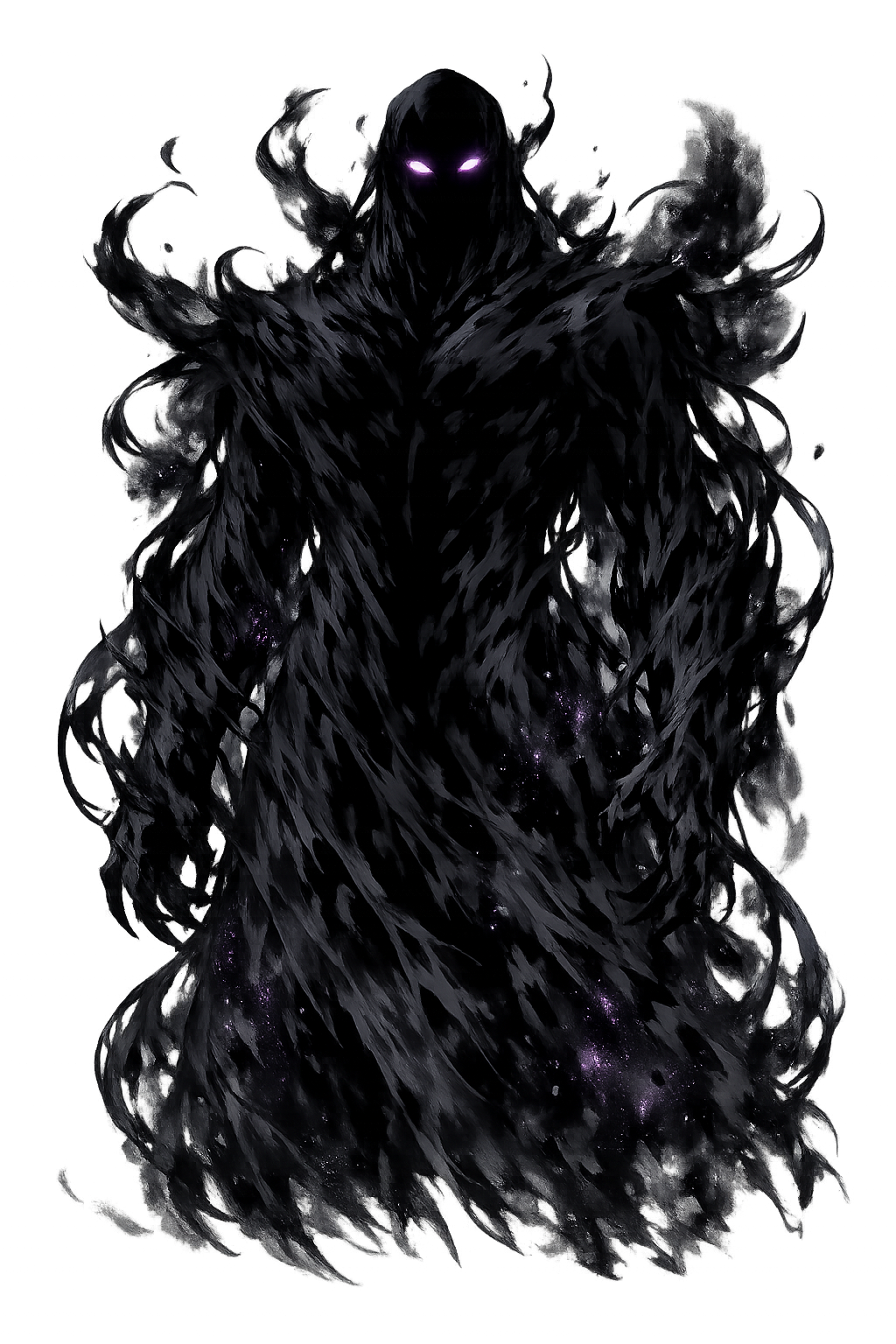
Stories of Érebos
Érebos has few independent myths because he is a condition rather than a character — darkness given a genealogy. Yet his appearances are foundational: he is born second of all things from Cháos, he fathers light itself upon Night, and he marks the boundary that every living thing must eventually cross. His mythology is the biography of darkness.
Hesiod opens the Theogony with a sequence that has no author and no maker: first Cháos came to be — the gaping void, the yawn — then broad-bosomed Gaia, then dim Tártaros in the depths, and from Cháos, 'on the same day,' were born Érebos and black Nyx (116–123). West's commentary on the passage stresses what the Greek says plainly: Érebos is not created, and not evil; he is simply second — the second fact of the cosmos after the void itself, the darkness that settles in the space between things before there are things to separate. His pairing with Nyx is exact: Érebos is the darkness that fills the depths, Nyx the night that covers the world above, and the two are born together because they are the two faces of one condition. Later tradition placed him beneath the earth as the dark passage the dead descend; Homer's underworld is wrapped in his gloom. The genealogy is a single claim stated at the very start of Greek literature: before light, before law, before the gods begin their quarrels, there is the shadow that makes all of them visible.
The very next lines of the Theogony (124–125) deliver one of the most elegant genealogies in Greek myth: Nyx, joined with Érebos in love, bore Aithḗr and Hēméra — the bright upper air and the day. It is a paradox engineered into the family tree: the darkest union imaginable produces the radiance that fills the sky and the hours that measure mortal life. The pattern is not conquest — darkness does not fight and lose to light; it emerges from darkness, as children emerge from the night of the womb. Hesiod extends the same rhythm later in the poem (748–757), where he pictures the gates of the abyss and the house of Night and Day standing opposite one another: the two goddesses 'greet each other as they cross the great threshold of bronze' — one descending as the other ascends, forever passing on the same threshold their parents built. The myth encodes the Greek experience of darkness as generative rather than malefic: night and day are sisters, children of the same dark house, and light is what darkness becomes when it is paired with time.
Homer gives Érebos his geography. To consult the dead, Odysseus must sail the deep-flowing Ōkeanos to the world's edge, to the land of the Cimmerians, 'wrapped in mist and cloud,' where the sun never looks down — 'neither when he climbs the starry heavens nor when he turns back from heaven toward earth' — and where night and day lie close together (Odyssey 11.13–19). There, at the boundary of Érebos, Odysseus digs the pit, pours the blood, and the shades come up — unmarried youths, old men, warriors still in their bloody gear, and Tiresias, who alone keeps his wits and can answer. The scene is the founding image of the western necromancy: darkness not as punishment but as threshold, the dim antechamber where the living can still question the dead. Kirkē's instructions had warned him not to let the shades taste the blood before Tiresias speaks — even in Érebos, there is protocol. The myth fixes the god's character forever: Érebos is the darkness you cross carefully, with offerings and with questions prepared, because on the far side of it, everyone you have lost is still waiting.
The Orphic poets re-worked the Hesiodic primordials into a more intricate cosmogony, and Érebos kept his station near the beginning of things. In the Rhapsodic Theogony as reconstructed from the Neoplatonic summaries, Chronos — Time itself — fashions the cosmic egg in the yawning void of Aithḗr, and from the egg bursts Phanēs, the first creator-god, whose first acts include the making of Nyx; the Orphic theogonies place the powers of darkness, including Érebos, among the deep substrata from which Phanēs arises (West, The Orphic Poems). The Orphic gold tablets — the lamellae buried with initiates from Thessaly to Thurii in southern Italy — send the soul on a journey that rehearses the same geography: past the spring of Memory and the gates of the underworld, through darkness toward light, with the passport line 'I am a child of Earth and starry Heaven' on the dead's own lips. In this tradition Érebos is not merely the place of the dead but the first veil the soul must remember how to cross. The myth's lesson is the mystery-cult's lesson: darkness is the beginning of the journey, not its end.
Shadow, Passage, and the Threshold of Death
Érebos is the personification of deep darkness, the shadow that fills the space between earth and Hades. Born directly from Cháos, he is the brother and consort of Nyx, and the father of Aithḗr and Hēméra. His name is both a place and a power: the darkness that the dead must cross, and the primordial shadow from which light first appears.
The second offspring of Cháos, older than the Titans, older than the Olympians — the original shadow.
The shades of the dead rise from or through Érebos; Odysseus must sail to the edge of the world to reach it.
His union with Nyx produces Aithḗr, the bright upper air, and Hēméra, the day — darkness begetting radiance.
In later usage Érebos names the deepest darkness beneath Hades, a region of mist and forgetfulness.
From the original script to the living URL
Ἔρεβος
The name in its original Greek form. Érebos (Ἔρεβος) is attested in the source tradition — “Darkness”. Its acute accents carry the full phonetic and orthographic weight of the source tradition.
erebus
Reduced to plain erebus, the name loses everything that made it specific: acute accents. What remains is an ASCII string that machines can parse but that no longer speaks with its original voice.
Érebos
The Unicode restoration recovers what ASCII flattened. Érebos restores acute accents, returning the name to its original written dignity. The domain encodes to Punycode, but the browser displays the truth.
Érebos.com → xn--rebos-9ra.com
The non-ASCII characters in Érebos are encoded while the ASCII remains visible. To the DNS, it is Punycode. To humanity, it is Érebos.
Owned, ideal, and ASCII forms of Érebos
Érebos
Restores Ἔρεβος. The live temple domain — érebos.com.
erebus
Flattens Ἔρεβος. The plain ASCII fallback — what DNS and legacy systems see.
How Érebos was spoken
How Érebos travels from ancient script to the modern URL
Greek Ἔρεβος; from a Proto-Indo-European root for darkness; the personification of darkness.
Darkness
The Unicode restoration Érebos preserves Greek stress and length; the ASCII form erebus loses these features.
The lore you have read is the living myth. Extended Lore opens the scholarly vault beneath it: the cult and its material remains, a history of the image, the name after antiquity, a meditation on what the name still means, and the full scholarly apparatus — etymology, orthography, sources.
Enter Extended Lore