
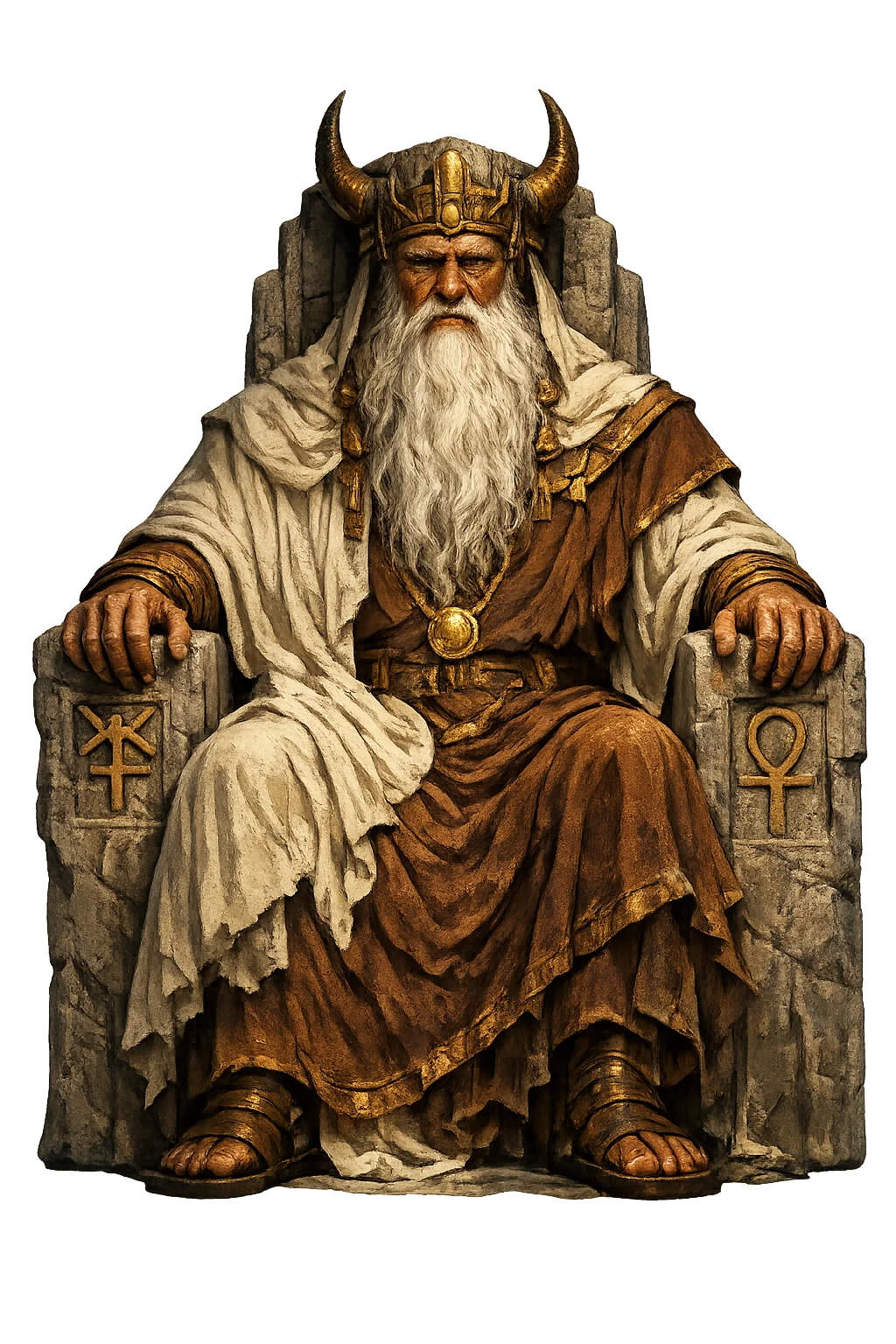
Why Ēl is spelled that way — and what it costs to get it right
There is a version of this name the early internet had to settle for: el. This is the file on how Ēl replaced it.
Ēl appears in almost every major Ugaritic myth, yet he rarely takes center stage. He is the one appealed to, the one who gives or withholds blessing, the one whose laughter signals cosmic assent. His mythology is the mythology of authority itself — distant, benevolent, sometimes foolish, always final.
At a Glance
- Restored name: Ēl
- ASCII form: el
- Meaning: "The high god of the Canaanite pantheon; the common Semitic word for "god" and a divine name"
- Domain of influence: Supreme God, Father of Gods
- Pantheon: Canaanite
- Classification: Tier 1
- Original script: 𐎛𐎍
- Series: The Restoration Files, No. 143 of 546
The Name Before the Marks
The name is attested as Ἠλ, in the attestation KTU (Ugaritic texts) and CIS give us. On the evidence, it means "The high god of the Canaanite pantheon; the common Semitic word for "god" and a divine name".
Strip Ēl to el and one piece of evidence vanishes:
- e → Ē — Macron marks long /ē/; capitalized in the restoration: the vowel length the ASCII form cannot show.
A reader who knows the marks hears the name correctly on the first try. A reader who never sees them never gets the chance.
Spoken, the name runs `/ʔeːl/` — 'AYLE' — like 'ale' with a long vowel and a slight glottal catch at the beginning; the name is short and resonant.
The Temple That Stands Now
The restored name is not a plaque; it is an address. The temple of Ēl lives at /el/, with its mythology in the lore halls, its peer-reviewed record in the Scholarly Edition, and its place in the pattern atlas on the patterns floor.
Tier-1 is not a compliment; it is a measurement. This restoration keeps something the ASCII form provably loses, and the measurement is repeatable.
Where the Name Stood First
At Ugarit the Baʿal Cycle tablets (KTU 1.1–1.6) and the Epic of Keret (KTU 1.14–1.16) name ʾil as supreme judge and royal patron. The Karatepe bilingual invokes El as creator of the earth. Kuntillet ʿAjrud and Khirbet el-Qom inscriptions preserve El names in an Israelite religious context, while Tel Arad ostraca, Shechem, and Jerusalem temple texts show his continued prestige. His name underlies Biblical ʾĒl, ʾĒl ʿElyôn, and theophoric names such as Israel and Gabriel. The temple on the web is the newest of these addresses — the first one that fits in a pocket.
The Archetype at Work
The pattern atlas seats this temple in 4 industries, each match argued and weighted: Leadership, Governance & Public Administration (the father of gods; the patriarchal template of rule.); Faith & Spiritual Organizations (the ancient Semitic god-name still embedded in living liturgy.); Ancestry & Heritage Services (father of gods and ‘father of years’; the patriarch at the head of the oldest divine family tree.). The Resonance File reads those seats through the myths themselves.
In the Sacred Texts
The Canaanite tradition is not a vibe; it is a library. The Sacred Texts collection holds Enūma Eliš — the primary sources the temple's scholarship is built on. The temple is the argument; the texts are the evidence.
The File Continues
The temple's founding dispatch tells the name's story; its Resonance File reads the myths into the industries; the blog index holds the whole archive.
Continue the series — previous file: Ekkeko (read it here) · next file: Enkidu (read it here).
The Restoration Files are written from the same canonical record as the temples themselves: the lexicon, the lore catalog, the pattern atlas, and the cited scholarly sources. If a file ever disagrees with its temple, the temple is right — tell us, and the file will be corrected.