The Living Myth
Supreme God, Father of Gods · The Ancient High God · Father of the Divine Assembly
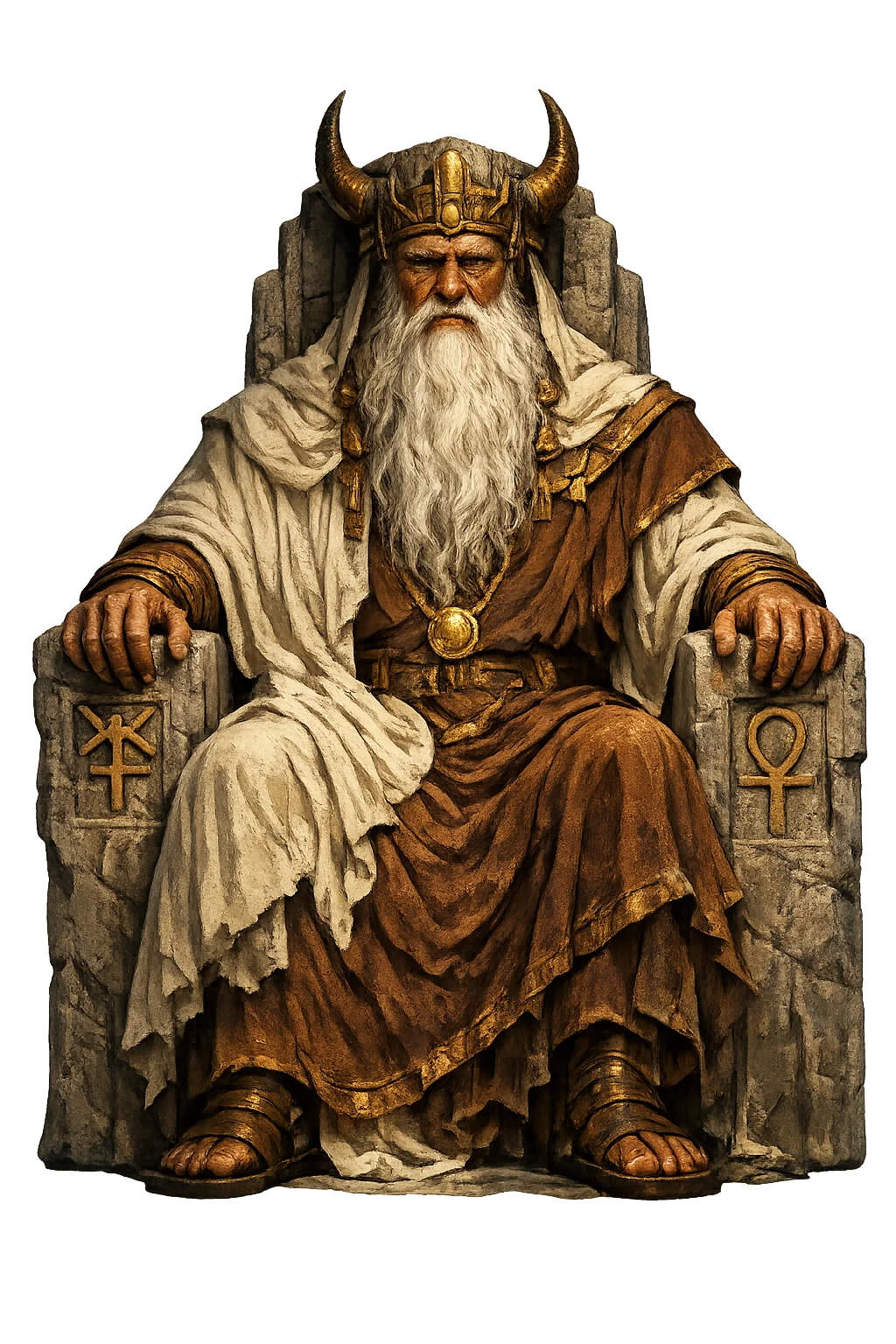
Stories of Ēl
Ēl appears in almost every major Ugaritic myth, yet he rarely takes center stage. He is the one appealed to, the one who gives or withholds blessing, the one whose laughter signals cosmic assent. His mythology is the mythology of authority itself — distant, benevolent, sometimes foolish, always final.
Twice in the Baꜥal Cycle the fate of the cosmos turns on a decree from Ēl's tent. First, persuaded by an appeal from the Sea, he grants kingship to Yamm, whose messengers then march into the assembly demanding Baꜥal as a captive (KTU 1.2 i–iii). Baꜥal's partisans seethe, but nothing moves until the old god speaks again. Much later, cajoled by his consort Asherah, Ēl grants Baꜥal the palace and the throne (KTU 1.4 iv–v). Even the mighty storm god, it turns out, rules only by the father's permission. The cycle makes an austere point about authority: Ēl never fights, never journeys, rarely leaves the source of the rivers, yet every coronation in heaven requires his word. Warrior gods can win the world; only the father of years can make a victory legitimate.
The poets give Ēl epithets no younger god can claim: ʾab šnm, 'Father of Years,' and bny bnwt, 'Creator of Creatures.' His dwelling is a tent pitched where the cosmic rivers rise, the ʾapq rḥm — the confluence of the freshwater springs beneath the world. When divine messengers seek him, they find him gracious, convivial, generous with blessing — and slow. The high god can even afford comedy: in KTU 1.114 he presides over a banquet, drinks himself insensible on wine, and must be carried home through the fields, while Aštart and ꜥAnat stagger along beside him and the moon god taunts him. The scene is funny; the theology is not. Ēl's power does not depend on dignity, beauty, or vigilance. It rests on nothing but age and word — the authority of the one who was already old when the seasons began.
At the low point of the Epic of Keret (KTU 1.14 i), the king weeps in his inner chamber: seven wives dead, his line broken, his house failing. Then Ēl comes to him in a dream and asks, 'Who is Keret, that he should weep...? Shall his harem die, his legitimate wives perish?' He instructs the king to march on the wealthy city of Udum and claim its princess, promising a house that will number seventy sons. Through three tablets the epic tests that promise — war, pestilence, a son's terrible curse — but its theology is set in the first scene: blessing, not battle magic, is Ēl's instrument, and it arrives uninvited to a weeping king. The poem is a window on Canaanite royal ideology. The legitimacy of a dynasty rested on the dream-voice of the father of gods, the only authority that could promise a king descendants 'like the stars of El.'
KTU 1.23 is among the strangest tablets from Ras Shamra: fragmentary, partly obscene, and tied to a rite of first fruits. In its mythic frame, Ēl, creator of creatures, sees two women bathing by the sea and seduces them 'in the best way and the worst way' — Wyatt's celebrated rendering of a phrase translators have wrestled with for a century. Later scenes show him in his palace, entangled with his wives, while the newborn Gracious Gods — Shahar and Shalim, Dawn and Dusk — demand meat and drink with an appetite compared to Death itself. Because the tablet is broken, scholars still dispute how the scenes connect. What is clear is the theology of fertility: the high god's sexuality is no scandal but the engine of the agricultural year, and even the hungriest newborn gods must finally be fed into goodness.
Supreme God, Creator, and King of the Divine Assembly
Ēl is the ancient one at the center of the Canaanite pantheon. He is the father of gods and men, the Bull whose creative power generates the divine assembly, and the king whose distant authority nonetheless settles every dispute. Unlike Baꜥal, who acts, Ēl decrees. His throne is at the source of the rivers; his tent is where the gods come to receive judgment.
His epithet bny bnwt, 'Creator of Creatures,' marks him as the ultimate source of all life.
The bull is his animal: strength, fertility, and patriarchal authority concentrated in one image.
The divine assembly gathers before him; kingship is conferred by his word, whether for Baꜥal or for Athtar.
He is 'ab ʾilm, 'father of the gods,' and 'ab ʾadmi, 'father of man' — the origin of all genealogies.
From the original script to the living URL
𐎛𐎍
The name in its original Canaanite form. Ēl (𐎛𐎍) is attested in the source tradition — “The high god of the Canaanite pantheon; the common Semitic word for "god" and a divine name”. Its original diacritics and script distinctions carry the full phonetic and orthographic weight of the source tradition.
el
Reduced to plain el, the name loses everything that made it specific: original diacritics and script distinctions. What remains is an ASCII string that machines can parse but that no longer speaks with its original voice.
Ēl
The Unicode restoration recovers what ASCII flattened. Ēl restores original diacritics and script distinctions, returning the name to its original written dignity. The domain encodes to Punycode, but the browser displays the truth.
Ēl.com → xn--l-oia.com
The non-ASCII characters in Ēl are encoded while the ASCII remains visible. To the DNS, it is Punycode. To humanity, it is Ēl.
Owned, ideal, and ASCII forms of Ēl
Ēl
Restores 𐎛𐎍. The live temple domain — ēl.com.
el
Flattens 𐎛𐎍. The plain ASCII fallback — what DNS and legacy systems see.
How Ēl was spoken
How Ēl travels from ancient script to the modern URL
Ugaritic ʾil is the common Semitic word for “god"; as a proper name Ēl is the high god and father of the gods.
Supreme God, Father of Gods
The Unicode restoration Ēl uses registrable Latin diacritics; the Ugaritic form is not registrable in .com.
The lore you have read is the living myth. Extended Lore opens the scholarly vault beneath it: the cult and its material remains, a history of the image, the name after antiquity, a meditation on what the name still means, and the full scholarly apparatus — etymology, orthography, sources.
Enter Extended Lore