
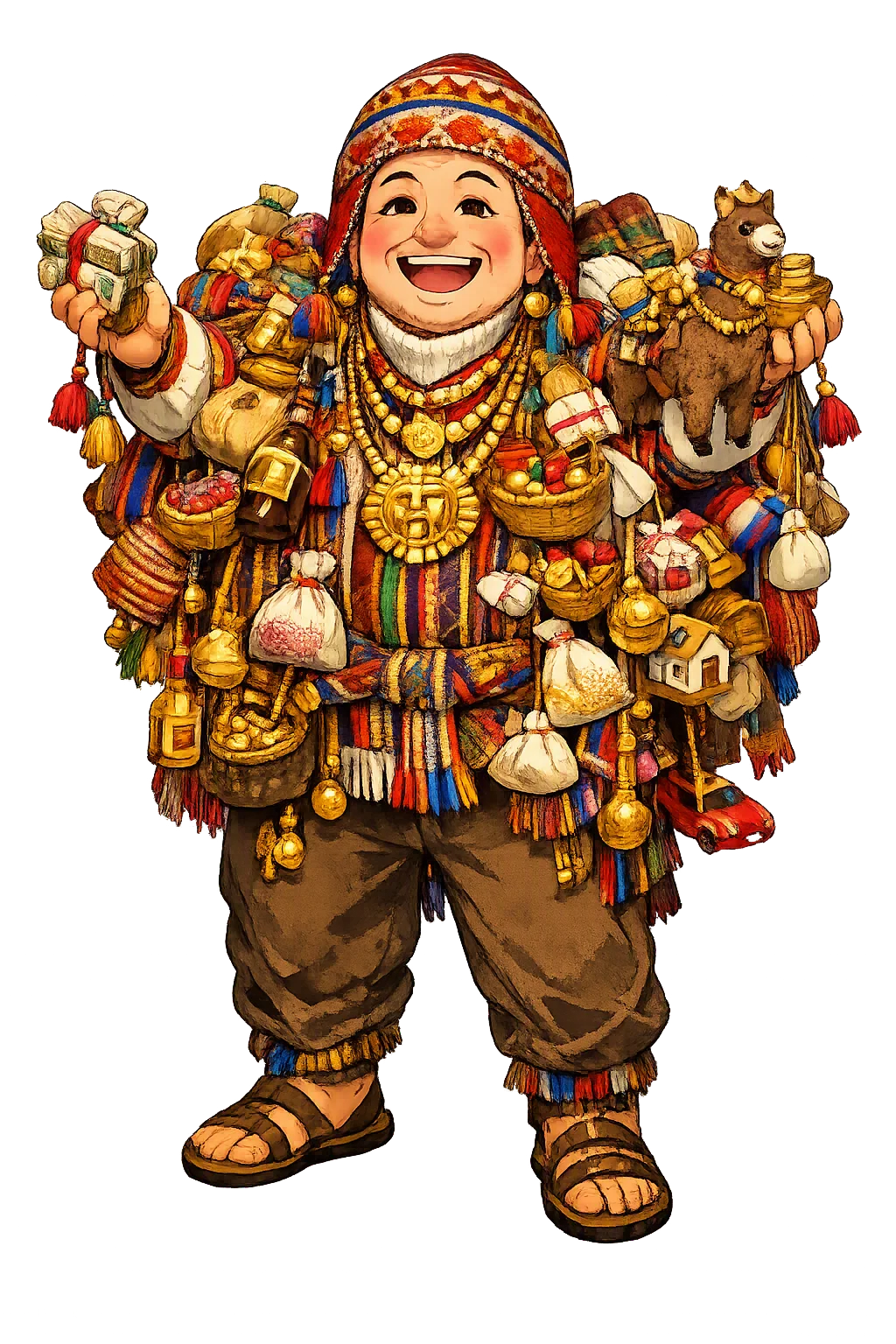
The provenance file on Ekkeko
Provenance record 142 · Ekkeko · one temple, fully accounted for.
Provenance
1. The attestation. —, from the tradition's own record.
2. The narrative record. Ekeko and Coya in the Famine — The best-known story of Ekeko is surprisingly recent: it was printed in 1904 by the Bolivian writer Antonio Díaz Villamil in his Exaltación de la Alasita. In the time of drought, when the storehouses stood empty, the little man Ekeko fed his beloved Coya from his own flesh, cutting pieces from his body so that she would not starve. The Little God Cobo Saw — Bernabé Cobo, writing his Historia del Nuevo Mundo in 1653, is the earliest secure witness. Among the household devotions of the Andean people he describes a small idol called Equeco, revered as a god of wealth and contentment: his image was a little figure loaded with packs and bundles, set up in the house and offered food, so that he would keep the family supplied with the small goods of life — food, clothing, coin.
3. The current holding. The temple at /ekkeko/, classified Tier 2. The restoration keeps one feature the ASCII form drops. One is enough to matter, and the label says so plainly: Tier-2.
4. The documented resonances. Defense, Military & Security, Gaming, Fantasy & Entertainment IP, History, Archives & Records — seats argued and weighted in the pattern atlas, read through the myths in this temple's Resonance File.
5. The continuing record. Ekeko is today a national emblem of Bolivia, printed on lottery tickets, staged in civic pageants, and set on altars in houses that no longer remember the famine legend. The Alasitas fair has travelled with Bolivian migration — to Buenos Aires, Santiago, and the Peruvian highlands, where Puno keeps its own January fair — so the little god now presides over diaspora longing as much as over household luck.
At a Glance
- Restored name: Ekkeko
- ASCII form: ekkeko
- Meaning: "The dwarf"
- Domain of influence: Luck, Abundance
- Pantheon: Incan
- Classification: Tier 2
- Original script: —
- Series: The Restoration Files, No. 142 of 548
The File Continues
Read the founding dispatch for the name's full story, the Resonance File for the archetype at work — or the whole archive in one sitting.
Continue the series — previous file: Eir (read it here) · next file: Ēl (read it here).
The Restoration Files are written from the same canonical record as the temples themselves: the lexicon, the lore catalog, the pattern atlas, and the cited scholarly sources. If a file ever disagrees with its temple, the temple is right — tell us, and the file will be corrected.