
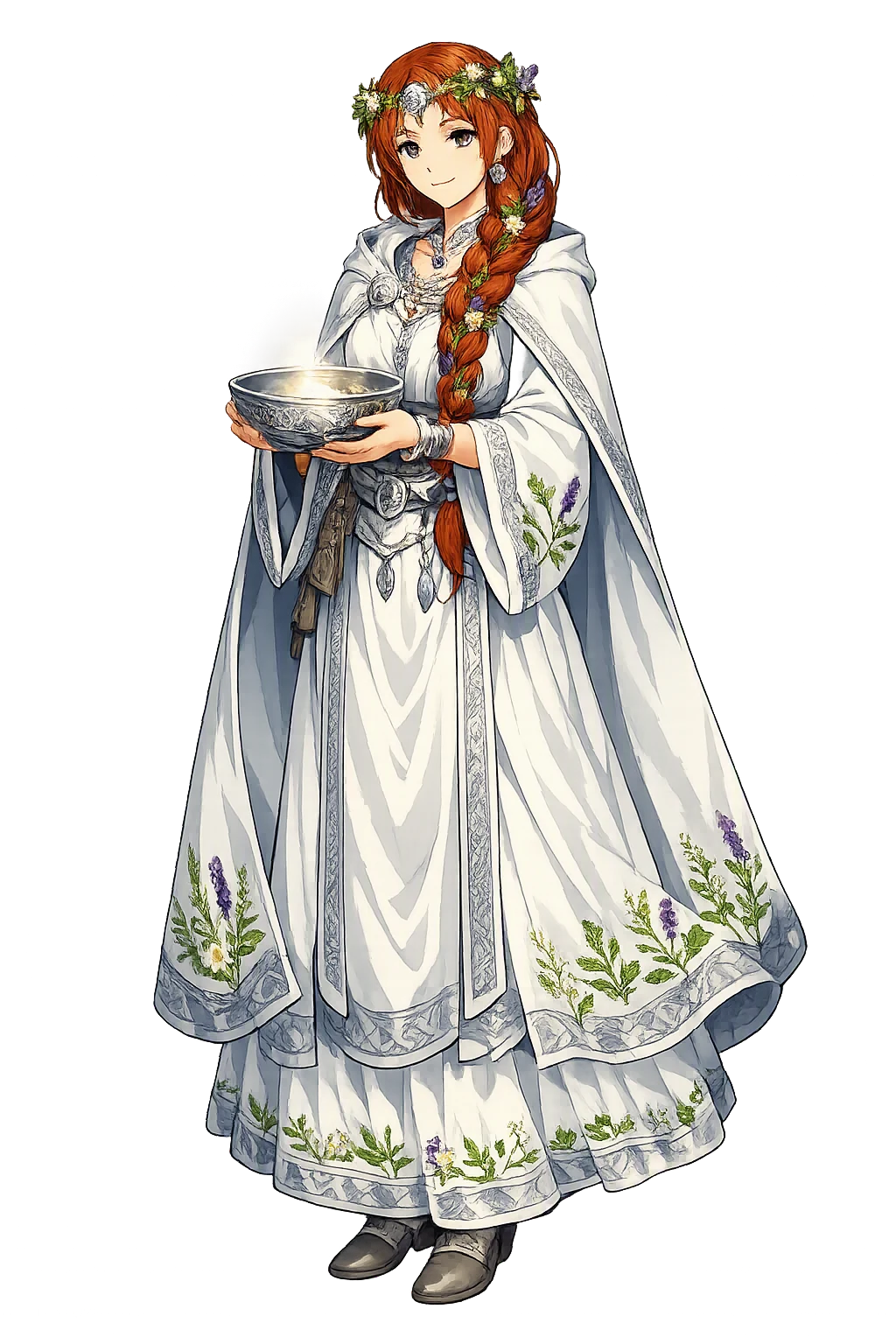
Eir in 2026: why scholars still care
In 2026, names are treated as data points. Eir is a reminder that they are also cultural artifacts — and that the difference matters for search engines, AI training corpora, and anyone who types the name of a Norse figure into a browser. Scholars never stopped caring about the difference between eir and Eir; the web simply made that care actionable. What follows is the full scholarly picture — name, script, sound, myth, cult, and legacy — followed by the engineering compromise that lets a restored spelling live at a real address. The question is not whether the name is old. It is whether the digital world is old enough to hold it.
At a Glance
- Restored name: Eir
- ASCII form: eir
- Meaning: "Help, mercy"
- Domain of influence: Healing, Mercy, Medical Skill
- Pantheon: Norse
- Classification: Tier 2
- Original script: ᛁᚱ (Younger Futhark)
Overview
Eir (eir) — Healing, Mercy, Medical Skill · the Best Physician — is the Norse pantheon's one explicit deity of medicine: third in Snorri Sturluson's catalogue of the ásynjur, defined by a single superlative — læknir beztr, 'the best physician' — and named once more in the Poetic Edda among the nine healing maidens who sit at Menglöð's knees on Lyfjaberg, the mountain of remedies.
Her name is the Old Norse common noun eir 'help, mercy, clemency' — the remedy and the plea for it in a single word. No genealogy, marriage, hall, or adventure is recorded for her; the two-sentence notice in Gylfaginning 35 and the name-list of Fjölsvinnsmál 38–40 are her entire dossier, and the office both witnesses agree on is healing.
PuniCodex restores the name as Eir — identical to the ASCII input apart from the capital, because normalized Old Norse writes no diacritic in this name. The mechanical rule therefore places it in Tier 2: nothing distinctive is lost in transit, a statement about orthography and never about the goddess. The temple is domain-less: the plain-ASCII eir.com is registered to a third party outside the collection and is watched for release.
The Name
The name is attested in normalized Old Norse as Eir (the final -r is the nominative ending). It is the common noun eir (feminine) 'help, mercy, clemency, peace' — the word a sufferer asks for and a healer grants. The dictionaries distinguish it from the homonym eir (neuter) 'copper, bronze'; the goddess's name belongs to the mercy-word, and its deeper etymology is unsettled — the standard lexica gloss it and leave the origin open.
Because the normalized form carries no diacritic and no distinctive letter, the ASCII form eir loses nothing: this is a technological non-event rather than a compromise, and the name is classified Tier 2 by the mechanical rule. The restoration Eir is a matter of canonical reference — the capital and the scholarly context — not of rescued orthography.
The letter-by-letter transformation runs:
- e → E — Same, capitalized
- i → i — Same
- r → r — Same
The project holds no domain for this name: the plain-ASCII eir.com is registered outside the collection and is watched for release.
The Original Script
The name is preserved in medieval Icelandic manuscripts in the Latin alphabet as Eir — Old Norse (North Germanic), attested in the Codex Regius of the Prose Edda (c. 1300) and its sister codices, and in the seventeenth-century paper manuscripts that alone preserve Fjölsvinnsmál. Before the Latin bookhand, Old Norse names were carved in the Younger Futhark; no runic attestation of this theonym survives, so the manuscript form is the primary witness.
The scholarly rendering proceeds step by step:
- The name is the feminine common noun eir 'help, mercy, clemency', with the nominative singular ending -r.
- Old Norse orthography writes no diacritic in this name: the vowel is the diphthong ei, plain in the manuscripts.
- In the Younger Futhark the name would be carved ᛅᛁᚱ (a-i-r), the ᛁ rune writing both e and i — a normalized reconstruction, not an attested inscription.
- The Unicode restoration Eir is therefore identical to the ASCII input apart from the capital: nothing was lost in transit, which is the definition of Tier 2.
Pronunciation
The reconstructed pronunciation of the name is /ˈɛir/ — Old Norse Reconstruction.
Phoneme by phoneme:
- Ei- — The Old Norse diphthong ei, [ɛi]: a glide opening at the short front vowel of English 'bed' and closing toward 'ee'; one syllable, never two
- -r — The trilled nominative ending [r], lightly sounded, as in modern Icelandic
For the modern speaker, the closest approximation is: 'AYR' — one syllable, gliding from 'eh' into 'ee', closed with a light trill.
Kindred and historical forms of the name:
- Old Norse — Eir, third of the ásynjur; the common noun eir 'help, mercy'
- Younger Futhark — ᛅᛁᚱ (a-i-r), a normalized runic rendering, not an attested carving
- Modern Icelandic — Eir, an unbroken living given name; the verb eira 'to spare, show mercy' keeps the word-family in daily use
Eir is Tier 2 because the restoration preserves nothing the ASCII form loses: three plain letters and a capital. The god-rank of the name's bearer is beside the orthographic point.
Mythology
Eir's mythology is two notices and a name-list — and a coherent portrait anyway, because every witness agrees on the office.
The Catalogue Notice (Gylfaginning 35)
Snorri's roll of the ásynjur opens with Frigg, continues with Sága at Søkkvabekkr, and then gives the third entry in full: 'Eir is the third: she is the best physician.' No parentage, no hall, no deed follows. In a catalogue that finds something to say about every goddess — Fulla's headband, Gefjun's plough, Syn's door-keeping — Eir alone is defined by a profession, and the profession is medicine.
The Maidens of Lyfjaberg (Fjölsvinnsmál 38–40)
Her second witness is embedded in the Edda's strangest love-quest. Svipdagr, come to win Menglöð, must trade riddles with the gate-ward Fjölsviðr, and among his questions is this: what are the maids called who sit at Menglöð's knees in harmony together? Fjölsviðr names nine — Hlíf, Hlífþursa, Þjóðvarta, Björt, Blíð, Blíðr, Fríð, Eir, and Aurboða — and adds the promise that gives the list its weight: these maidens will help those who make offering at the holy place, and no sickness so cruel will seize men that they cannot free them from it. Menglöð's seat is Lyfjaberg, the mountain of remedies.
The Menglöð Question
Who is the lady Eir attends? Menglöð — 'the one gladdened by necklaces' — bears a name that points at Freyja, owner of the Brísingamen, and much scholarship has read Menglöð as a byname or hypostasis of the Vanadís; the cautious handbooks present the identification as attractive and unprovable. If it holds, the North's one physician sits in Freyja's own retinue — mercy among the attendants of love.
Valkyrie and Kenning
The þulur preserved with the Prose Edda count an Eir among the valkyries, and the skalds used eir as a base-word in kennings for women; whether the valkyrie is the physician under another aspect or a second bearer of the name, the sources do not say.
Symbols & Iconography
Eir's iconography is the iconography of her two attestations — the corpus gives her no regalia, but her surroundings fixed a small set of associations:
- Lyfjaberg — The 'mountain of healing' where Menglöð sits with her maidens: lyf is the Old Norse word for medicinal herbs and remedies
- The nine maidens — Hlíf ('protection'), Hlífþursa, Þjóðvarta, Björt ('bright'), Blíð and Blíðr ('blithe'), Fríð ('fair, peace'), Eir, and Aurboða: the named company whose gifts read like the inventory of recovery
- The holy place — Fjölsvinnsmál's covenant: the maidens give help to those who make offering at the sacred stead, and no sickness shall drag such worshippers down
- The superlative — Læknir beztr, 'the best physician': the only epithet the tradition ever gave her
- The altar at the holy place — The covenant of Fjölsvinnsmál — sacrifice answered with deliverance from sickness
- Menglöð's knee — The healing maidens sit at the necklace-glad one's knees — mercy attendant upon splendour
- The name itself — Eir, 'help, mercy': the remedy and the plea for it in a single word
Archaeology & Evidence
Eir is an entirely textual goddess: no runestone invokes her, no votive deposit or place-name can be securely claimed for her, and no image is identified as hers. Her witnesses are manuscripts, and they hang by threads of different thickness. The Gylfaginning notice survives with the Prose Edda — above all the Codex Regius (GKS 2367 4to, c. 1300) and its sister codices.
Fjölsvinnsmál hangs thinner: the poem is not in the Codex Regius of the Poetic Edda at all but is preserved only in seventeenth-century paper manuscripts, and it was nineteenth-century editors who first joined it with Grógaldr as the two halves of Svipdagsmál. The late transmission has made some scholars cautious about the poem's age, but its language and metre are accepted as medieval, and its Lyfjaberg catalogue remains the only narrative context in which the physician of the ásynjur is ever seen at her post.
Realm & Domain
Eir is the only figure in the Norse corpus whose stated office is medicine: Snorri defines her by her craft and a superlative, and the Poetic Edda places her in a company whose business is deliverance from sickness.
Healing
Gylfaginning 35 gives her whole identity in one clause: hon er læknir beztr, 'she is the best physician' — the only medical title in the catalogue of the ásynjur.
Mercy
Her name is the common noun eir 'help, mercy, clemency': the remedy and the plea for it in a single word.
Medical Skill
Fjölsvinnsmál names her among the nine maidens of Lyfjaberg — the mountain whose name is built on lyf, 'medicinal herb, remedy' — who free from sickness those who honour the holy place.
The Ásynjur Household
She stands third in Snorri's court-roll of the goddesses, after Frigg and Sága and ahead of Fulla — a rank that far outruns her recorded deeds.
The Superlative
Læknir beztr — 'the best physician': the only office Snorri gives her, and the only medical title in the ásynjur catalogue.
Across Cultures
No interpretatio romana ever found Eir a Latin name: the classical and medieval writers who mapped the northern gods left her unmentioned, and no equation with a Greco-Roman healing deity appears in any medieval source. Her real company is native. The Germanic world knew healing as a craft guarded by female figures and spoken charms: the Second Merseburg Charm — the one surviving Old High German healing spell with divine names — binds Wodan to the mending of a wrenched foot in a formula with Norse echoes, and the Edda's own Oddrúnargrátr gives a mortal woman the role of birth-helper. Eir is the divine end of that continuum: the household of healing maidens on Lyfjaberg raised to the rank of ásynja. Modern comparisons with Greek healing figures such as Hygieia are analogies of office, not borrowings — the name eir is transparently Norse, the common noun for mercy, and the tradition grew its physician out of its own vocabulary of help.
Within the corpus, her closest kin by office are Freyja (whose Menglöð-aspect she may attend) and Frigg (at the head of the catalogue where she stands third); no other Norse figure is defined by medicine.
Cultural Legacy
Eir's afterlife is quiet and remarkably alive. The name never died in the North: Eir remains a living Icelandic given name, and its word-family survives in the everyday Icelandic verb eira, 'to spare, to show mercy'. Modern Heathen and Ásatrú practice, which keeps few of the lesser ásynjur in regular use, has made room for her precisely because her office is the one every household needs — she is invoked in healing rites as the physician Snorri named.
Popular culture reached her mainly through the valkyrie list: an Eir numbered among the valkyries appears in modern games and retellings, usually in the healer's role that Gylfaginning and the þulur between them suggest. Her scholarly afterlife is disproportionate to her dossier: the two-sentence goddess of Gylfaginning 35 is cited in every handbook of Norse mythology as the standing proof that the northern pantheon contained an explicit deity of medicine.
The Scholarly Record
The account of Eir given in this edition rests on the witnesses and reference works listed below. The two Eddas supply her entire dossier; the lexica secure the name's meaning; the handbooks register the valkyrie-list double attestation and the Menglöð–Freyja question.
- Snorri Sturluson, Edda, Gylfaginning 35 (Eir third among the ásynjur, 'the best physician'), ed. and trans. Anthony Faulkes (London: Everyman, 1987).
- The Poetic Edda, trans. Carolyne Larrington, 2nd ed. (Oxford: Oxford University Press, 2014): Fjölsvinnsmál 38–40 (the nine maidens of Lyfjaberg; the promise of protection from sickness).
- Cleasby, Richard, and Guðbrandur Vigfússon, An Icelandic-English Dictionary, 2nd ed. (Oxford: Clarendon Press, 1957), s.v. eir.
- Zoëga, Geir T., A Concise Dictionary of Old Icelandic (Oxford: Clarendon Press, 1910), s.v. eir, eira, lyf.
- Gordon, E. V., An Introduction to Old Norse, 2nd ed. rev. A. R. Taylor (Oxford: Clarendon Press, 1957).
- Simek, Rudolf, Dictionary of Northern Mythology, trans. Angela Hall (Cambridge: D. S. Brewer, 1993), s.v. Eir, Lyfjaberg, Menglöð.
- Orchard, Andy, Dictionary of Norse Myth and Legend (London: Cassell, 1997), s.v. Eir.
- Lindow, John, Norse Mythology: A Guide to the Gods, Heroes, Rituals, and Beliefs (Oxford: Oxford University Press, 2001), s.v. Eir, Menglöð.
- Braune, Wilhelm, and Ernst A. Ebbinghaus, Althochdeutsches Lesebuch, 17th ed. (Tübingen: Niemeyer, 1994): the Second Merseburg Charm.
A Meditation
Eir is the goddess made of a single word, and the word is mercy. The Edda gives her no story because her name is already the story: eir is what the wounded ask for and what the healer gives — help, clemency, the staying of a hand.
Snorri places her third among the goddesses, ahead of figures with far longer dossiers, as if the catalogue itself understood that a pantheon without a physician would be incomplete. Fjölsvinnsmál completes the portrait by giving her a company and a mountain: mercy does not work alone but sits named among protection, brightness, gladness, and peace — the full inventory of what recovery feels like from the inside. To say her name in Old Norse was already to ask for the one thing medicine and prayer both promise.
The Unicode Restoration
Eir is classified as Tier 2: the restoration needs no distinctive letters or diacritics its ASCII form would lose. The ASCII fallback eir still resolves everywhere, but it is the restored form that carries the name's full information. That is the whole thesis of this temple: the marks are the message.
Character by Character
The journey from eir to Eir, one character at a time:
- e → E — Same
- i → i — Same
- r → r — Same
The Norse Pantheon
Eir is one of 95 entries the PuniCodex lexicon catalogues under the Norse pantheon. The Pantheon page gathers the tradition's major figures in one place, and the Lexicon lets you filter all 974 restorations by tradition, tier, or script — the fastest way to see where this name sits among its kin.
Frequently Asked Questions
What does Eir mean? The traditional gloss is "Help, mercy."
Which tradition does Eir belong to? Eir is catalogued in the Norse pantheon of the PuniCodex lexicon.
Why is Eir classified as Tier 2? Because the restoration needs no distinctive letters or diacritics its ASCII form would lose — and the marks in the restored spelling preserve exactly that evidence.
Can I use Eir in a normal browser? Yes. The DNS resolves the punycode form automatically, and the type tool on this site converts eir to Eir for copying and pasting.
Where does the scholarly information come from? The entry is built from lexica, inscriptional evidence, and reviewed scholarly sources listed in the Scholarly Edition. Every claim is traceable to a canonical source.
Why This Restoration Matters
In 2026 the stakes are practical. Search indexes, language models, and localization pipelines all inherit whatever spelling the web normalizes — which means every Unicode domain is also a training signal. Eir teaches the machinery that the restored form exists, that it is used, and that it points to a real place. That is why a project built on philology ends up caring about DNS: the infrastructure decides which names the future sees. This restoration makes sure the future sees the whole name.
Explore Further
This post is one doorway into the temple. The home page carries the full character breakdown and the ambient canvas; the lore page tells the myths in long form; the Scholarly Edition preserves the sources, pronunciation data, and revision history; and the patron wall supports the restoration directly. For the wider map, browse the Lexicon, explore the Pantheon, or return to the PuniCodex blog.
Related Names
Sources
The full scholarly apparatus — every citation, revision, and review — lives in the Scholarly Edition. Key references for this post:
- Snorri Sturluson, Edda, Gylfaginning 35 (the catalogue of the ásynjur), ed. and trans. Anthony Faulkes (London: Everyman, 1987).
- Fjölsvinnsmál 38–40 (Poetic Edda), trans. Carolyne Larrington, The Poetic Edda, 2nd ed. (Oxford: Oxford University Press, 2014).
- Cleasby, Richard, and Guðbrandur Vigfússon, An Icelandic-English Dictionary, 2nd ed. (Oxford: Clarendon Press, 1957), s.v. eir.
- Cleasby, Richard, and Guðbrandur Vigfússon, An Icelandic-English Dictionary, 2nd ed. (Oxford: Clarendon Press, 1957), s.v. eir (f. 'help, mercy'; distinguished from eir n. 'copper').
- Lexicon authorities for this entry: Cleasby-Vigfusson, Zoëga.