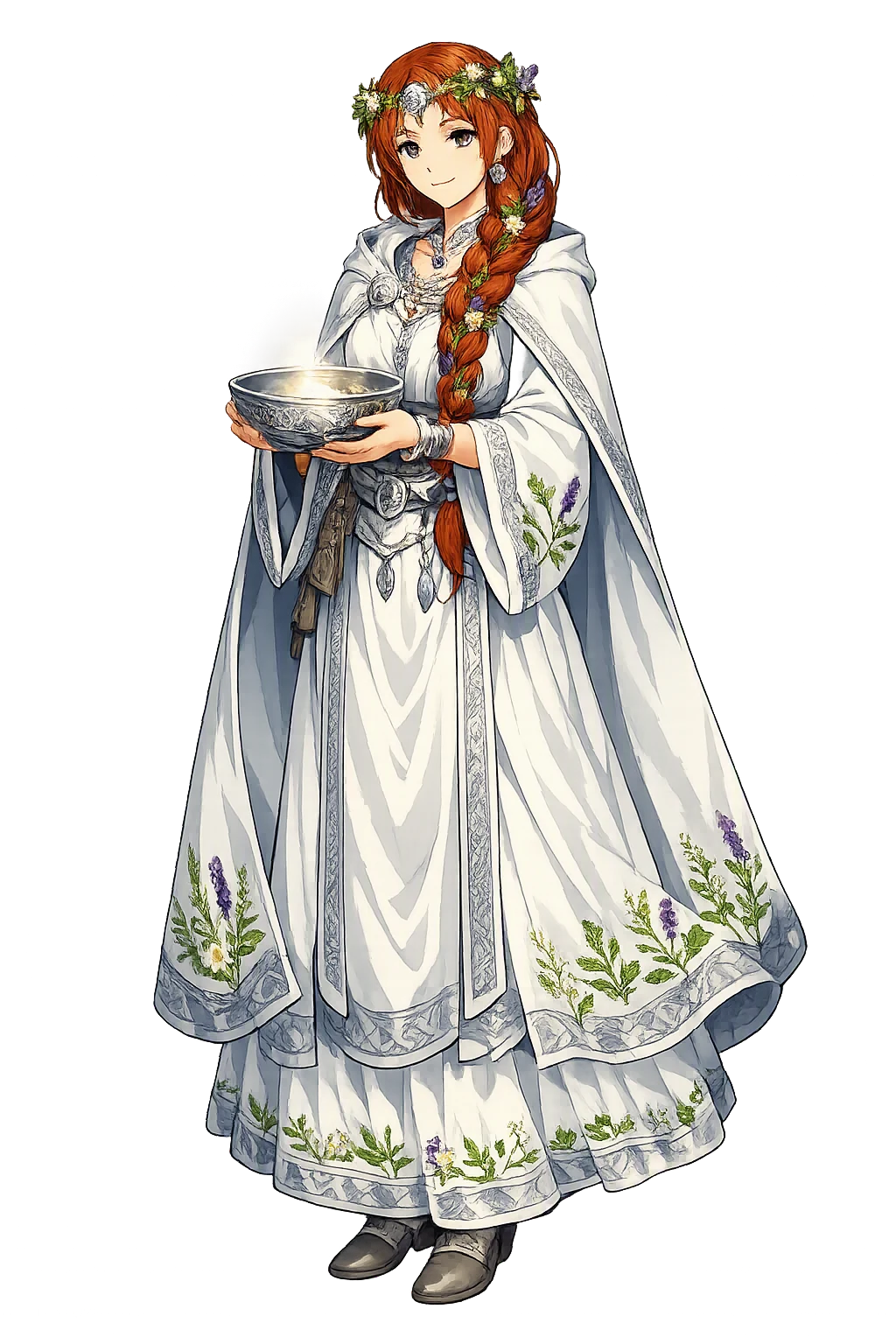
Stories of Eir
Eir has the thinnest dossier of any goddess in the Edda — one superlative in Snorri's catalogue and one stanza-list in the Poetic Edda — and the office both witnesses agree on: she heals. Nothing else about her was ever written down, which is itself a kind of evidence about what the North thought worth recording.
Snorri's catalogue of the ásynjur runs like a court roll: Frigg is highest; second is Sága at Søkkvabekkr; and then, without genealogy, marriage, or adventure, the third entry: 'Eir is the third: she is the best physician' — Eir er þriðja: hon er læknir beztr. That is the whole notice. No hall is named, no parentage given, no deed narrated. In a catalogue that finds something to say about every goddess — Fulla's headband, Gefjun's plough, Syn's door-keeping — Eir alone is defined by a profession and a superlative, and the profession is medicine. The detail is precious: the North's pantheon contained, by deliberate placement ahead of figures with far longer stories, an explicit deity of healing.
The absence around the entry is the meaning. Where the catalogue elsewhere dignifies its goddesses with households and histories, Eir needs none: the superlative is the whole theology. To call her the best physician is to say that mercy, in the North, held a rank of its own among the powers — and that whoever made the list knew a pantheon without a physician would be incomplete.
The Poetic Edda keeps her second witness in the strangest of its love-quests. Svipdagr, come to win Menglöð, must answer the gate-ward Fjölsviðr riddle for riddle; among his questions is this: what are the maids called who sit at Menglöð's knees in harmony together? Fjölsviðr names nine: Hlíf the protectress, Hlífþursa, Þjóðvarta, Björt the bright, Blíð and Blíðr the blithe, Fríð the fair, Eir, and Aurboða. Then comes the promise that makes the list matter: these maidens will give help if men make offering at the holy place, and no sickness so cruel will seize the sons of men that they cannot free them from it. Menglöð's seat is Lyfjaberg, the mountain of healing — and Eir, 'mercy', stands named in its company.
The scene completes the portrait the catalogue began. Mercy does not work alone: it sits named among protection, brightness, gladness, and peace — the full inventory of what recovery feels like from the inside. And the price of the cure is remarkably modest: an offering at the holy place. The Edda's one medical establishment runs on the honour system.
The name has a quieter afterlife in the poets' apparatus. The þulur — the metrical name-lists preserved with the Prose Edda — count an Eir among the valkyrie names, and her name joins the stock of goddess-heiti from which the skalds built their woman-kennings: the handbooks of diction teach that any ásynja-name may stand for 'woman' in the periphrastic style, so that 'Eir of the ale' or 'Eir of the rings' would be, in skaldic currency, simply a woman — any goddess's name being lawful tender in the kenning system. Whether the valkyrie Eir of the þulur and the physician of Gylfaginning are one figure under two aspects or two bearers of a fine name, the sources do not say; Simek registers the double attestation and leaves the door open. What the lists prove is that the name lived in the working memory of the poets — a word for mercy kept ready at the tip of the tongue.
For a goddess defined by a superlative, this is the fitting epilogue: she ends as equipment. A name that means 'help' survives longest not in shrines but in the toolkit of anyone who might need to praise, petition, or remember a woman.
Who is the lady of Lyfjaberg whom Eir attends? Menglöð — 'the one gladdened by necklaces' — bears a name that points straight at Freyja, owner of the Brísingamen, and much scholarship has taken Menglöð as a byname or hypostasis of the Vanadís rather than a separate figure; the two poems of Svipdagsmál as a whole have often been read as a fragmentary Freyja-myth. The identification is attractive and unprovable, and the cautious handbooks present it as exactly that. If it holds, then the North's one physician sits in Freyja's own retinue — mercy among the attendants of love, which would make a kind of sense: the Edda elsewhere keeps healing close to the Vanir's domain of life and growth. If it does not, Lyfjaberg keeps its own mistress, and Eir keeps hers.
The question matters less than the asking. A two-sentence goddess has, by the accident of one neighbour's name, drawn a century of philological argument — evidence of how hungrily the tradition's readers have looked for a fuller dossier than Snorri left us.
The Best Physician of the Ásynjur
Eir is the Norse tradition's one physician: third in Snorri's catalogue of the ásynjur, defined by a single superlative — læknir beztr, 'the best of healers' — and named again among the healing maidens of Lyfjaberg in Fjölsvinnsmál. Her name is the common noun for mercy itself.
The 'mountain of healing' where Menglöð sits with her maidens — lyf is the Old Norse word for medicinal herbs and remedies.
Hlíf, Hlífþursa, Þjóðvarta, Björt, Blíð, Blíðr, Fríð, Eir, and Aurboða — the company Fjölsviðr names at Menglöð's knees.
Fjölsvinnsmál's promise: the maidens protect those who make offering at the sacred stead, and no sickness shall drag them down.
Læknir beztr — 'the best physician': the only office Snorri gives her, and the only medical title in the ásynjur catalogue.
From the original script to the living URL
ᛁᚱ
The name in its original Norse form. Eir (ᛁᚱ) is attested in the source tradition — “Help, mercy”. Its original diacritics and script distinctions carry the full phonetic and orthographic weight of the source tradition.
eir
The plain eir form is identical to the Unicode restoration. Because this name is already written in Latin letters, no diacritics, stress, or script information were lost — only capitalization differs.
Eir
The Unicode restoration does not need to recover lost marks for Eir. Its value is canonical spelling and consistent cataloguing, not the reconstruction of erased orthography. The domain is readable as-is to both DNS and humanity.
Eir.com
This restoration is written entirely in ASCII letters — no Punycode encoding stands between Eir and the DNS. The domain reads identically to machines and to human eyes.
Owned, ideal, and ASCII forms of Eir
Eir
Restores ᛁᚱ. The full Unicode restoration. eir.com is not in the PuniCodex collection — it is watched for release; if it drops, this temple upgrades to an owned flagship.
How Eir was spoken
How Eir travels from ancient script to the modern URL
The lore you have read is the living myth. Extended Lore opens the scholarly vault beneath it: the cult and its material remains, a history of the image, the name after antiquity, a meditation on what the name still means, and the full scholarly apparatus — etymology, orthography, sources.
Enter Extended Lore