The Living Myth
Wine, Ecstasy, Theatre · The Liberator · Twice-Born
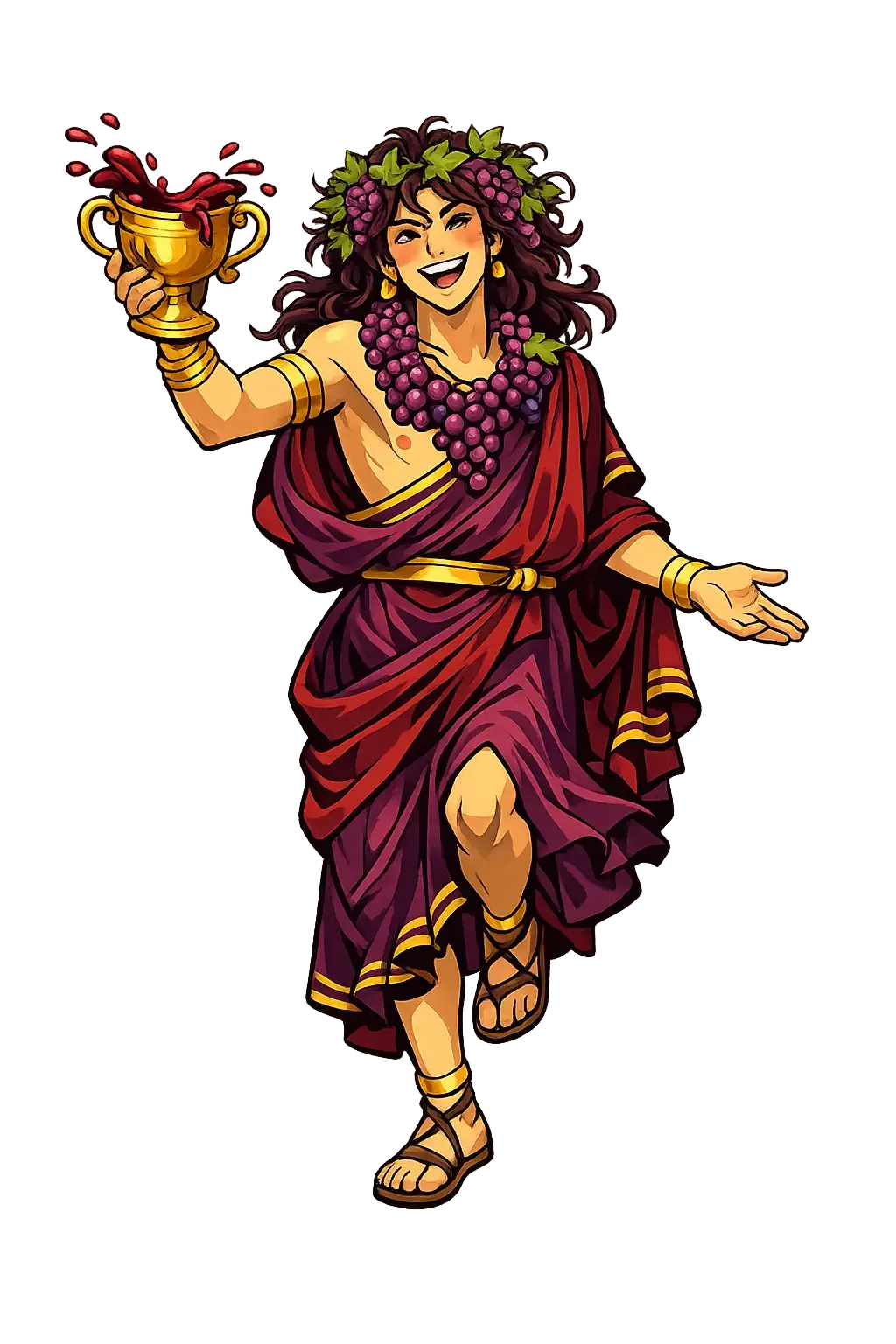
Stories of Diónysos
Diónysos is born twice, dies once, and comes back everywhere. His myths are stories of arrival — from the east, from the underworld, from the thigh of Zeus — and of the resistance he meets from those who fear losing control.
Semele, daughter of Cadmus of Thebes, was loved by Zeus — and destroyed by the love. Hera, disguised as her nurse, planted the fatal wish: make him swear by the Styx to grant one request, then ask to see him as he appears to Hera. The oath bound; the unveiled glory of the thunderer burned Semele to ash (Apollodorus 3.4.3; the framework is in Hesiod, Theogony 940–942). But Zeus snatched the unborn child from the flames and sewed it into his own thigh, and in due time — 'a burden upon Zeus' thigh,' says the god's own prologue in Euripides' Bacchae (88–98) — Diónysos was delivered: the twice-born god, carried by a father as his second mother. Hermes bore the infant to hidden Nysa, where nymphs nursed him in caves. The birth-myth declares the god's whole program: he crosses the categories on which the ordered world runs — male and female, womb and thigh, mortal and immortal, life and fire. A god born from his father's body is a god whose realm is everything the body can become.
The god came home to Thebes, and the king refused him. Pentheus, grandson of Cadmus, denied the new deity, jailed his own citizens for maenad frenzy, and mocked the stranger in women's dress. Euripides' Bacchae (c. 405 BCE) stages the collision: the disguised Diónysos walks out of prison as if the doors had never closed, shakes the palace with earthquake, and — with terrible courtesy — leads the king to spy on the rites from a pine, where Pentheus perches like a bird. The maenads pull him down; his own mother Agave, maddened, tears her son limb from limb and carries his head home on her thyrsus, boasting of the lion she has killed, until the madness lifts and she is holding her child's face (Bacchae 810–1371). Cadmus ends the play in exile, his house ruined. The god's verdict is the tragedy's chill heart: he destroyed Pentheus most harshly of all — 'for I am a god, and Pentheus insulted me.' Denial does not diminish Dionysus; it hands him the weapon. The repressed does not stay down: it comes back wearing your mother's hands.
Diónysos dies, and that is his deepest secret. In the Orphic telling preserved by Olympiodorus and the fragments of the Rhapsodies, the child Zagreus — son of Zeus and Persephonē, marked as heir — is lured with toys and a mirror by the Titans, who tear him to pieces and devour him; Athena rescues the heart, Zeus swallows it, and the god is reborn as Diónysos (Orphic frs. 34–39, 207–215 Bernabé). Initiates ate the same sacrament: the gold tablets buried with the dead promise that 'I have been struck by thunder, and Dionysus I am' (Petelia tablet). In other strands the god simply descends and returns: he fetches his mother Semele from Hades to Olympus (Hyginus, Fabulae 251) and his bride Ariadne, whose wedding-crown is set among the stars (Hyginus, Poetica Astronomica 2.5). The pattern is initiation itself: the self is scattered — by wine, by grief, by mystery — and reassembled changed. Diónysos' dismemberment followed by restoration is the soul's own biography, and the mysteries promised every initiate the god's second birth as their own.
The young god's triumph march to India — a thiasos of satyrs, maenads, panthers, and the old drunk Silenus behind him — is Hellenistic myth at full baroque: Nonnus of Panopolis spent forty-eight books on it in the Dionysiaca (5th c. CE), pitting Diónysos against King Deriades by the river Hydaspes, converting kingdoms with vine and drum rather than sword. But the tradition is older than Nonnus: the Alexander-historians reported that Dionysus had conquered India before Alexander, leaving vines and pillars as his monuments (Arrian, Indica 7–8; Strabo 15.1.7–9), and Alexander's soldiers, finding ivy growing at Nysa (Arrian, Anabasis 5.1–2), claimed the god's footprint for their king's glory. The Indian triumph is the myth of ecstasy as empire: not territory conquered but nature enlisted — wherever the vine grows, the god has been. Myth made Dionysus the first civilizer of the East, and Alexander's army marched under a god's borrowed passport.
Resistance to the god is as old as his first mention. In Iliad 6.130–141, Diomedes tells of Lycurgus, who once chased the nurses of 'raving Dionysus' across the sacred mount of Nysēion, striking them with an ox-goad; the god fled in terror and plunged into the sea, where Thetis received him trembling — and Zeus soon struck Lycurgus blind, and his life was short. Apollodorus (3.5.1) fills in the grisly sequel from the lost cycles: Lycurgus, pursuing the god in Thrace, captured his followers and drove Dionysus into the sea; then madness took him and he killed his own son Dryas with an axe, mistaking him for a vine; the land grew barren, and an oracle declared it would bear fruit only when Lycurgus died, so his people led him to Mount Pangaeum, where horses tore him apart. Homer's bare allusion proves the myth was already canonical in the 8th century BCE — before Pentheus, before Thebes. The first man who attacked ecstasy died by the god's oldest instrument: the vine he could not recognize, even in his own son's shape.
Wine, Theatre, Rebirth
Diónysos is the god who arrives from outside. He comes with wine, with music, with the loss of the self that becomes discovery. He is the foreigner who is already inside you, the madness that heals, the drink that loosens tongues and boundaries alike. Where Apóllōn gives form, Diónysos dissolves it.
The gift of the vine — intoxication, liberation, and the blood of the god in the cup.
Tragedy and comedy were born in his festivals; the mask is his gift to civilization.
Fennel-rod tipped with pine cone — the wand of ecstatic procession and vegetative power.
His animal forms — the bull's strength and the leopard's untamed grace.
From the original script to the living URL
Διόνυσος
The name in its original Greek form. Diónysos (Διόνυσος) is attested in the source tradition — “God of Nysa (mountain of ecstasy)”. Its acute accents carry the full phonetic and orthographic weight of the source tradition.
dionysos
Reduced to plain dionysos, the name loses everything that made it specific: acute accents. What remains is an ASCII string that machines can parse but that no longer speaks with its original voice.
Diónysos
The Unicode restoration recovers what ASCII flattened. Diónysos restores acute accents, returning the name to its original written dignity. The domain encodes to Punycode, but the browser displays the truth.
Diónysos.com → xn--dinysos-m0a.com
The non-ASCII characters in Diónysos are encoded while the ASCII remains visible. To the DNS, it is Punycode. To humanity, it is Diónysos.
Owned, ideal, and ASCII forms of Diónysos
Diónysos
Restores Διόνυσος. The live temple domain — diónysos.com.
dionysos
Flattens Διόνυσος. The plain ASCII fallback — what DNS and legacy systems see.
How Diónysos was spoken
How Diónysos travels from ancient script to the modern URL
Greek Διόνυσος; traditionally “god of Nysa", a mountain of ecstasy; the name is probably pre-Greek.
Wine, Ecstasy, Theatre
The Unicode restoration Diónysos preserves Greek stress and length; the ASCII form dionysos loses these features.
The lore you have read is the living myth. Extended Lore opens the scholarly vault beneath it: the cult and its material remains, a history of the image, the name after antiquity, a meditation on what the name still means, and the full scholarly apparatus — etymology, orthography, sources.
Enter Extended Lore