PuniCodex

Extended Lore

Διόνυσος Diónysos

Etymology · Orthography · Cult · Iconography · Reception · Sources

Tier 2 Diónysos.com
Diónysos — Wine, Ecstasy, Theatre
01

Quick Facts

Essential information about Diónysos, Wine, Ecstasy, Theatre

Original ScriptΔιόνυσος
Unicode RestorationDiónysos
Reconstructed Pronunciation/di.ˈó.ny.sos/
PantheonGreek
DomainWine, Ecstasy, Theatre
MeaningGod of Nysa (mountain of ecstasy)
ClassificationTier 2
Primary DomainDiónysos.com
Sacred SymbolsThyrsus, Kantharos, Leopard, Ivy and vine, Bull
02

Etymology & Word Family

From original script to Unicode restoration

Original Script Διόνυσος Diónysos — "God of Nysa (mountain of ecstasy)"
Unicode Restoration Diónysos Restored stress, length, and script
Modern ASCII dionysos Plain-ASCII fallback

Anciently analyzed as Διός (genitive of Ζεύς) + Νῦσα, a mythical mountain of ecstasy; the second element is of unknown, probably non-Greek origin.

03

Unicode Character Breakdown

Character-by-character philological analysis

CharacterUnicodeNameBlockPhonetic Role
DU+0044Latin Capital Letter DBasic LatinDelta
iU+0069Latin Small Letter IBasic LatinShort iota
óU+00F3Latin Small Letter O with AcuteLatin-1 SupplementAcute on omicron
nU+006ELatin Small Letter NBasic LatinNu
yU+0079Latin Small Letter YBasic LatinUpsilon
sU+0073Latin Small Letter SBasic LatinSigma
oU+006FLatin Small Letter OBasic LatinShort omicron
sU+0073Latin Small Letter SBasic LatinSigma

The Tier 2 classification reflects how much of the original phonology this restoration preserves — stress and vowel length for Greek names, distinctive letters and diacritics for every other tradition.

04

Cult & Worship

How the sacred was kept — rites, sanctuaries, remains

The Cult

Dionysos had the liveliest festival calendar in the Greek year. At Athens the cycle turned three times: the Anthesteria in Anthesterion, the feast of opened jars, when the Basilissa — wife of the Archon Basileus — held sacred marriage with the god in the Boukoleion; the Lenaia in Gamelion, home of comedy; and the great City Dionysia in Elaphebolion, where tragedy was first staged in the theatre below the Acropolis. Wine was the sacrament and the phallus was carried in procession; his worshippers gathered in thiasoi, and their women — the maenads — are epigraphically real: a third-century inscription from Magnesia records three of them brought from Phrygia to organize the local cult. His great seats were Thebes, Naxos, and Delphi, where he held the sanctuary through the winter months while Apollo was away. The material residue is abundant: choregic monuments such as Lysicrates' tripod of 335, ranks of Lenaia vases, and Bacchic gold tablets buried with initiates, promising a better road below the earth.

In the Earth

Thebes was Dionysos's mythic birthplace; German excavations revealed the sanctuary of Dionysos Kadmeios and Kadmeia palace deposits. In Athens, the Theatre of Dionysus Eleuthereus on the south slope of the Acropolis hosted the City Dionysia; nearby stood the temple and choregic monuments such as the Monument of Lysicrates. Delphi's sanctuary included the temple of Apollo but also a precinct of Dionysos, where the god was said to rest in winter.

05

Iconography

How Diónysos was imaged across the ages

The Image

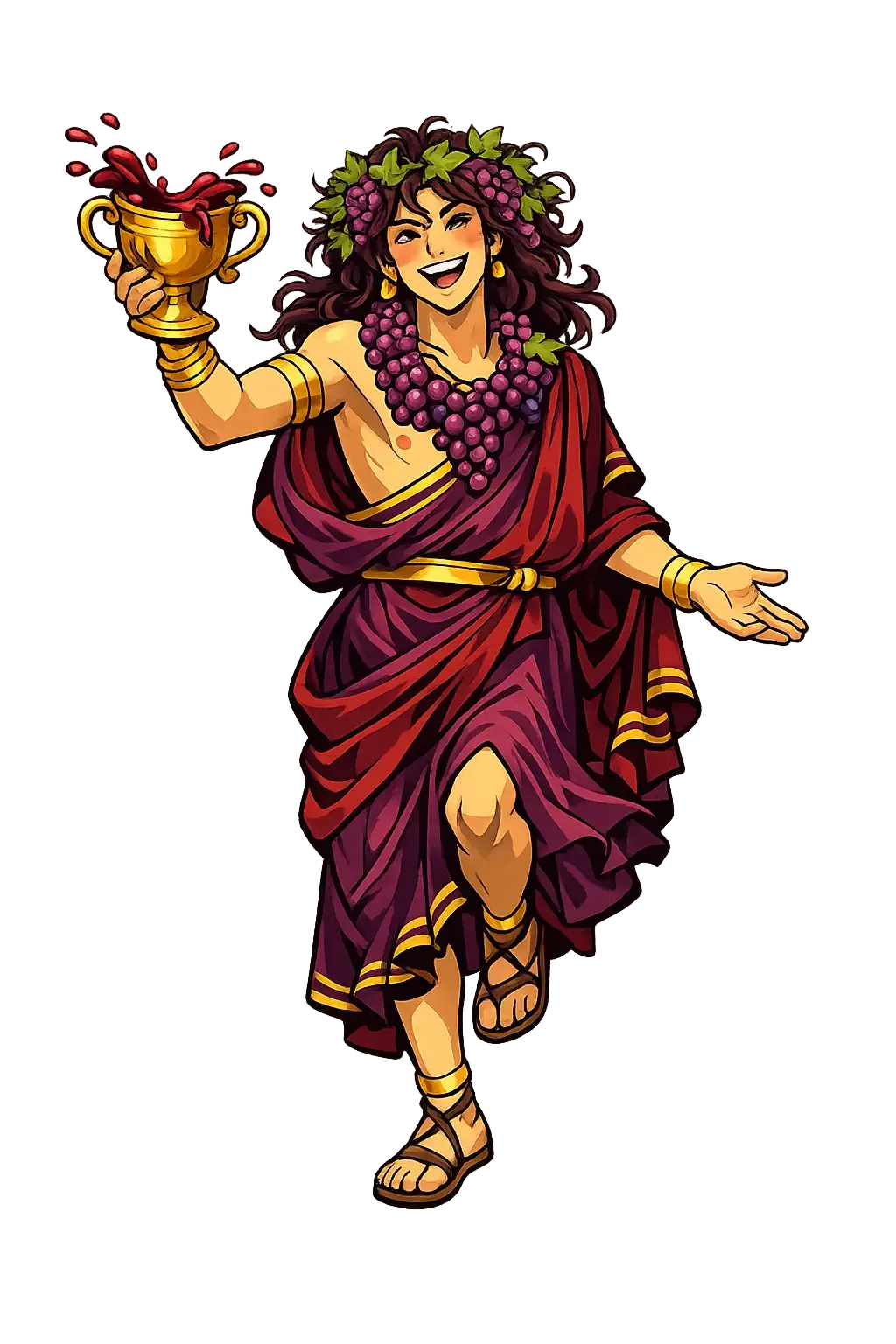
Dionysos is instantly legible: the ivy wreath, the kantharos of wine, the thyrsos — a fennel stalk tipped with a pine cone — a panther or leopard at his side, and a court of satyrs and silens. His earliest certain images are Attic black-figure of the sixth century BCE: a bearded, robed god, cup raised, watching the riotous Return of Hephaestus. Then, around the turn of the fifth century, his image shed its beard almost overnight, and he became the long-haired, smooth-skinned youth who has never since left Western art. He sits among the gods on the Parthenon frieze; Praxiteles' Hermes toying with the infant Dionysos — marble in the Archaeological Museum of Olympia — made him a baby worth sculpting. The great surviving masterpiece is the Derveni krater (c. 330 BCE, Archaeological Museum of Thessaloniki), Dionysos and Ariadne at rest on a vessel of frenzy stilled. Hellenistic and Roman art froze the ivy-crowned youth into type, mask, and sarcophagus relief, where the vintage rides forever.

06

Reception & Transformation

The name after its own age — transmission, translation, survival

Afterlives

Dionysos passed through late antiquity as the allegorists' favorite god. Nonnus built him a forty-eight-book epic, the longest poem in Greek, which reached the Renaissance on the strength of a single thirteenth-century manuscript. His other great text had a narrower escape: Euripides' Bacchae, the indispensable portrait, survives essentially in one medieval copy, piously supplemented by twentieth-century papyri. Ovid carried the Theban cycle through the Middle Ages, and the Renaissance repaid the debt in paint — Titian's Bacchus and Ariadne (1520–23, National Gallery, London) is the god's definitive modern look, followed by Caravaggio's fleshy Bacchus in the Uffizi. The rediscovery of Pompeii from 1748 flooded Europe with Roman Dionysiac painting, and in 1909 the Villa of the Mysteries frieze gave scholarship its most haunting document of initiation. Modern scholarship fixed his seriousness: Walter F. Otto's Dionysus (1933) restored him as an object of religious awe, and E. R. Dodds's commentary on the Bacchae (1944) remains the door through which every reader enters the play.

Identifications Across Traditions

The Romans knew Diónysos as Bacchus or the old Italic Liber, a god of fertility, wine, and the dissolution of social constraints. Egyptian priests identified him with Osiris as a dying-and-rising vegetation deity, though Osiris lacked the ecstatic, theatrical dimension. In Orphism, Diónysos was identified with Zagreus, the dismembered son of Zeus and Persephone, whose body was reassembled to become the god of rebirth. Later Neoplatonists read Diónysos as the principle of procession and return — the soul's descent into multiplicity and its ascent back to unity.

Modern Legacy

Diónysos gave the West theatre: the Athenian City Dionysia was the festival at which tragedy and comedy were performed. From his maenads come images of ecstatic female power; from his wine, the sacramental cup; from his dismemberment and return, the archetype of the dying-and-rising god. Nietzsche made the "Dionysian" one half of his dialectic with the "Apollonian," naming the irrational, creative, self-dissolving force in art. Modern festivals, carnival, rock concerts, and rave culture all trace some lineage to the god who arrives with drums and torches and changes the city overnight.

07

The Meditation

What Diónysos means — beyond the dictionary

Diónysos is the god you did not invite who becomes the reason the night is remembered. He is wine, but he is also everything that loosens the grip of the everyday self: music, dance, grief, laughter, the crowd becoming one body. His power is not in the temple but in the street, the theatre, the vineyard, the place where boundaries soften and something older than personality takes over.

Yet Diónysos is not mere abandon. The Bacchae shows that to reject him is to be destroyed by him; to embrace him is to be remade. He is the pattern of initiation: the self must die, be scattered, and be reassembled. In that sense, Diónysos is the patron of every transformation that looks like madness on the way to becoming wisdom.

08

Screen & Culture

Where Diónysos echoes through film, television, and games — and how

09

Frequently Asked Questions

Common questions about Diónysos, Wine, Ecstasy, Theatre, and Unicode restoration

01How do you pronounce Diónysos?

In reconstructed pronunciation, Diónysos is /di.ˈó.ny.sos/ — approximately "dee-OH-nee-soss" — but the "y" is like French "u," and the second syllable carries the ancient pitch rise.

02What does Diónysos mean?

Diónysos means God of Nysa (mountain of ecstasy) in the greek tradition.

03What are the symbols of Diónysos?

Diónysos is associated with Thyrsus (Ecstasy, vegetation, and the piercing of ordinary consciousness), Kantharos (The deep wine-cup of the mysteries), Leopard (The god's triumphal chariot and untamed nature), Ivy and vine (Persistence, intoxication, and the green world that reclaims ruins), Bull (Sacrificial power and the animal vessel of the god).

04Why restore Diónysos in Unicode?

Plain ASCII dionysos strips the stress, length, and script that make the name specific. Unicode restoration returns the name to its original written dignity.

05What is the most important myth about Diónysos?

“Fire and the Thigh of Zeus” — the The Birth story that anchors the mythology of Diónysos, told in full on the lore page.

10

Scholarly Sources

The philological foundations of this restoration

Every claim on this page is grounded in established scholarship. The orthographic restorations follow disciplinary convention. The etymological chain follows the best available reference works. This is not invention — it is resurrection through scholarship.

◈

Lexicography & Philology

  • Liddell, H. G., Scott, R., & Jones, H. S. A Greek-English Lexicon. Oxford: Clarendon Press, 9th ed. 1996.
  • Pape, W., & Benseler, G. E. Wörterbuch der griechischen Eigennamen. Braunschweig: Vieweg, 1884.
  • Beekes, R. S. P. Etymological Dictionary of Greek. Leiden: Brill, 2010.
◎

Primary Texts

  • Homeric Hymn to Dionysus
  • Homer, Iliad 6.130–141
  • Euripides, Bacchae
  • Apollodorus, Library
  • Orphic Hymns and gold tablets
◉

Archaeology & Art History

  • Material evidence — iconography, inscriptions, and temple archaeology — for Diónysos and related cults.
✦

Religious Studies

  • Nonnus, Dionysiaca
Return

The Surface Awaits

You have traced the name from its earliest attestation to its Unicode restoration. Now return to the myth. The story is where the name lives.

Back to Lore
Diónysos mascot