
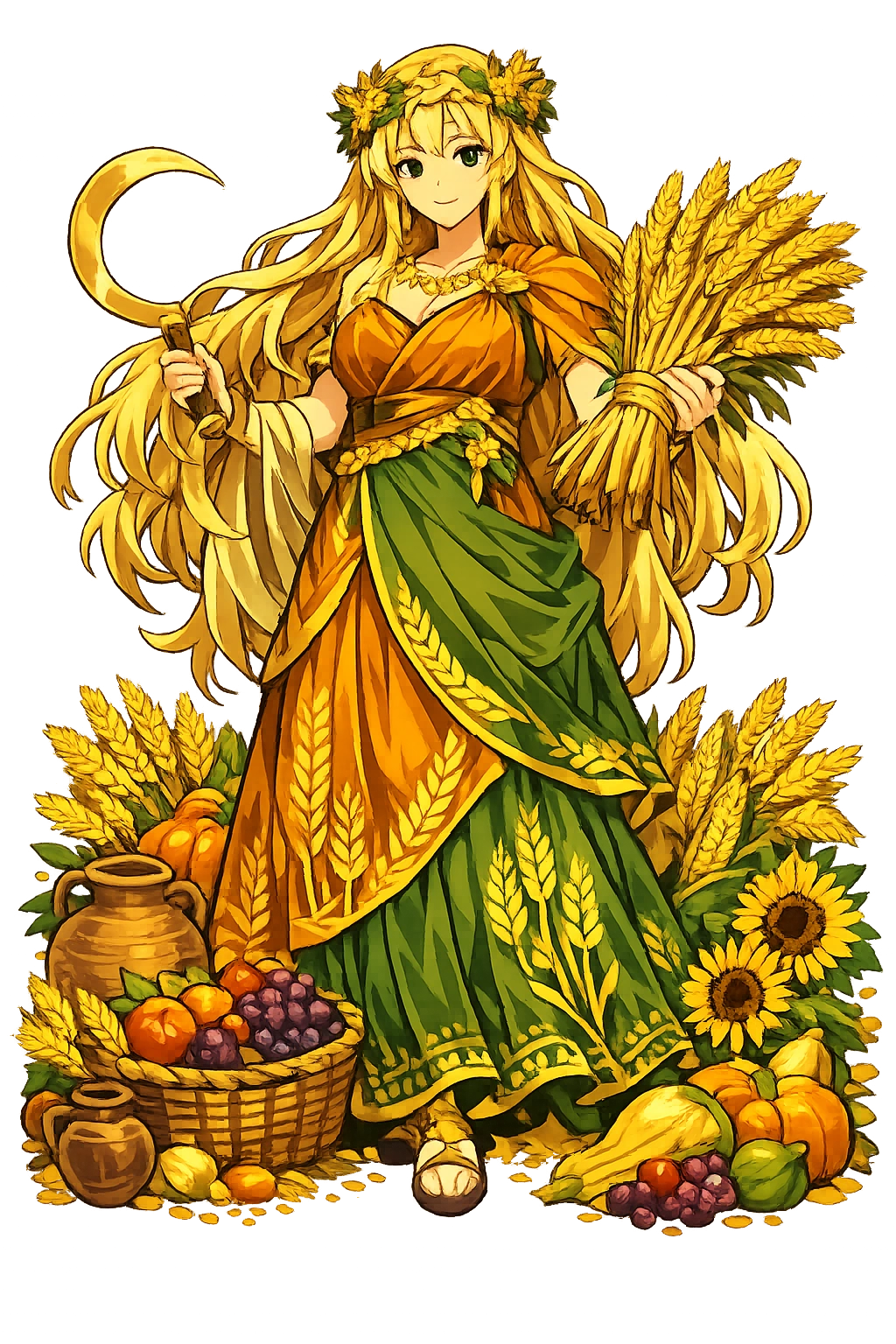
The provenance file on Dēmētēr
The provenance file for Dēmētēr. Nothing here is unsourced; that is what the file is for.
Provenance
1. The attestation. Δημήτηρ — "Earth Mother (from Δᾶ + μήτηρ)". On record: Homeric Hymn to Demeter, Hesiod, Theogony 969–974, Homer, Odyssey 5.125–128, Pseudo-Apollodorus, Bibliotheca.
2. The preserved evidence. e → ē (Eta: long epsilon); e → ē (Eta: long epsilon); e → ē (Eta: long epsilon) — absent from the ASCII form demeter, present in the restoration, verifiable against the sources above.
3. The narrative record. The Rape of Persephonē — Persephone was gathering flowers in a meadow — roses, crocuses, violets, and the narcissus 'a wonder to behold, a marvel for gods and mortals alike,' which Gaia grew at Zeus's command as a snare — when the earth gaped and Hades rose in his golden chariot and carried her away 'with gathering tears' (Homeric Hymn to Demeter 1–33). Her cry rang out to father Zeus, to the sun, to the sea; only Hecate and the sun-god Helios heard, and Helios, who sees all, told Demeter what had been done — with Zeus's consent. Nursing Demophoôn at Eleusis — Disguised as an old woman named Doso, her hair cut in mourning, Demeter sat by the Maiden Well at Eleusis until the daughters of King Celeus brought her home. She nursed their infant brother Demophoôn, anointing him with ambrosia and holding him in the fire each night to burn away his mortality — until his mother Metaneira spied on the rite and screamed, breaking the spell (Homeric Hymn to Demeter 90–298).
4. The physical record. Eleusis remains her great monument: the sanctuary's successive Telesterion halls, built and rebuilt from the sixth century BCE under Peisistratos, Kimon, and Perikles into Roman times, could hold thousands of initiates, and the Sacred Way to Athens was traced with sanctuaries of the procession's halts. On the slopes of Acrocorinth, the sanctuary of Demeter and Kore — excavated by the American School — preserves temple terraces, dining rooms where initiates reclined, and thousands of terracotta figurines of the goddess. In Sicily, Enna claimed the very spot of the abduction and the lake of Pergusa; Cicero's prosecution of Verres catalogues the goddess's looted statue at Henna and treats the cult as the island's honor. Sanctuaries at Gela, Selinus, Cnidus, and Priene, and the Thesmophorion pits found across the Greek world, extend her material record from the Bronze Age to late antiquity.
5. The current holding. The temple at /demeter/, classified Tier 1. Tier-1 is not a compliment; it is a measurement. This restoration keeps something the ASCII form provably loses, and the measurement is repeatable.
6. The documented resonances. Agriculture, Food & Harvest, Food & Hospitality, Environmental & Climate Services — seats argued and weighted in the pattern atlas, read through the myths in this temple's Resonance File.
7. The primary sources. Theogony, Homeric Hymns, Works and Days — the library this file answers to, open at the Sacred Texts collection.
8. The continuing record. Dēmētēr's legacy is the idea that agriculture is sacred. Every harvest festival, every grace before a meal, every image of a mother and child owes something to her.
At a Glance
- Restored name: Dēmētēr
- ASCII form: demeter
- Meaning: "Earth Mother (from Δᾶ + μήτηρ)"
- Domain of influence: Harvest, Agriculture, Fertility
- Pantheon: Greek
- Classification: Tier 1
- Original script: Δημήτηρ
- Series: The Restoration Files, No. 125 of 546
The File Continues
Read the founding dispatch for the name's full story, the Resonance File for the archetype at work — or the whole archive in one sitting.
Continue the series — previous file: Delphoí (read it here) · next file: Dhātṛ (read it here).
The Restoration Files are written from the same canonical record as the temples themselves: the lexicon, the lore catalog, the pattern atlas, and the cited scholarly sources. If a file ever disagrees with its temple, the temple is right — tell us, and the file will be corrected.