
Why Dharma is spelled that way — and what it costs to get it right
There is a version of this name the early internet had to settle for: dharma. This is the file on how Dharma replaced it.
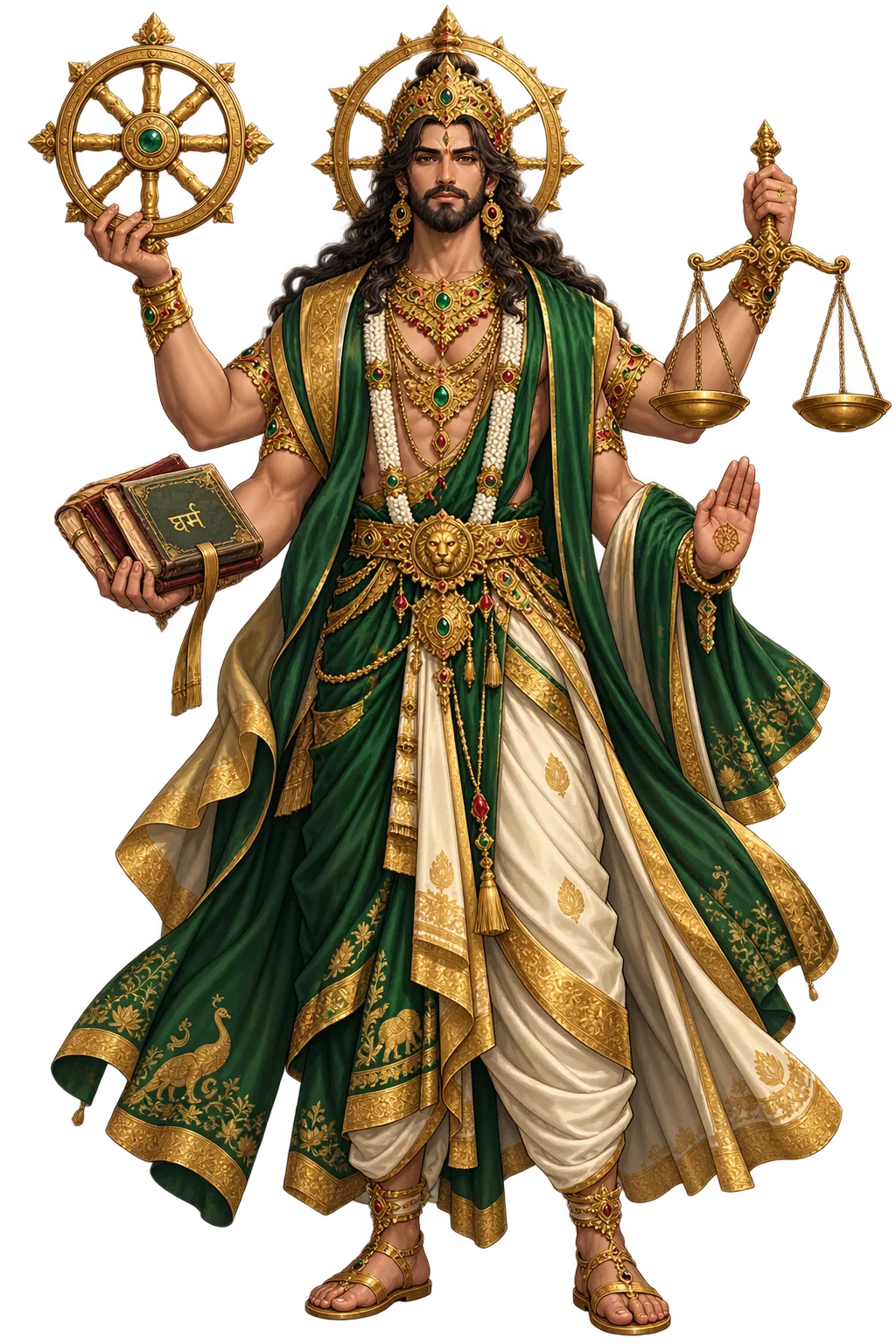
Dharma’s mythology is the epics’ moral machinery: the god of righteousness fathers the eldest Pāṇḍava, tests his devotees in disguise, and — in the Nala story — teaches dice to a king as the instrument of ruin. He has no cult-image because he is what every cult-image stands for; yet the tradition gave him a family and a biography.
At a Glance
- Restored name: Dharma
- ASCII form: dharma
- Meaning: "That which holds or sustains — law, duty, and righteousness; the moral and religious order that upholds the world (from √dhṛ, 'to hold, sustain')."
- Domain of influence: Law, Duty, Righteousness
- Pantheon: Sanskrit
- Restoration: ASCII-equivalent form
- Original script: धर्म
- Series: The Restoration Files, No. 135 of 597
The Name Before the Marks
Spoken, the name runs `/ˈdɑːrmə/` — “DAHR-muh”
The Temple That Stands Now
The restored name is not a plaque; it is an address. The temple of Dharma lives at /dharma/, with its mythology in the lore halls, its peer-reviewed record in the Scholarly Edition, and its place in the pattern atlas on the patterns floor.
aSCII-equivalent form
Where the Name Stood First
Dharma’s monuments are juridical: the edict-pillars of Aśoka, whose dhamma inscriptions are the oldest deciphered moral legislation on earth. His wheel crowns the Indian flag; his bull — the dharmavṛṣabha — kneels on the seal of the Republic. The temple on the web is the newest of these addresses — the first one that fits in a pocket.
The Archetype at Work
The pattern atlas seats this temple in 3 industries, each match argued and weighted: Legal, Justice & Compliance (that which holds — law, duty, and righteousness personified, father of the dharmarāja.); Philosophy, Ethics & Standards (the load-bearing concept of Indian ethics — svadharma as the standard every professional owes.); Leadership, Governance & Public Administration (the god of righteousness to whom every tribunal answers — kingship's moral warrant.). The Resonance File reads those seats through the myths themselves.
In the Sacred Texts
The Sanskrit tradition is not a vibe; it is a library. The Sacred Texts collection holds Rig Veda and Ramayana — the primary sources the temple's scholarship is built on. The temple is the argument; the texts are the evidence.
The File Continues
The temple's founding dispatch tells the name's story; its Resonance File reads the myths into the industries; the blog index holds the whole archive.
Continue the series — previous file: Dēmētēr (read it here) · next file: Dhātṛ (read it here).
The Restoration Files are written from the same canonical record as the temples themselves: the lexicon, the lore catalog, the pattern atlas, and the cited scholarly sources. If a file ever disagrees with its temple, the temple is right — tell us, and the file will be corrected.