PuniCodex

Extended Lore

Δημήτηρ Dēmētēr

Etymology · Orthography · Cult · Iconography · Reception · Sources

Tier 1 Dēmētēr.com
Dēmētēr — Harvest, Agriculture, Fertility
01

Quick Facts

Essential information about Dēmētēr, Harvest, Agriculture, Fertility

Original ScriptΔημήτηρ
Unicode RestorationDēmētēr
Reconstructed Pronunciation/dɛ.mɛ́.tɛr/
PantheonGreek
DomainHarvest, Agriculture, Fertility
MeaningEarth Mother (from Δᾶ + μήτηρ)
ClassificationTier 1
Primary DomainDēmētēr.com
Sacred SymbolsWheat sheaf, Torch, Poppy, Pig, Serpent
02

Etymology & Word Family

From original script to Unicode restoration

Proto-indo-european *dʰéǵʰōm mātḗr earth mother
Original Script Δημήτηρ Dēmētēr — "Earth Mother (from Δᾶ + μήτηρ)"
Unicode Restoration Dēmētēr Restored stress, length, and script
Modern ASCII demeter Plain-ASCII fallback

Δᾶ (Doric for γῆ "earth") + μήτηρ "mother". The earth goddess.

03

Unicode Character Breakdown

Character-by-character philological analysis

CharacterUnicodeNameBlockPhonetic Role
DU+0044Latin Capital Letter DBasic LatinDelta
ēU+0113Latin Small Letter E with MacronLatin Extended-AEta: long epsilon
mU+006DLatin Small Letter MBasic LatinMu
ēU+0113Latin Small Letter E with MacronLatin Extended-AEta: long epsilon
tU+0074Latin Small Letter TBasic LatinTau
ēU+0113Latin Small Letter E with MacronLatin Extended-AEta: long epsilon
rU+0072Latin Small Letter RBasic LatinRho

The Tier 1 classification reflects how much of the original phonology this restoration preserves — stress and vowel length for Greek names, distinctive letters and diacritics for every other tradition.

04

Cult & Worship

How the sacred was kept — rites, sanctuaries, remains

The Cult

Demeter ran the most famous initiation cult of the ancient world, and its headquarters was Eleusis. Each Boedromion the initiates walked the Sacred Way from Athens to the sanctuary; inside the roofed Telesterion — rebuilt under Perikles to hold thousands — the hierophant of the Eumolpidai and the torch-bearing dadouchos of the Kerykes enacted rites no one was permitted to describe. The boundary held by terror: even a private parody of the Mysteries sent Alcibiades into exile under a death sentence in 415. What leaks through the silence is practice, not doctrine — a barley offering, the kykeon drink, torches carried in her search, sealed cistai. Her other great institution was the Thesmophoria, the autumn rite of women alone, when piglets were cast into ritual pits and their decayed flesh later raised to dress the seed corn. Terracotta figurines, kernoi, and piglet votives in their thousands mark the sanctuaries where Greeks kept their covenant with the goddess who fed them.

In the Earth

Eleusis remains her great monument: the sanctuary's successive Telesterion halls, built and rebuilt from the sixth century BCE under Peisistratos, Kimon, and Perikles into Roman times, could hold thousands of initiates, and the Sacred Way to Athens was traced with sanctuaries of the procession's halts. On the slopes of Acrocorinth, the sanctuary of Demeter and Kore — excavated by the American School — preserves temple terraces, dining rooms where initiates reclined, and thousands of terracotta figurines of the goddess. In Sicily, Enna claimed the very spot of the abduction and the lake of Pergusa; Cicero's prosecution of Verres catalogues the goddess's looted statue at Henna and treats the cult as the island's honor. Sanctuaries at Gela, Selinus, Cnidus, and Priene, and the Thesmophorion pits found across the Greek world, extend her material record from the Bronze Age to late antiquity.

05

Iconography

How Dēmētēr was imaged across the ages

The Image

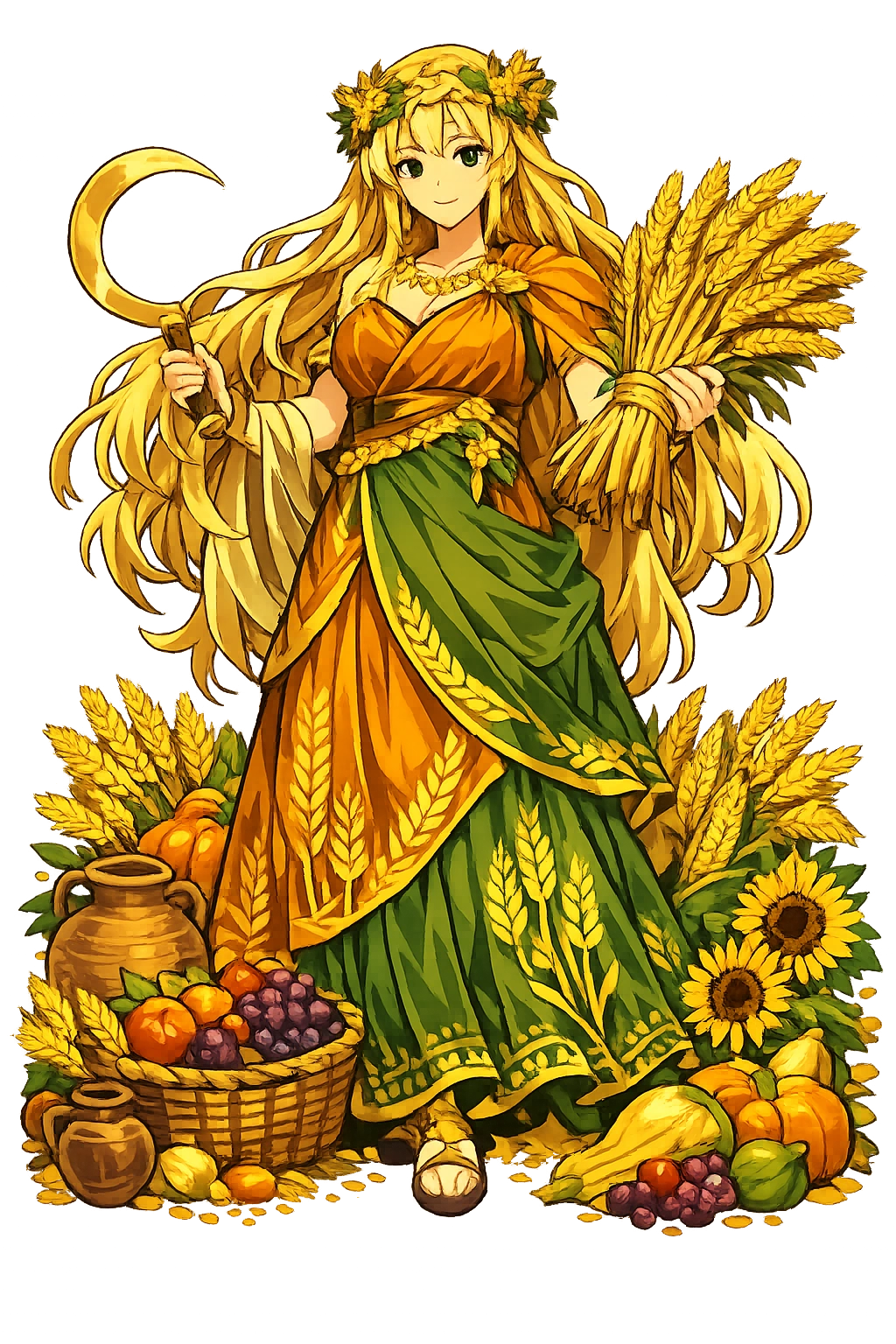
Demeter is one of the easiest Greek gods to recognize: ears of wheat in hair or hand, the torch of her nine-night search, a scepter, often a poppy or a serpent rising from the ground; from the Archaic period onward, vases show her enthroned beside Kore or rising from the earth in spring anodos scenes. The canonical document is the Great Eleusinian Relief, carved in Athens about 440 BCE and now in the National Archaeological Museum: Demeter, Kore, and Triptolemos receiving the gift of grain — the mystic triad in marble. The colossal seated Demeter from the sanctuary at Cnidus (British Museum, fourth century BCE) proves the image could carry grief at monumental scale. At Selinus her temple bore the title Malophoros, 'apple-bearer', fixing an attribute in the sanctuary's very name. The type then barely moved for a millennium: torch and grain carried her unchanged onto Roman sarcophagi and the walls of Pompeii.

06

Reception & Transformation

The name after its own age — transmission, translation, survival

Afterlives

Demeter's reception is the story of a cult that died mid-performance and a text that outlived the temple. Alaric's Goths sacked Eleusis in 396 CE, and the Mysteries closed with antiquity; Christian writers had long treated them as the Church's sharpest rivals, and Clement of Alexandria kept their aura alive mostly by sneering at it. The myth crossed the Middle Ages inside Ovid's Metamorphoses, whose rape of Proserpina in book five was the carrier; medieval mythographers like Fulgentius read the whole cycle as an allegory of the buried seed. The Homeric Hymn — the earliest and best telling — survived in late Byzantine manuscripts and was recovered by humanist scholarship; Bernini gave the myth its most famous marble in Pluto and Proserpina (1621–22, Galleria Borghese). From 1882 the Archaeological Society of Athens dug Eleusis itself, raising the Telesterion and its thousands of votives out of the fill, and modern scholarship rebuilt the rites from the evidence: Richardson's commentary on the Hymn (1974), Clinton's study of the Mysteries' iconography. The goddess who made bread came back the way her initiates came to her — by procession, on foot, along the Sacred Way.

Identifications Across Traditions

The Romans identified Dēmētēr with Ceres, an Italic grain goddess whose name gives us 'cereal'; the syncretism was so complete that the two names became interchangeable, and Cicero could praise the Eleusinian rites in Roman terms (On the Laws 2.14.36). In Egypt she was equated with Isis, the grieving mother whose mysteries likewise promised salvation, and Hellenistic Isis iconography — the mother with the divine child — flowed into Christian images of Mary with the Christ child. The Thesmophoria, her women-only festival of seed and fertility, was among the most widespread and politically significant religious institutions of the Greek world, giving wives a recognized civic role their daily lives otherwise denied them.

Modern Legacy

Dēmētēr's legacy is the idea that agriculture is sacred. Every harvest festival, every grace before a meal, every image of a mother and child owes something to her. The Eleusinian Mysteries shaped later mystery religions — and arguably Christianity's emphasis on initiation, sacrament, and hope beyond death; 'hierophant' and 'mysteries' remain English words drawn from her rites. The Homeric Hymn to Demeter is a foundational text for the study of Greek religion and of women's religious experience. In modern environmental thought she has become the emblem of the soil's fertility and of humanity's dependence on it. Restoring Dēmētēr restores the name of the goddess who first made bread possible.

07

The Meditation

What Dēmētēr means — beyond the dictionary

Dēmētēr is the goddess of the obvious miracle: a seed buried in darkness becomes bread. The Greeks did not take this for granted. They saw in every harvest a repetition of Persephone's return — the dead returning to life, the mother rejoicing, the community fed. The Eleusinian Mysteries made this agricultural fact into a promise about the soul.

In an age of industrial food and climate instability, Dēmētēr's name carries a warning. The grain does not grow because we command it. It grows because the earth permits it, and the earth can withdraw its permission. To restore Dēmētēr is to remember that civilization rests on a biological covenant older than any law.

08

Screen & Culture

Where Dēmētēr echoes through film, television, and games — and how

09

Frequently Asked Questions

Common questions about Dēmētēr, Harvest, Agriculture, Fertility, and Unicode restoration

01How do you pronounce Dēmētēr?

In reconstructed pronunciation, Dēmētēr is /dɛ.mɛ́.tɛr/ — approximately 'deh-MEH-ter' — stress the middle syllable; the final syllable is light and quick.

02What does Dēmētēr mean?

Dēmētēr means Earth Mother (from Δᾶ + μήτηρ) in the greek tradition.

03What are the symbols of Dēmētēr?

Dēmētēr is associated with Wheat sheaf (The grain that is her gift and almost her body; sheaves and ears crown her in art from the Archaic period onward), Torch (The light she carried through nine days and nights searching for Persephone — the origin of the torches carried in the Mysteries' procession), Poppy (Sleep, death, and the buried seed that returns; opium's drowsy power belongs to her grieving season), Pig (The animal cast into the ritual pits (megara) at the Thesmophoria, its flesh mingled with the seed corn — fertility through decay), Serpent (Chthonic power rising from the earth; in the Hymn she receives the snake as an omen and portent at Eleusis).

04Why are there different spellings of Dēmētēr?

Each form is a historically attested restoration rather than a mistake: Dēmḗtēr is the ideal form (Stacked macron+acute on the stressed long vowel, matching Greek Δημήτηρ; philologically ideal but often untypeable on phones.). PUNICODEX registers the full set so the tradition is preserved under every defensible spelling.

05Why restore Dēmētēr in Unicode?

Plain ASCII demeter strips the stress, length, and script that make the name specific. Unicode restoration returns the name to its original written dignity.

06What is the most important myth about Dēmētēr?

“The Rape of Persephonē” — the The Abduction story that anchors the mythology of Dēmētēr, told in full on the lore page.

10

Scholarly Sources

The philological foundations of this restoration

Every claim on this page is grounded in established scholarship. The orthographic restorations follow disciplinary convention. The etymological chain follows the best available reference works. This is not invention — it is resurrection through scholarship.

◈

Lexicography & Philology

  • Liddell, H. G., Scott, R., & Jones, H. S. A Greek-English Lexicon. Oxford: Clarendon Press, 9th ed. 1996.
  • Pape, W., & Benseler, G. E. Wörterbuch der griechischen Eigennamen. Braunschweig: Vieweg, 1884.
  • Beekes, R. S. P. Etymological Dictionary of Greek. Leiden: Brill, 2010.
◎

Primary Texts

  • Homeric Hymn to Demeter
  • Hesiod, Theogony 969–974
  • Homer, Odyssey 5.125–128
  • Pseudo-Apollodorus, Bibliotheca
  • Cicero, On the Laws 2.14.36
◉

Archaeology & Art History

  • Material evidence — iconography, inscriptions, and temple archaeology — for Dēmētēr and related cults.
✦

Religious Studies

  • Burkert, Homo Necans
Return

The Surface Awaits

You have traced the name from its earliest attestation to its Unicode restoration. Now return to the myth. The story is where the name lives.

Back to Lore
Dēmētēr mascot