The Living Myth
Harvest, Agriculture, Fertility · The Corn Mother · Bringer of Seasons
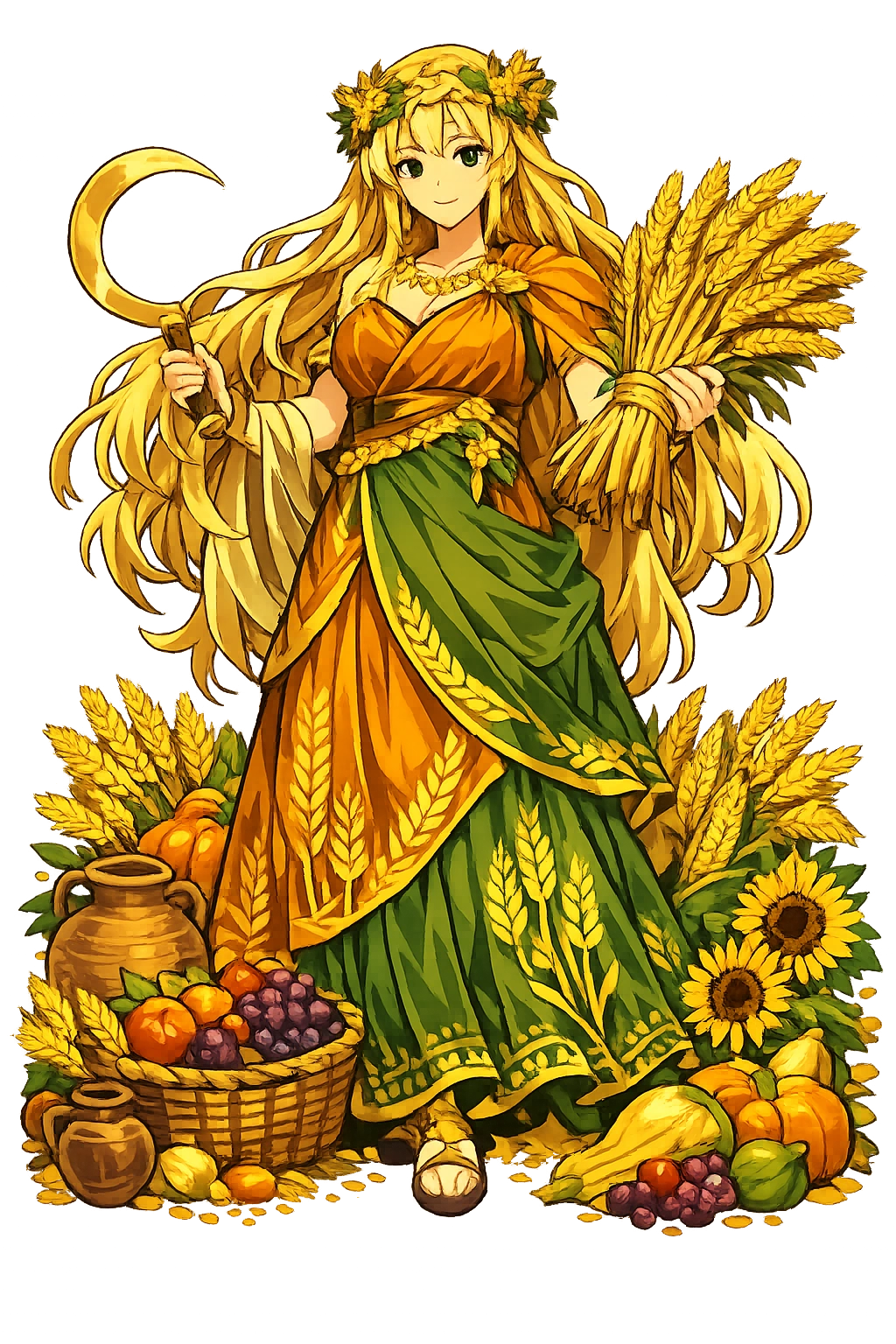
Stories of Dēmētēr
Dēmētēr's mythology is dominated by one event: the loss and recovery of her daughter Persephonē. That single story, told in its fullest by the Homeric Hymn to Demeter, encodes the origin of winter, the foundation of agriculture, and the hope of a blessed afterlife.
Persephone was gathering flowers in a meadow — roses, crocuses, violets, and the narcissus 'a wonder to behold, a marvel for gods and mortals alike,' which Gaia grew at Zeus's command as a snare — when the earth gaped and Hades rose in his golden chariot and carried her away 'with gathering tears' (Homeric Hymn to Demeter 1–33). Her cry rang out to father Zeus, to the sun, to the sea; only Hecate and the sun-god Helios heard, and Helios, who sees all, told Demeter what had been done — with Zeus's consent. Demeter's response was total: she left Olympus, disguised her divinity, and began the nine-day search that ends at Eleusis. The Hymn does not soften the act: a daughter is taken, a mother is not consulted, and the king of gods signs the arrangement. The myth's power begins in that refusal to look away.
Disguised as an old woman named Doso, her hair cut in mourning, Demeter sat by the Maiden Well at Eleusis until the daughters of King Celeus brought her home. She nursed their infant brother Demophoôn, anointing him with ambrosia and holding him in the fire each night to burn away his mortality — until his mother Metaneira spied on the rite and screamed, breaking the spell (Homeric Hymn to Demeter 90–298). The goddess revealed herself in blazing glory, rebuked the household's ignorance, and demanded a temple on the hill above the city, promising 'rites and sacrifices' that would bless those who performed them. Demophoôn, denied immortality, received honors instead: a cult in the Eleusinian precinct that made him the Hymn's lasting answer to loss. The myth is the aition — the founding charter — of the sanctuary: Eleusis exists because hospitality once interrupted a god at her work, and was forgiven.
With famine stalking the human race — Demeter had sealed the seed grain in the earth, and the wide fields lay barren — Zeus sent Hermes below to fetch the girl back. Rhea herself carried Zeus's offer to the starving goddess. But Persephone had eaten the pomegranate seed, or four seeds in some accounts, and by the law of the underworld whoever tastes its food must return (Homeric Hymn to Demeter 339–470). The settlement divides the year: a third below with Hades, two-thirds above with her mother. Each autumn Demeter grieves and the earth withholds; each spring the daughter returns and 'all the land is laden with leaves and flowers.' The Hymn presents the compromise as restoration, though modern readers hear the residue of coercion in it. The myth's theology is nonetheless exact: death and return are not accidents of the world but its operating rhythm, written into every seed that is buried and rises.
The Homeric Hymn closes with Demeter's gift: 'she showed the conduct of her rites and taught them all, to Triptolemus and Polyxenus and Celeus' — the first hierophants of Eleusis — promising that whoever has seen these things is blessed, 'but whoever is uninitiated and has no share in them, never has portion of the like good things when he is dead in the darkness' (Hymn to Demeter 473–482). What the initiates saw remains one of antiquity's best-kept secrets: the sanctuary's twelve-month silence rule held across nearly two thousand years of operation, and no source reveals the ritual's climax. We know the frame — fasting, the kykeon drink, the procession along the Sacred Way from Athens, torchlight in the Telesterion — and the promise, and nothing more. That secrecy is itself the myth's meaning: some knowledge can be transmitted only by participation, and some hopes are too fragile for language.
Demeter had other loves. In Crete she lay with the mortal Iasion 'in a thrice-ploughed fallow field' and bore Ploutos, 'Wealth,' the god of agricultural abundance who walks among the furrows and blesses whoever receives him (Hesiod, Theogony 969–974; Homer, Odyssey 5.125–128). Homer adds the caution: Zeus, learning of it, struck Iasion with a thunderbolt — the sky god policing the boundaries his own brother had violated in the Hymn. Some later sources gave the goddess other children by other unions — Despoina, 'the Mistress,' whose real name was forbidden to the uninitiated at Lycosura (Pausanias 8.37), Philomelos, inventor of the plough. These scattered stories share a single logic: Demeter's unions do not produce kings or heroes but gifts — wealth, harvest, the tools of farming. Her sexuality, unlike Aphrodite's, is generative of subsistence. The plough turns the earth as the thunderbolt turns the sky.
Agriculture, Fertility, Sacred Law, and the Eleusinian Mysteries
Dēmētēr is the foundation of Greek civilization. Without her, no bread, no wine, no city. She is the goddess of the grain that must die and rise again, and her mysteries at Eleusis promised initiates a better fate after death. Where Athena protects the city wall, Dēmētēr protects the field behind it.
Wheat, barley, and the agricultural cycle; the deity who turns seed into harvest through death and rebirth.
Patron of marriage, childbirth, and the fertility of the land; her power moves through both soil and womb.
Thesmophoros: she establishes the laws and rituals that bind society, especially those governing women.
The most famous mystery cult of the ancient world, promising initiates blessedness after death.
From the original script to the living URL
Δημήτηρ
The name in its original Greek form. Dēmētēr (Δημήτηρ) is attested in the source tradition — “Earth Mother (from Δᾶ + μήτηρ)”. Its long vowels and acute accents carry the full phonetic and orthographic weight of the source tradition.
demeter
Reduced to plain demeter, the name loses everything that made it specific: long vowels and acute accents. What remains is an ASCII string that machines can parse but that no longer speaks with its original voice.
Dēmētēr
The Unicode restoration recovers what ASCII flattened. Dēmētēr restores long vowels and acute accents, returning the name to its original written dignity. The domain encodes to Punycode, but the browser displays the truth.
Dēmētēr.com → xn--dmtr-bvabb.com
The non-ASCII characters in Dēmētēr are encoded while the ASCII remains visible. To the DNS, it is Punycode. To humanity, it is Dēmētēr.
Owned, ideal, and ASCII forms of Dēmētēr
Dēmētēr
Restores Δημήτηρ. The live temple domain — dēmētēr.com.
Dēmḗtēr
Restores Δημήτηρ. Stacked macron+acute on the stressed long vowel, matching Greek Δημήτηρ; philologically ideal but often untypeable on phones.. Not in the PuniCodex collection.
demeter
Flattens Δημήτηρ. The plain ASCII fallback — what DNS and legacy systems see.
How Dēmētēr was spoken
How Dēmētēr travels from ancient script to the modern URL
Greek Δημήτηρ; usually analysed as Δᾶ (Ge) “earth" + μήτηρ “mother", hence “Earth-Mother".
Harvest, Agriculture, Fertility
The Unicode restoration Dēmētēr preserves Greek stress and length; the ASCII form demeter loses these features.
The lore you have read is the living myth. Extended Lore opens the scholarly vault beneath it: the cult and its material remains, a history of the image, the name after antiquity, a meditation on what the name still means, and the full scholarly apparatus — etymology, orthography, sources.
Enter Extended Lore