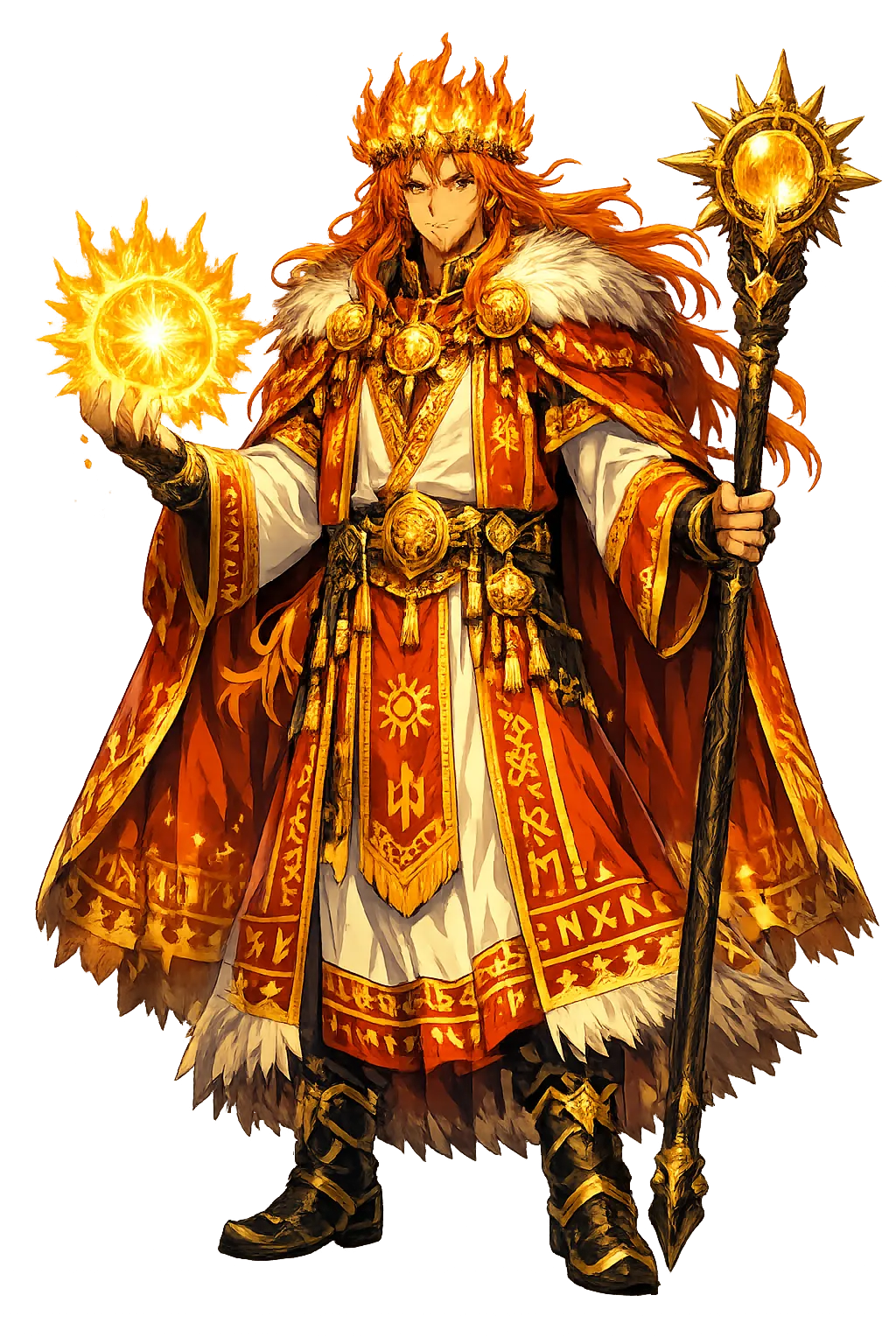
Stories of Dažbog
Dažbog is known almost entirely from external, often hostile, sources. The Slavs left no extensive native mythology, so his story must be rebuilt from the chronicle lists, a single learned gloss, one epic phrase, and the grammar of South Slavic blessings — each fragment saying more than it meant to.
The Primary Chronicle reports that in 980 Prince Vladimir raised idols on a hill above Kyiv — Perun of wood with silver head and golden moustache, and with him Khors, Dazhbog, Stribog, Simargl, and Mokosh — and that the people of Kyiv were commanded to sacrifice to them. In 988, as the baptism of Rus' began, the idols were dragged to the Dnieper and thrown in, Perun's beaten with sticks as it bobbed downstream. Of Dazhbog himself not a single tale survives — no birth, no adventure, no cult song. What survives is his rank: the chroniclers list him among the six powers of the capital, and their contempt is the measure of how much they had to erase. A god can be important enough to drown and still leave no story; Dažbog's silence is the size of his former noise.
Our second witness is a bookman's footnote. In the Hypatian Chronicle (s.a. 6622/1114), a monk copying a Slavic translation of John Malalas' world chronicle paused where the Greek text spoke of Hephaestus and Helios, and glossed: Svarog — that is Hephaestus — and his son Dažbog, whom they call Helios. In one stroke the gloss supplies a genealogy (son of the heavenly smith), a domain (the sun), and a place in a learned interpretatio Graeca. And it may be nothing more than one twelfth-century copyist's guess. Everything 'known' about Dažbog as sun god hangs on this marginal act of identification, and scholarship has never stopped weighing how much is living cult and how much is Byzantine bookkeeping. The footnote is either the last echo of a real theology or the birthplace of a scholarly ghost — and the two are not easy to tell apart.
When Prince Igor's campaign collapsed before the Polovtsians around 1185, the anonymous author of the Slovo o polku Igoreve ('The Tale of Igor's Campaign') cursed the squabbling princes and roused the nation in one breath: 'Go, Rusichi, ride to the land of the Polovtsian!' — and named them grandsons of Dažbog. Here, two centuries after the baptism, the sun god's name survives as a title of ethnic nobility: the Rus' are Dažbog's descendants, marked by his radiance, entitled by his generosity, shamed by their own feuding. A god who has become the name of a people's lineage has ceased to be a god and become an origin. The epic does not pray to Dažbog; it invokes him the way one invokes a grandfather — as the standard against which the present generation is measured and found wanting.
South Slavic folklore kept the compound alive long after the pantheon was gone. In Serbian speech Dajbog — 'may God give' — prefixes wishes for health, children, and harvest; Dabog appears in oaths and curses as a divine witness; and across Bosnian and Herzegovinian epic the name persists as a fossil the singers no longer parse. Linguists long debated whether Dajbog is the old god or simply a folk formation of dati, 'to give', plus bog, 'god' — the debate dissolves on inspection, because the formation is the god: a deity whose entire theology was the grammar of giving. Wherever a South Slav says 'Dajbog!' over a wish, Dažbog is doing the only work he ever certainly did — attaching the sacred to the act of asking, one small blessing at a time, across six centuries and three religions.
Sun, Wealth, and Fertility in Slavic Tradition
Dažbog is the Slavic sun god, son of the smith-god Svarog, and a giver of wealth and agricultural bounty. His name means 'giving god,' and in the medieval East Slavic sources he is honored alongside Perun, Svarog, and other members of the Kievan pantheon. Although the Christian chroniclers dismissed him as a demon, folk memory preserved him in blessings, oaths, and the figure of Dabog.
A twelfth-century gloss equates him with Helios; his warmth is the wealth the name promises.
The Hypatian Chronicle's gloss on Malalas names him son of the heavenly smith Svarog.
His name is a grammar of giving: South Slavs still open wishes with 'Dajbog — may God give'.
The Slovo o polku Igoreve hails the Rus' princes as 'grandsons of Dažbog' — an origin, not just a god.
From the original script to the living URL
Дажбог
The name in its original Slavic form. Dažbog (Дажбог) is attested in the source tradition — “Giving god”. Its original diacritics and script distinctions carry the full phonetic and orthographic weight of the source tradition.
dazhbog
Reduced to plain dazhbog, the name loses everything that made it specific: original diacritics and script distinctions. What remains is an ASCII string that machines can parse but that no longer speaks with its original voice.
Dažbog
The Unicode restoration recovers what ASCII flattened. Dažbog restores original diacritics and script distinctions, returning the name to its original written dignity. The domain encodes to Punycode, but the browser displays the truth.
Dažbog.com → xn--dabog-vib.com
The non-ASCII characters in Dažbog are encoded while the ASCII remains visible. To the DNS, it is Punycode. To humanity, it is Dažbog.
Owned, ideal, and ASCII forms of Dažbog
Dažbog
Restores Дажбог. The live temple domain — dažbog.com.
dazhbog
Flattens Дажбог. The plain ASCII fallback — what DNS and legacy systems see.
How Dažbog was spoken
How Dažbog travels from ancient script to the modern URL
Old East Slavic daždĭ 'gift, rain' + bogŭ 'god'; 'the giving god'.
Sun, wealth, giving; a solar deity whose gifts include rain and prosperity.
The Unicode restoration Dažbog uses the caron ž; the Cyrillic form is not supported in .com.
The lore you have read is the living myth. Extended Lore opens the scholarly vault beneath it: the cult and its material remains, a history of the image, the name after antiquity, a meditation on what the name still means, and the full scholarly apparatus — etymology, orthography, sources.
Enter Extended Lore