PuniCodex

Extended Lore

Дажбог Dažbog

Etymology · Orthography · Cult · Iconography · Reception · Sources

Tier 1 Dažbog.com
Dažbog — Sun, Wealth, Giving
01

Quick Facts

Essential information about Dažbog, Sun, Wealth, Giving

Original ScriptДажбог
Unicode RestorationDažbog
Reconstructed Pronunciation/ˈdaʒ.boɡ/
PantheonSlavic
DomainSun, Wealth, Giving
MeaningGiving god
ClassificationTier 1
Primary DomainDažbog.com
Sacred SymbolsSun wheel or disk, Wheat or sheaf, Gold and amber, Horse or chariot
02

Etymology & Word Family

From original script to Unicode restoration

Original Script Дажбог Dažbog — "Giving god"
Unicode Restoration Dažbog Restored stress, length, and script
Modern ASCII dazhbog Plain-ASCII fallback

The name Dažbog carries the orthographic signature of the slavic tradition: Дажбог. Unicode restoration recovers what ASCII flattens.

03

Unicode Character Breakdown

Character-by-character philological analysis

CharacterUnicodeNameBlockPhonetic Role
DU+0044Latin Capital Letter DBasic LatinSame
aU+0061Latin Small Letter ABasic LatinSame
žU+017ELatin Small Letter Z with CaronLatin Extended-AZ with caron
—N/ADropped characterSlavic orthographyNot written
bU+0062Latin Small Letter BBasic LatinSame
oU+006FLatin Small Letter OBasic LatinSame
gU+0067Latin Small Letter GBasic LatinSame

The Tier 1 classification reflects how much of the original phonology this restoration preserves — stress and vowel length for Greek names, distinctive letters and diacritics for every other tradition.

04

Cult & Worship

How the sacred was kept — rites, sanctuaries, remains

The Cult

The cult of Dažbog is known from exactly one kind of evidence: two hostile chronicle entries. The Primary Chronicle under the year 980 reports that Vladimir raised idols on a hill above Kyiv — Perun of wood with a silver head and golden moustache, and beside him Khors, Dazhbog, Stribog, Simargl, and Mokosh — and commanded the people to sacrifice to them; under 988 it reports the idols dragged to the Dnieper and drowned when the baptism of Rus' began. Everything beyond those lines is inference. The shrine was an open-air height, not a temple; no festival, priesthood, or votive inscription of his is recorded anywhere, and no certain archaeological trace of the Kyiv sanctuary has been found — scholars still argue over how organized Kievan paganism ever was. The one fully attested cultic act is collective destruction: the mob beat Perun's idol as it floated downstream, and Dažbog sank beside him. The rites offered to him today are those of modern Slavic Native Faith, a twentieth-century revival with no claim on continuity.

In the Earth

No archaeological find names Dažbog directly. His attestation depends on the written sources, especially the Primary Chronicle and the Hypatian Malalas gloss, and on the survival of his name in South Slavic folklore. Solar imagery in Slavic folk art — wheel-shaped amulets, spring-sun rituals, roundel embroidery — may indirectly reflect the cult of a solar deity, but none can be securely linked to Dažbog by inscription or context. The destruction of the Kyiv idols in 988 and the thoroughness of Christianization mean that material evidence for the major gods is sparse and ambiguous; for the sun-giver, the word giving outlasted every object it once described.

05

Iconography

How Dažbog was imaged across the ages

The Image

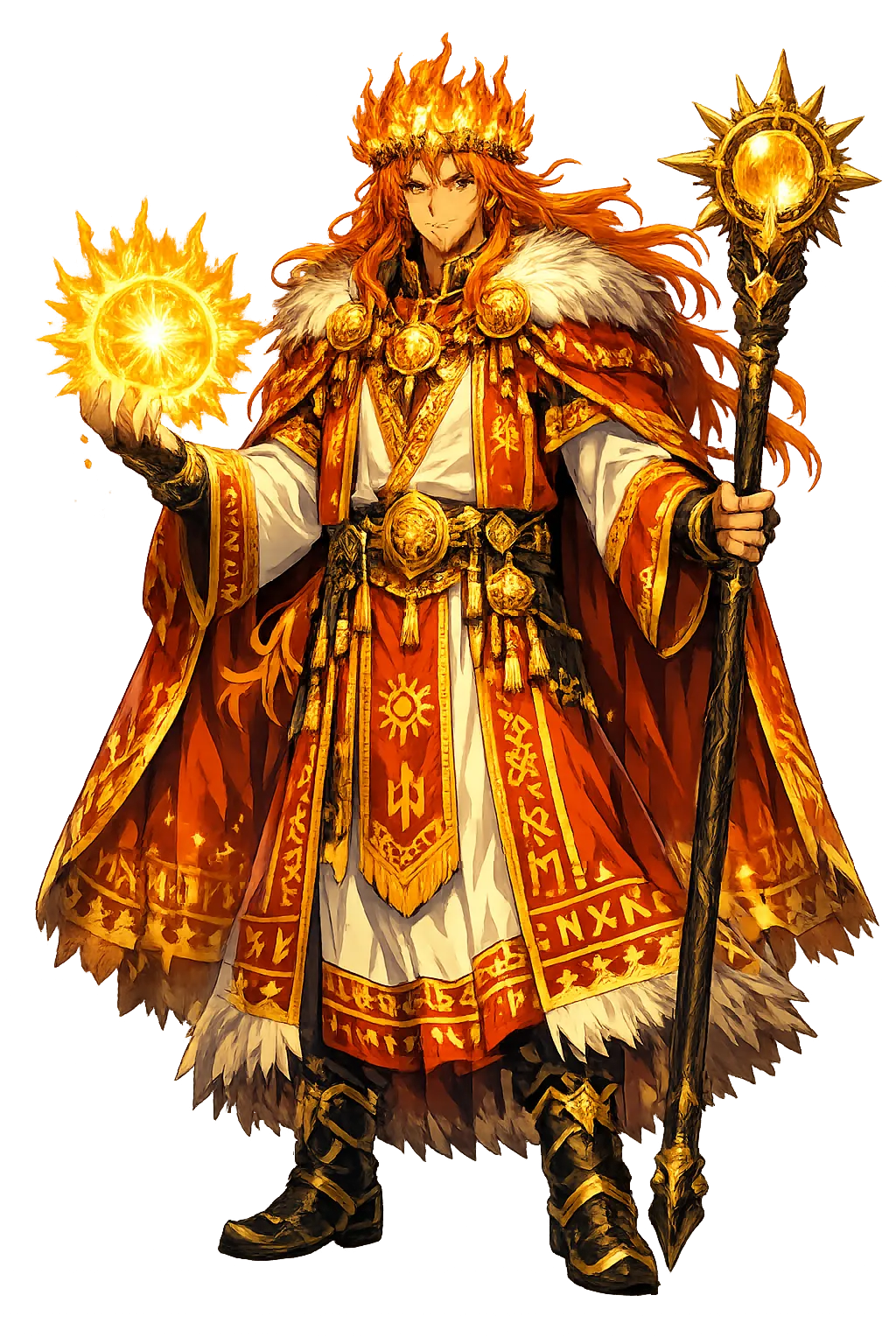
No image of Dažbog survives, and no text describes one. Slavic paganism left no identified cult sculpture, no votive figurine, no engraved gem — nothing inscribed, because it wrote nothing down. What the sources give him is a domain rather than a body: a twelfth-century chronicle gloss equates him with the sun, which suggests any contemporary image would have been solar — disk, wheel, or chariot — but that is inference from a copyist's equation, not from a picture. The four-sided stone idol dredged from the river Zbruch, now in the National Museum in Kraków, is the one substantial candidate for a Slavic cult image of his era, and no argument tying any of its carved faces to him has prevailed. Folk invocations of Dabog carried no image at all. His visible form belongs to the present: sun-wheels and radiant solar figures drawn by modern Slavic Native Faith artists — an iconography of sincere reconstruction, not descent.

06

Reception & Transformation

The name after its own age — transmission, translation, survival

Afterlives

Dažbog's afterlife is a study in how far a name can travel after its cult is drowned. The chronicles threw his idol in the Dnieper in 988; two centuries later the epic Slovo o polku Igoreve was calling the Rus' princes his grandsons — a dead god promoted to the title of a people's descent. The epic itself barely escaped oblivion: its unique manuscript perished in the Moscow fire of 1812, and the tale survives only in copies made for Catherine the Great's never-written history; even its authenticity was disputed for decades after it reached print in 1800. South Slavic speech kept the compound warm for centuries, and philology made it a question — Vasmer, then Ivanov and Toporov, weighing whether the living Dajbog preserved the god or re-formed 'give' plus 'god' by folk grammar; the chronicle texts themselves were fixed for scholarship in the Complete Collection of Russian Chronicles from 1841. Modern Slavic Native Faith completes the arc: a name carried by epic, folklore, and philology alone has altars again — a reception history in which scholarship itself did the temple's work.

Identifications Across Traditions

Christian chroniclers explicitly equated Dažbog with the Greek sun god Helios, reflecting both his solar identification and the Byzantine interpretatio Graeca favored in Kievan Rus'. In South Slavic folk religion, Dabog/Dajbog blends with the Christian God while retaining the old 'giving' epithet. Comparisons have been made to the Vedic Savitar and the Roman Sol Invictus, both solar deities associated with bestowal; the Iranian Mithra has been proposed as a distant cousin, though the evidence is speculative. Dažbog illustrates a common pattern: a major pagan god is first demonized by the chronicle, then absorbed into popular Christian speech, and finally resurrected by philology. In modern Slavic Native Faith he is honored again as a solar and prosperity deity — a reconstruction, but one with better folk credentials than most.

Modern Legacy

Dažbog survives most clearly in South Slavic invocations of Dajbog and in place-names and personal names across Slavic-speaking regions — Dajbog's compound still opens every well-wishing sentence in Serbia, unremarked and unbroken. Modern Slavic Rodnovery (Native Faith) movements honor him as a solar and prosperity deity. In linguistics, his name is a textbook example of the Common Slavic compound *dažь bogъ. For scholars of medieval Slavic religion, Dažbog is a crucial but frustratingly elusive figure: important enough to be named by chroniclers and sworn by in epic, yet absent from the rich narrative cycles that preserve Norse or Greek mythology.

07

The Meditation

What Dažbog means — beyond the dictionary

Dažbog is the god of giving made visible in sunlight. Every harvest, every warm morning, every coin earned is a gift that his name once sanctified. The chroniclers called him a demon and threw his idol in the river, but the people kept saying his name whenever they hoped for something good.

There is a quiet resistance in that survival. Dažbog did not need temples or epics; he needed only the human habit of asking. 'Giving god' is not a description of power but a description of relationship: the deity who responds to need, who makes the asker and the giver partners in one small sacred transaction. In an age of scarcity and competition, his name is a reminder that the sun still rises without charge and that generosity can be sacred.

08

Frequently Asked Questions

Common questions about Dažbog, Sun, Wealth, Giving, and Unicode restoration

01How do you pronounce Dažbog?

In reconstructed pronunciation, Dažbog is /ˈdaʒ.boɡ/ — approximately 'DAHZH-bog' — crisp 'dah', then the 'zh' sound of 'measure', and end with 'bog' as in 'god' (which is what the word means).

02What does Dažbog mean?

Dažbog means Giving god in the slavic tradition.

03What are the symbols of Dažbog?

Dažbog is associated with Sun wheel or disk (The solar body with which Dažbog was identified in the learned glosses), Wheat or sheaf (The harvest produced by the sun's warmth and the god's generosity), Gold and amber (Treasures associated with sunlight and divine wealth), Horse or chariot (The solar vehicle common to Indo-European sun-god imagery, inferred rather than attested).

04Why restore Dažbog in Unicode?

Plain ASCII dazhbog strips the stress, length, and script that make the name specific. Unicode restoration returns the name to its original written dignity.

05What is the most important myth about Dažbog?

“The Idols on the Hill” — the Kyiv, 988 story that anchors the mythology of Dažbog, told in full on the lore page.

09

Scholarly Sources

The philological foundations of this restoration

Every claim on this page is grounded in established scholarship. The orthographic restorations follow disciplinary convention. The etymological chain follows the best available reference works. This is not invention — it is resurrection through scholarship.

◈

Lexicography & Philology

  • Miklosich
◎

Primary Texts

  • The Primary Chronicle (Povest’ vremennykh let); the Hypatian Codex; East Slavic chronicle tradition and South Slavic folk invocations.
◉

Archaeology & Art History

  • Material evidence — iconography, inscriptions, and temple archaeology — for Dažbog and related cults.
✦

Religious Studies

  • Primary Chronicle / Povest' vremennykh let, s.a. 980, 988
  • Hypatian Chronicle, s.a. 1114 (Malalas gloss: Dažbog, son of Svarog, called Helios)
  • Slovo o polku Igoreve (The Tale of Igor's Campaign)
  • Vasmer, Max, Russisches etymologisches Wörterbuch
  • Ivanov, Vyacheslav, and Vladimir Toporov, Studies in Slavic mythology
  • Zaroff, Roman, 'Organized Pagan Cult in Kievan Rus''
Return

The Surface Awaits

You have traced the name from its earliest attestation to its Unicode restoration. Now return to the myth. The story is where the name lives.

Back to Lore
Dažbog mascot