
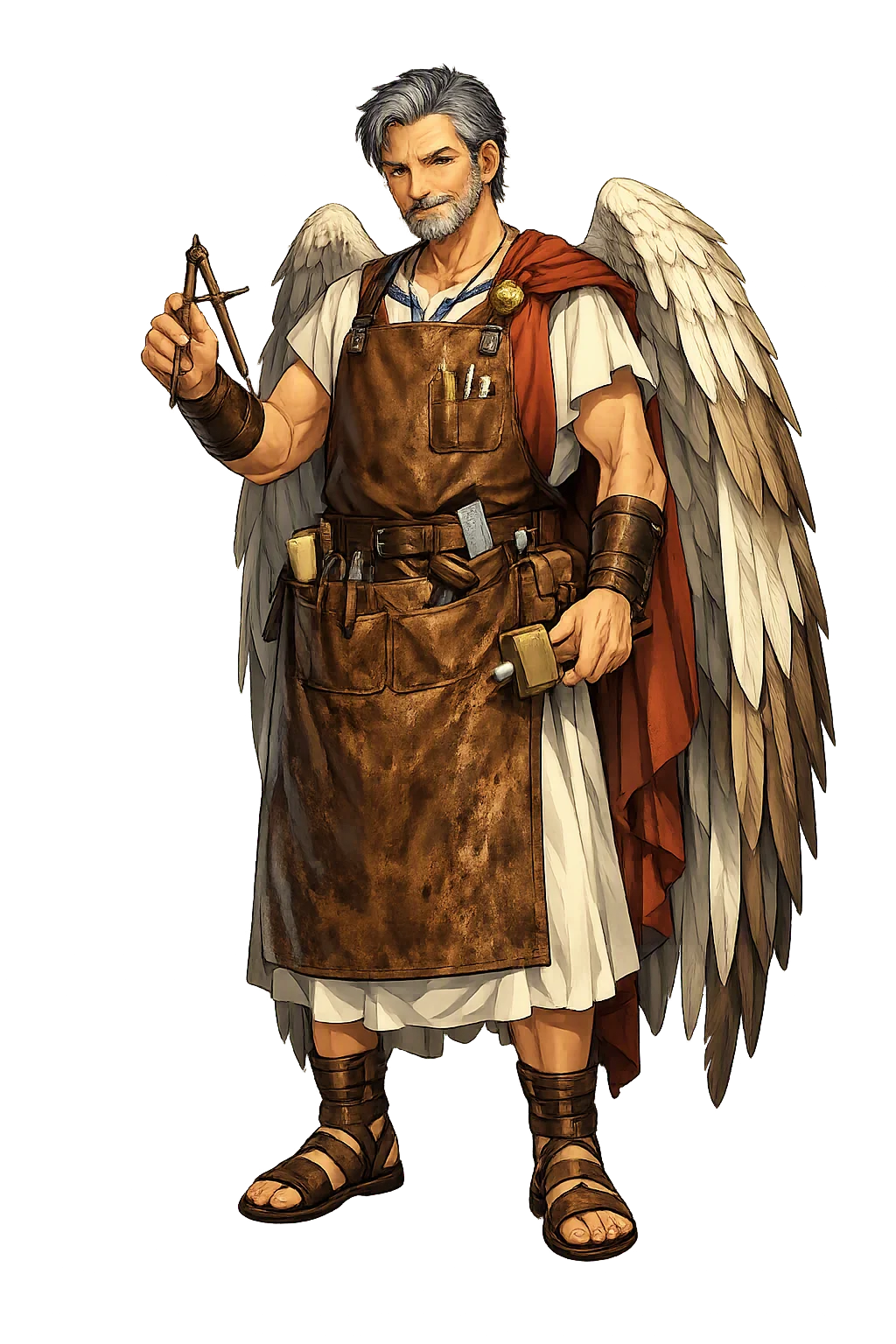
How Daídalos was rebuilt, mark by mark
From the restoration bench — the working notes on Daídalos, kept because the process is the proof.
What We Found
The attestation, as Homer, Iliad 18.590-592 (the dancing-floor of Knossos) and Apollodorus, Library 3.15.8; Epitome 1.7-15 preserve it: Δαίδαλος. Meaning: "Cunningly wrought".
The figure behind the name: The myths of Daidalos are preserved in Homer, Apollodorus, Diodorus, and Ovid: a small cycle that celebrates human invention and prices it — envy, exile, and the fall of a son.
What the Name Carried In
The Nephew He Killed. Daedalus' first recorded act is his worst. His sister entrusted her son to his tutelage — the boy is Perdix in Apollodorus (Library 3.
The Labyrinth. At the court of Minos, Daedalus built the monument that defines him: the Labyrinth, 'a maze with winding paths, confusing and impassable,' designed to imprison the Minotaur — the bull-headed child born of Pasiphaē and the Cretan bull (Apollodorus, Epitome 1. 7-9).
A spelling that has to carry stories like these is not a label. It is equipment.
Where It Stood Before Us
Homer anchors Daedalus in Bronze Age Knossos a thousand years before the classical city-states told his story, and Arthur Evans' excavations (1900-1905) gave the myth a landscape: the palace's corridors, bull-imagery, and wall paintings let moderns walk his labyrinth. Ancient Athens claimed him too — the murder of Perdix was set on the Acropolis — and classical authors (Pliny, Natural History 36.13) credited him with the first true sculpture, 'opening the eyes and separating the limbs.' The Archaic sculptural style of the seventh century BCE is still called 'Daedalic' after him. No secure artifact is his; like the labyrinth, his archaeology is a structure of plausible paths. The bench inherits all of it — the web temple is the newest site, not the first.
What We Kept
The evidence, mark by mark — 1 feature the keyboard form daedalus cannot hold:
- e → í — Iota. Kept.
What We Rejected
daedalus as the primary form. It survives as the convenience it is; it does not get to lead. The hierarchy is full restoration first, and this name can afford to stand at the top of it.
What We Set Down
Daídalos — What survives here cannot be shown in ASCII: a feature of the original that the fallback alphabet flattens. That is the Tier-1 test, and this name passes it without argument.
For the voice: 'DIE-dah-los' — the first syllable is long and carries the ancient pitch rise; the remaining syllables are short and light.
The temple stands at /daedalus/ — the notes above are public in its Scholarly Edition, sources and all.
At a Glance
- Restored name: Daídalos
- ASCII form: daedalus
- Meaning: "Cunningly wrought"
- Domain of influence: Craftsman, Inventor, Wings
- Pantheon: Greek
- Classification: Tier 1
- Original script: Δαίδαλος
- Series: The Restoration Files, No. 114 of 548
The File Continues
The temple's founding dispatch tells the name's story; its Resonance File reads the myths into the industries; the blog index holds the whole archive.
Continue the series — previous file: Koîos (read it here) · next file: Dāgān (read it here).
The Restoration Files are written from the same canonical record as the temples themselves: the lexicon, the lore catalog, the pattern atlas, and the cited scholarly sources. If a file ever disagrees with its temple, the temple is right — tell us, and the file will be corrected.