
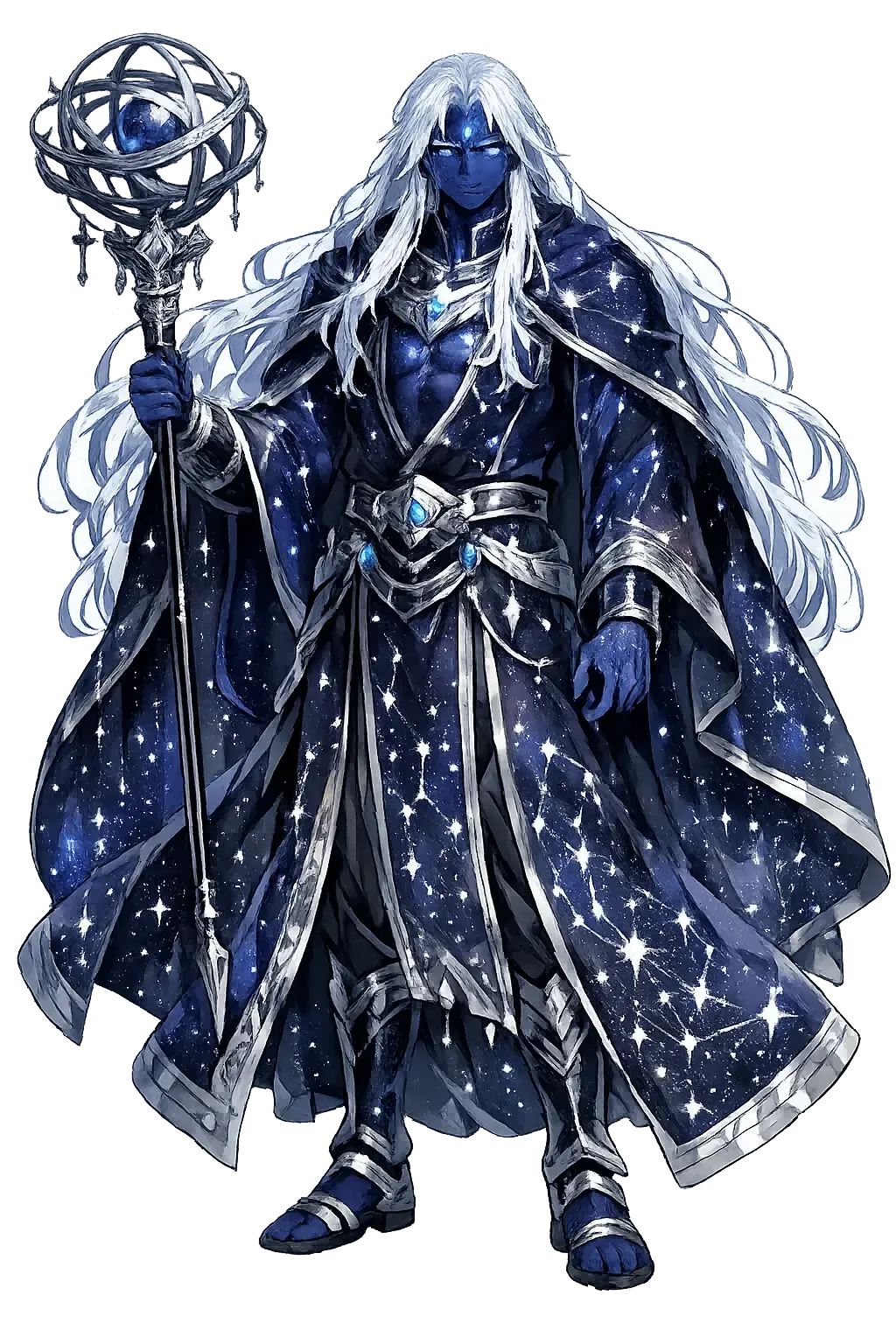
How Koîos was rebuilt, mark by mark
Bench notes, Koîos: what we found, what we rejected, and what we finally set down. Kept in the open, because a restoration you cannot audit is just a spelling with confidence.
What We Found
The attestation, on the evidence Hesiod, Theogony 132–138, 404–410, 617–745, 918 and Aeschylus, Eumenides 1–8 set down: Κοῖος. Meaning: "Questioning, inquiry".
The figure behind the name: Koîos has no independent mythic biography; he exists in Hesiod's genealogies and in the shadow of the Titanomachy.
What the Name Carried In
Son of Ouranos, Husband of Phoibe. Hesiod gives Koîos his entire childhood in a few lines: he is a son of Ouranos (Sky) and Gaia (Earth), born among the twelve Titans whom the wide-seeing son of Earth bore (Theogony 132–138). When Ouranos was overthrown, the Titans' turn came to hold the cosmos — and Koîos held the north.
The War of the Titans. When Zeus led the younger gods against the old order, Koîos fought with his brothers, and the war shook the cosmos. Hesiod's Titanomachy (Theogony 617–735) thunders with the detail: the hundred-handed Hekatoncheires hurling mountains, the sea roaring, the sky itself groaning under the strain.
A spelling that has to carry stories like these is not a label. It is equipment.
Where It Stood Before Us
No temple, altar, or inscribed dedication to Koîos is known; a god without cult leaves no cult debris. His material record is instead textual: the manuscript tradition and ancient papyri of Hesiod's Theogony — the sole early witness to his name — and the vast apparatus of scholia and lexica that glossed it for two millennia. Monumentally, his generation's war is preserved in stone at Pergamon, where the Great Altar's Gigantomachy frieze (c. 180–160 BCE) shows gods and Giants locked in the combat in which the Titan order fell; the frieze names no Koîos, but it gives his war its surviving image. For a Titan, that is fitting archaeology: no coins, no votives — only the papyrus, the commentary, and one of antiquity's most violent works of art. The bench inherits all of it — the web temple is the newest site, not the first.
What We Rejected
Any form invented for availability. The rule on the bench: if the evidence does not carry it, the domain does not get it — whatever the registrar has in stock.
What We Set Down
Koîos — Tier-1 is not a compliment; it is a measurement. This restoration keeps something the ASCII form provably loses, and the measurement is repeatable.
For the voice: 'KOY-oss' — pronounce the 'oy' as in 'boy', and keep the final syllable short.
The temple stands at /coeus/ — the notes above are public in its Scholarly Edition, sources and all.
At a Glance
- Restored name: Koîos
- ASCII form: coeus
- Meaning: "Questioning, inquiry"
- Domain of influence: Titan of Intellect
- Pantheon: Greek
- Classification: Tier 1
- Original script: Κοῖος
- Series: The Restoration Files, No. 113 of 546
The File Continues
The temple's founding dispatch tells the name's story; its Resonance File reads the myths into the industries; the blog index holds the whole archive.
Continue the series — previous file: Cōātlīcue (read it here) · next file: Daídalos (read it here).
The Restoration Files are written from the same canonical record as the temples themselves: the lexicon, the lore catalog, the pattern atlas, and the cited scholarly sources. If a file ever disagrees with its temple, the temple is right — tell us, and the file will be corrected.