
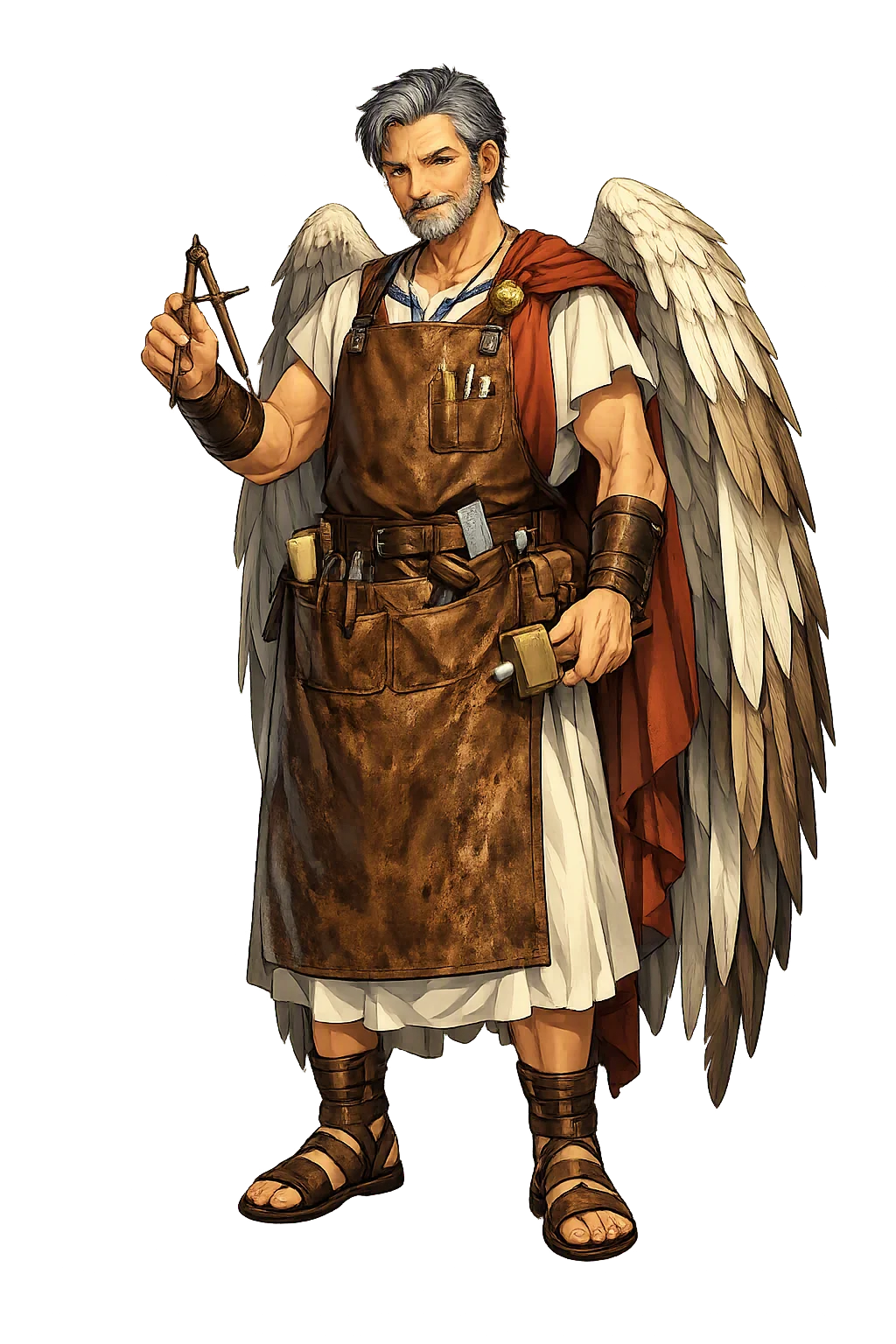
From Greek to Unicode: the journey of Daidalos
Long before it was a domain, this name traveled through scripts. Daidalos begins in Greek, passes through scholarly transliteration, and ends — for now — inside the punycode machinery of the global DNS. Each stage of that journey preserves some information and loses some, and the craft of restoration is knowing exactly which marks matter. This post follows the name stage by stage: the original script, the reconstructed pronunciation, the mythological record, the material evidence, and finally the Unicode form that carries all of it into the address bar. Think of it as a biography of a name, told through its spelling.
At a Glance
- Restored name: Daidalos
- ASCII form: daedalus
- Meaning: "Cunningly wrought"
- Domain of influence: Craftsman, Inventor, Wings
- Pantheon: Greek
- Classification: Tier 1
- Original script: Δαίδαλος (Greek)
Overview
Daidalos (daedalus) — Craftsman, Inventor, Wings · Cunningly wrought — belongs to the Greek tradition, where it is catalogued under the domain "Craftsman, Inventor, Wings". The name means "Cunningly wrought".
Daidalos is the master craftsman of Greek mythology: the architect of the Labyrinth, the maker of moving statues, and the father of Icarus. His name means "cunningly wrought" and became a byword for any work so skillful that it seemed alive. He is the first engineer in Western literature, the inventor whose ingenuity saves him and destroys those he loves.
PuniCodex restores the name as Daidalos and serves its temple at its temple. The original carries both stress and vowel length, and exactly one historically valid Unicode restoration exists, which places the name in Tier 1. The plain ASCII form daedalus survives as a modern convenience imposed by the early domain-name system; the restoration, not the fallback, is the form the project defends as philologically complete.
The Name
The name is attested in Greek as Δαίδαλος. Etymologically it means "Cunningly wrought".
The ASCII form daedalus survives only because the early domain-name system could not carry diacritics; it is a technological compromise, not an ancient spelling. The Unicode restoration Daidalos recovers the full diacritic detail of the scholarly transliteration directly in the address bar. The original carries both stress and vowel length, and exactly one historically valid Unicode restoration exists, which places the name in Tier 1.
The letter-by-letter transformation runs:
- d → D — Same
- a → a — Same
- e → i — Iota
- d → d — Same
- a → a — Same
- l → l — Same
- u → o — Omicron
- s → s — Same
The Original Script
The name is written in Greek as Δαίδαλος. This original script is the form against which the ASCII fallback daedalus and the PuniCodex restoration Daidalos are measured: the restoration preserves its full diacritic detail of the written form, so that a reader typing the modern address still speaks the ancient name.
The name is written in Greek as Δαίδαλος. The first syllable is a long diphthong αι with an acute accent. The plain ASCII daedalus flattens the diphthong into ae and removes the accent. The PuniCodex restoration Daidalos preserves the scholarly transliteration of the Greek form and is classified as Tier 1 because the diphthong is long and accented.
Pronunciation
The reconstructed pronunciation of the name is /dai̯.da.los/ — Attic Greek Reconstruction.
Phoneme by phoneme:
- Dai- — Long diphthong αι [ai̯] with acute pitch accent; the alpha is open and the iota forms an off-glide.
- -da- — Short [da], the middle syllable of the name.
- -los — Short [los], the final syllable with a clear liquid l.
For the modern speaker, the closest approximation is: 'DIE-dah-los' — the first syllable is long and carries the ancient pitch rise; the remaining syllables are short and light.
Kindred and historical forms of the name:
- Greek — Δαίδαλος (Daidalos), the cunningly wrought craftsman
- Latin — Daedalus, the Roman rendering adopted into English
The Greek Δαίδαλος contains both stress (acute on the diphthong) and length (the diphthong αι is long), making it a Tier 1 restoration. The Latin-derived English form Daedalus is a secondary spelling that preserves the consonants but obscures the original Greek vowel quantities.
Mythology
The myths of Daidalos are preserved in Homer, the lost Catalogue of Women, Diodorus Siculus, Ovid, and Apollodorus. They celebrate the power of human invention and warn against its costs: jealousy, exile, and the death of a son.
The Killing of Talos (Athens)
Daidalos was born in Athens, where his skill as an inventor aroused the jealousy of his nephew Talos (or Perdix). When the boy invented the saw and the potter's wheel, Daidalos threw him from the Acropolis in envy. For this murder he was exiled from Athens and fled to Crete, where King Minos welcomed him.
The Labyrinth (Crete)
At Knossos, Daidalos built the Labyrinth to house the Minotaur, the half-man, half-bull born of Pasiphae. The maze was so cunningly designed that even its maker could barely find his way out. When Theseus came to slay the Minotaur, Ariadne gave him the thread that Daidalos had taught her to use.
The Wings (Crete)
When Minos imprisoned Daidalos and his son Icarus in the Labyrinth, Daidalos made wings from feathers and wax. He warned Icarus not to fly too close to the sun, but the boy, exulting in flight, ignored him. The wax melted, Icarus fell into the sea, and Daidalos flew on alone to Sicily.
Death of Daidalos (Sicily)
In Sicily, Daidalos built marvellous works for King Cocalus. When Minos came to demand his surrender, Cocalus' daughters killed Minos in his bath. Daidalos lived out his life in Sicily, still inventing, still exiled from the ordinary happiness of family and home.
Symbols & Iconography
The iconography associated with Daidalos concentrates in a small set of recurring attributes, each a compressed statement about the name:
- Wings — The instruments of escape and the boundary between human and divine.
- Wax — The material that holds the wings together and melts when Icarus flies too close to the sun.
- Labyrinth — The architectural puzzle that embodies Daidalos' cunning and its dangerous consequences.
- Tools — The axe, file, and compass of the craftsman who can make anything except a safe life.
- Wax — The material that holds the wings together and melts when Icarus flies too close to the sun.
Archaeology & Evidence
No monument, inscription, or artifact in the current PuniCodex corpus is yet assigned to Daidalos with certainty. That absence should be read honestly: for a Greek name of this type the material record is expected to be thin, and the primary evidence remains the textual testimony gathered in the Scholarly Sources section.
Were such evidence to surface, it would take recognizable forms: votive or dedicatory inscriptions naming Δαίδαλος, sanctuary or cult remains tied to craftsman and iconography matching its traditional attributes (wings and wax). Each candidate would be weighed against the reconstructed form of the name before entering the scholarly record.
Realm & Domain
Daidalos is the master craftsman of Greek mythology: the architect of the Labyrinth, the maker of moving statues, and the father of Icarus. His name means "cunningly wrought" and became a byword for any work so skillful that it seemed alive. He is the first engineer in Western literature, the inventor whose ingenuity saves him and destroys those he loves.
The Labyrinth
The maze Daidalos built to contain the Minotaur at Knossos.
Wings
The feathered wings he fashioned from wax and twine to escape Crete.
Automata
The moving statues he made so lifelike that they had to be chained down.
Invention
The transforming power of human skill, celebrated and feared by the Greeks.
Across Cultures
The Greek Daidalos was absorbed into Roman literature as Daedalus, most famously in Ovid's Metamorphoses. In the Renaissance he became an emblem of the artist as rebel and genius, and in modern culture he stands for every inventor who creates what he cannot control. James Joyce made Stephen Dedalus a Daidalos-figure, the young artist escaping the nets of family, religion, and nation. The name has also been used for spacecraft, engineering projects, and artificial-intelligence ventures.
Within the Greek tradition, closely related names in the corpus include Achérōn, Achilleús, Adámas, Aḗr, Aithḗr, and Aias.
Cultural Legacy
Daidalos is the archetype of the engineer, the artist, and the scientist whose creations escape his intentions. He built the Labyrinth, the wings, and the moving statues; each invention brought wonder and disaster. Modern discussions of artificial intelligence, genetic engineering, and autonomous weapons revisit his dilemma: can we make things so complex that even their makers cannot predict their effects? Daidalos reminds us that skill without wisdom is exile.
The Scholarly Record
The account of Daidalos given in this edition rests on the witnesses and reference works listed below. Lexica and etymological dictionaries secure the form and meaning of the name; the literary and religious texts supply the narrative evidence.
- Homer, Iliad 18.590-592 (references to Daidalea).
- Diodorus Siculus, Library of History 4.76-79.
- Apollodorus, Bibliotheca 3.15.8; Epitome 1.8-15.
- Ovid, Metamorphoses 8.152-235.
- Morris, Sarah, Daidalos and the Origins of Greek Art (1992).
- Liddell-Scott-Jones Greek-English Lexicon, s.v. Δαίδαλος.
A Meditation
Daidalos is the first Western portrait of the inventor as tragic hero. His gifts are extraordinary; his judgement is not. He kills his nephew from envy, builds a prison for a monster, and loses his son to the very technology that saved him. Each invention solves one problem and creates another.
To meditate on Daidalos is to meditate on the double edge of human making. We are the species that makes wings, and we are the species whose children fly too high. The question is not whether to invent but whether we can invent with the humility that knows our limits.
The Unicode Restoration
Daidalos is classified as Tier 1: the original carries both stress and length, and only one valid Unicode restoration exists. The ASCII fallback daedalus still resolves everywhere, but it is the restored form that carries the name's full information. That is the whole thesis of this temple: the marks are the message.
Character by Character
The journey from daedalus to Daidalos, one character at a time:
- d → D — Same
- a → a — Same
- e → i — Iota
- d → d — Same
- a → a — Same
- l → l — Same
- u → o — Omicron
- s → s — Same
The Greek Pantheon
Daidalos is one of 275 entries the PuniCodex lexicon catalogues under the Greek pantheon. The Pantheon page gathers the tradition's major figures in one place, and the Lexicon lets you filter all 980 restorations by tradition, tier, or script — the fastest way to see where this name sits among its kin.
Frequently Asked Questions
What does Daidalos mean? The traditional gloss is "Cunningly wrought."
Which tradition does Daidalos belong to? Daidalos is catalogued in the Greek pantheon of the PuniCodex lexicon.
Why is Daidalos classified as Tier 1? Because the original carries both stress and length, and only one valid Unicode restoration exists — and the marks in the restored spelling preserve exactly that evidence.
Can I use Daidalos in a normal browser? Yes. The DNS resolves the punycode form automatically, and the type tool on this site converts daedalus to Daidalos for copying and pasting.
Where does the scholarly information come from? The entry is built from lexica, inscriptional evidence, and reviewed scholarly sources listed in the Scholarly Edition. Every claim is traceable to a canonical source.
Typing Daidalos
You do not need a special keyboard to use this restoration. The PuniCodex Type Tool converts the ASCII form daedalus into Daidalos as you type, and the browser extension offers the same conversion inside any text field. Copy the restored form, paste it into the address bar, and the DNS does the rest.
Sister Temples
Other temples in the Greek pantheon include Mégaira, Meriónēs, and Moîra — each with its own restoration story, its own scholarly record, and its own place in the lexicon.
Why This Restoration Matters
Every stage of the journey from Greek to Unicode was an act of care: the scribe who first wrote the name, the lexicographer who glossed it, the engineer who taught the DNS to carry it. The PuniCodex restoration is the latest stage, not the last word — the Scholarly Edition is revised as the evidence improves. What does not change is the principle: a name deserves to be written the way its own tradition wrote it. Daidalos in the address bar is that principle, made routable.
Explore Further
This post is one doorway into the temple. The home page carries the full character breakdown and the ambient canvas; the lore page tells the myths in long form; the Scholarly Edition preserves the sources, pronunciation data, and revision history; and the patron wall supports the restoration directly. For the wider map, browse the Lexicon, explore the Pantheon, or return to the PuniCodex blog.
A Closer Look at the Marks
A restored name is a small map. In the case of Daidalos, the map does not lead through diacritics or special letters, because the source tradition wrote the name in Greek rather than in the Latin alphabet. The ASCII form daedalus and the restored form share the same letters; the restoration is a decision about which conventional spelling should serve as the public reference.
That decision is not cosmetic. The original script attestation carries semantic and phonetic information that no romanization can fully reproduce. By fixing one conventional spelling as the canonical domain form, the project prevents the drift that happens when a name is romanized differently in every article, map, and database. The breakdown still lists each character — d, a, e, d, a, l, u, s — so visitors can see exactly what is being carried forward and what is not. What looks like "no change" is, in fact, a deliberate choice to keep the name stable, searchable, and addressable.
Daidalos in Its Tradition
Daidalos does not stand alone. It belongs to the Greek tradition, where it is counted among 275 names in the PuniCodex lexicon. Its sphere — Craftsman, Inventor, Wings — places it beside other figures who govern similar aspects of experience. The restored spelling is therefore not only a philological decision; it is a way of keeping the name in the company of its kin. When the address bar shows Daidalos, it marks the boundary between a generic search term and a named entry in a living catalog of myth. That catalog is the point of the project. Every restored name is a vote for specificity: the web should know the difference between a figure and a keyword, between a tradition and a trend. Daidalos is one such vote.
What You Will Find in the Temple
The temple page for Daidalos is more than a landing page. The home tab presents the character breakdown, the pronunciation guide, and the live domain status in a single view. The lore tab gathers the myths and narratives that give the name its depth. The Scholarly Edition tab publishes the sources, variant forms, and review history that justify the restoration. Industry patterns show where the name appears in modern commerce and culture, while the gallery and creatives tabs collect visual and sponsor material. The patron wall lets visitors support the restoration directly. Each tab is generated from the same canonical sources, so the domain, the blog, the scholars page, and the search index all agree. The result is a single source of truth about a name, delivered through several doors.
The Restoration on the Live Web
A domain name is a kind of publication. When Daidalos resolves, it proves that the restored spelling is not a theoretical exercise; it is a working address on the public internet. Search engines can index it, language models can encounter it, and anyone who copies it from a manuscript can paste it into a browser. That practical reality changes the status of the restoration. Before Unicode domains, a scholar could write the name correctly in an article while the public web flattened it to daedalus. Now the public web can carry the correct form end to end. The punycode translation happens silently, so the infrastructure remains compatible while the visible name keeps its marks. That compromise — human-readable restoration, machine-readable encoding — is the foundation of every PuniCodex temple.
Restoration Notes
Restoring a name is not a single decision; it is a sequence of smaller decisions, each backed by a different kind of evidence. For Daidalos, the chain begins with the attested form in Greek, continues through the standard scholarly romanizations, and ends with the DNS-compatible Unicode spelling used by this temple. The meaning "Cunningly wrought" anchors the name in its semantic field; without that anchor, the marks would float free of the figure they name. The restored form Daidalos and the ASCII form daedalus share the same Latin letters; the restoration here is a conventional capitalization rather than a recovery of lost diacritics or special characters. Those adjustments are not arbitrary styling. They follow the tier rule that places Daidalos in Tier 1: the original carries both stress and length, and only one valid Unicode restoration exists. The rule is mechanical, not editorial, which means the same standard applies to every entry in the lexicon. A visitor who disagrees with the classification can at least see exactly which evidence produced it, because every step is recorded in the Scholarly Edition. That transparency is the difference between a restoration project and a branding exercise. The name is being put back, not invented.
Related Names
Sources
The full scholarly apparatus — every citation, revision, and review — lives in the Scholarly Edition. Key references for this post:
- Homer, Iliad 18.590-592 (references to Daidalea).
- Diodorus Siculus, Library of History 4.76-79.
- Apollodorus, Bibliotheca 3.15.8; Epitome 1.8-15.
- Ovid, Metamorphoses 8.152-235.
- Lexicon authorities for this entry: LSJ, Pape-Benseler, Beekes.