
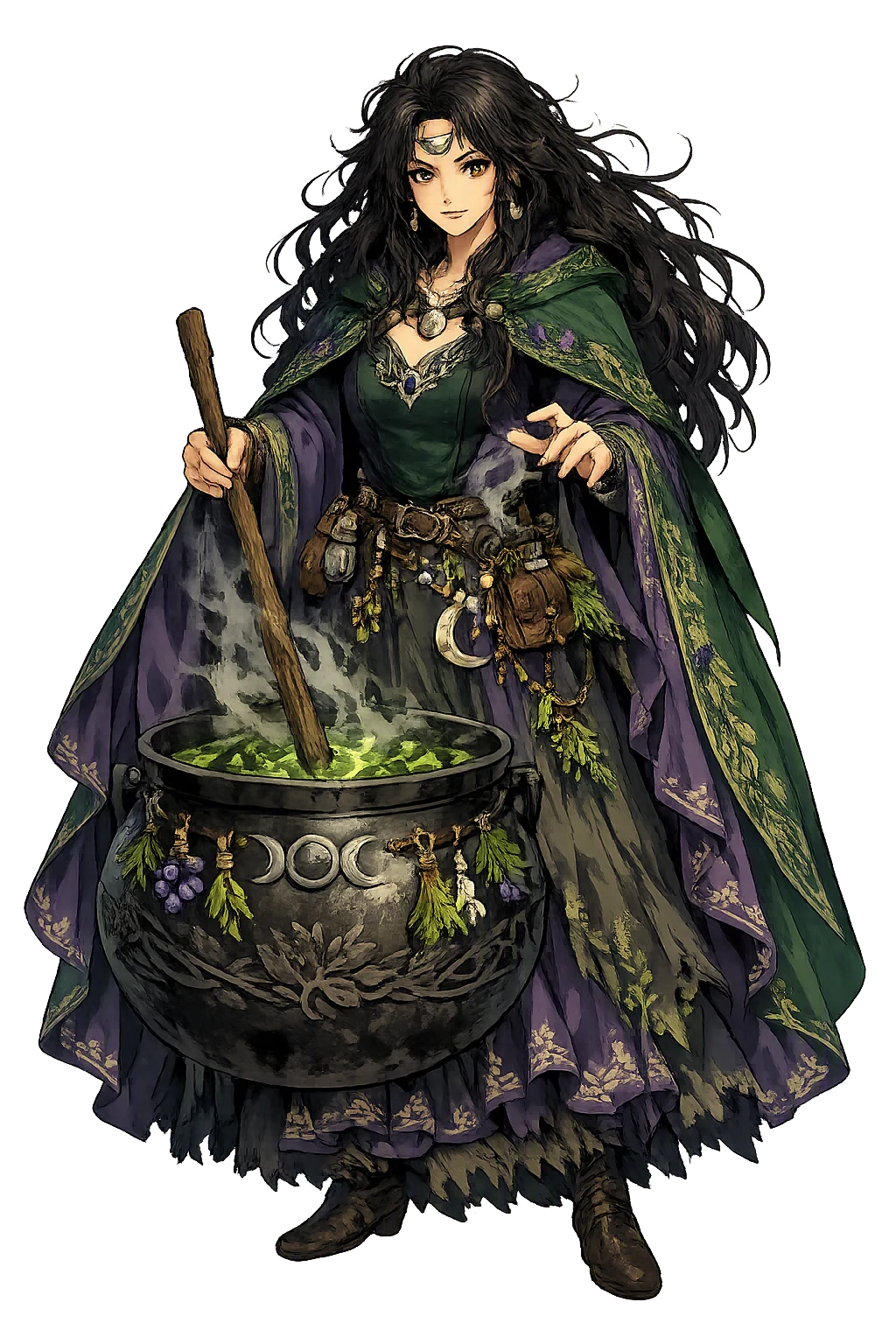
From Celtic transcription to Unicode: the journey of Ceridwen
Long before it was a domain, this name traveled through scripts. Ceridwen begins in Celtic transcription, passes through scholarly transliteration, and ends — for now — inside the punycode machinery of the global DNS. Each stage of that journey preserves some information and loses some, and the craft of restoration is knowing exactly which marks matter. This post follows the name stage by stage: the original script, the reconstructed pronunciation, the mythological record, the material evidence, and finally the Unicode form that carries all of it into the address bar. Think of it as a biography of a name, told through its spelling.
At a Glance
- Restored name: Ceridwen
- ASCII form: ceridwen
- Meaning: "Bent or crooked woman"
- Domain of influence: Inspiration, Transformation
- Pantheon: Celtic
- Classification: Tier 2
Overview
Ceridwen (ceridwen) — Inspiration, Transformation · bent or crooked woman — is the keeper of the cauldron of awen in Welsh tradition: the enchantress of Llyn Tegid who brews a year and a day for the three drops of inspired knowledge, hunts the servant-boy who steals them through every shape in creation, swallows him as a grain of wheat, and gives him back to the world as Taliesin, the greatest poet of the Welsh tradition.
Her whole dossier is a single prose tale, Hanes Taliesin — the Tale of Taliesin — preserved in sixteenth-century Welsh manuscripts and customarily printed with the Mabinogion, though it is none of the Four Branches. The name itself is older than the tale: medieval Welsh poetry attests it in spellings such as Kerritwen and Kyrridven, and the editors of the Welsh triads record that the early sources concur on her one fixed attribute — ownership of the cauldron that is the source of poetic inspiration, the awen.
The lexicon glosses the name 'bent or crooked woman', following the analysis Ifor Williams advanced for an original form Cyridfen; the dictionaries also print the traditional reading cerdd 'song, craft, poetry' + gwen 'white, fair, blessed' — 'fair of song' — and the question remains genuinely open.
PuniCodex restores the name as Ceridwen — identical to the ASCII input, because Welsh writes the name in plain Latin letters with no diacritic for the restoration to recover; the name is Tier 2 by the mechanical rule. The plain-ASCII ceridwen.com is held by a third party outside the PuniCodex collection and is watched for release; no form of the name is currently owned, and this temple claims none.
The Name
The name is attested in Welsh as Ceridwen, with the early spellings Kerritwen and Kyrridven preserved in medieval Welsh poetry — the name circulated in the verse tradition long before the sixteenth-century prose tale that now defines her. The etymology is one of the honest open questions of Welsh onomastics, and the dictionaries register two analyses rather than settling between them.
The first is the traditional reading: cerdd — 'song, craft, poetry', the very word for the poet's art — plus gwen, the feminine of gwyn, 'white, fair, blessed'. 'Fair of song, blessed of poetry' is the romantic analysis, and it fits the keeper of the cauldron of awen almost too well.
The second is philologically harder and is the one this lexicon prints: Ifor Williams, the greatest modern editor of early Welsh poetry, held that the original and authentic form was Cyridfen, 'crooked woman' — an analysis the early spellings with their double-r shapes (Kyrridven) do more to support than the cerdd-reading can. The gloss 'bent or crooked woman' therefore stands in the entry not as a slur but as the harder-won reading; the name's connection with poetry belongs to the figure, and need not be forced into her etymology.
The ASCII form is not a compromise here: Welsh writes the name in plain Latin letters, and the normalized spelling is already Ceridwen. There is no diacritic and no distinctive letter for the restoration to recover; only the capital distinguishes the restored form from the input, which places the name in Tier 2 by the mechanical rule.
The letter-by-letter transformation runs:
- c → C — Same, capitalized
- e → e — Same
- r → r — Same
- i → i — Same
- d → d — Same
- w → w — Same
- e → e — Same
- n → n — Same
The project holds no domain for this name: ceridwen.com is registered to a third party outside the PuniCodex collection and is watched for release. The temple is served at /ceridwen/ and claims no domain it does not hold.
The Original Script
The name is preserved in Welsh manuscripts in the Latin alphabet as Ceridwen — the prose tale in sixteenth-century Welsh (NLW MS 5276D; the Gellilyfdy copy), with earlier poetic attestations in spellings such as Kerritwen and Kyrridven. The script is the medieval Welsh bookhand, left to right.
The scholarly rendering proceeds step by step:
- Welsh writes the name in plain Latin letters; no diacritic attaches to it in any witness, and normalized orthography and the ASCII spelling are identical.
- The early double-r spellings (Kyrridven) are the evidence Ifor Williams read in proposing the original form Cyridfen, 'crooked woman' — the analysis the lexicon's gloss follows.
- The traditional analysis cerdd + gwen, 'song' + 'fair, blessed', remains in the dictionaries as the alternative reading; the debate is registered, not settled.
- The Unicode restoration Ceridwen therefore changes nothing but the capital; the name stands in Tier 2 by the mechanical rule, and the plain-ASCII domain ceridwen.com — held by a third party outside the PuniCodex collection and watched for release — is the philologically complete form.
Pronunciation
The pronunciation of the name in Modern Welsh is /kɛrˈɪd.wɛn/ — Modern Welsh; the medieval value is held to be substantially the same.
Phoneme by phoneme:
- Cer- — Hard velar stop [k] (Welsh c is never soft), short open [ɛ], and trilled [r]: the light, unstressed first syllable
- -id- — Short close [ɪ] under stress with a voiced dental [d]: Welsh words are stressed on the penultimate syllable, so the weight of the name lands here
- -wen — Labial-velar [w], open-mid [ɛ], and alveolar [n]; the unstressed ultima closes quietly
For the modern speaker, the closest approximation is: 'keh-RID-wen' — the c hard, the r rolled, the stress on the middle syllable.
Kindred and historical forms of the name:
- Medieval Welsh verse — Kerritwen, Kyrridven, the early spellings of the poetry
- Ifor Williams (reconstruction) — Cyridfen, 'crooked woman', the proposed original form
- Traditional analysis — cerdd + gwen, 'song' + 'fair, blessed'
- Modern Welsh — Ceridwen, the unbroken living form
Ceridwen is Tier 2 by the mechanical rule: the Welsh form is already plain ASCII, and the restoration preserves nothing the ASCII form loses. The name's information-richness is semantic and mythic, not orthographic.
Mythology
Ceridwen's mythology is one tale, Hanes Taliesin, told with unusual economy — she holds its first half absolutely and vanishes from its second.
The Household by Llyn Tegid (Hanes Taliesin)
Ceridwen lived beside Llyn Tegid in Penllyn, the wife of Tegid Foel — Tegid the Bald — whose name the lake still carries. Their children were weighed in opposite scales: Creirwy, the fairest maiden in the world, and Morfran, a son so dark and ill-favoured he was called Afagddu, Utter Darkness. What nature had refused the boy, his mother resolved to supply from her arts: knowledge, and the gift of poetry.
The Cauldron of a Year and a Day (Hanes Taliesin)
From the books of the feryllt — the Welsh term for the alchemist's art — she compounded a cauldron of Inspiration and Science, to be boiled without ceasing for a year and a day, until three drops of the spirit of inspiration were won. A blind man, Morda, was set to kindle the fire; a servant-boy, Gwion Bach, son of Gwreang of Llanfair in Powys, to stir. The design was exact; everything that follows is its unmaking.
The Three Drops and the Flight of Shapes (Hanes Taliesin)
At the year's end the three charmed drops leapt from the cauldron onto Gwion Bach's finger. He put it in his mouth, and in that instant all knowledge of things past and to come was his — and he fled, knowing Ceridwen would kill him. She pursued through the great transformation-chase of Welsh tradition: he a hare, she a greyhound; he a fish, she an otter-bitch; he a bird, she a hawk; every shape he took, she took its hunter.
The Black Hen and the Rebirth (Hanes Taliesin)
Spent, the boy hid himself as one grain of winnowed wheat on a barn floor; Ceridwen became a high-crested black hen, found the grain, and swallowed it. She carried him nine months, and when she bore him he was so beautiful she could not kill him: she sewed him in a hide bag and cast him into the sea on the twenty-ninth of April — and passes out of the tale.
The Radiant Brow (Hanes Taliesin)
On May Day the bag came to the salmon-weir of Gwyddno Garanhir near the Dyfi's mouth, and Gwyddno's son Elffin found it. Seeing the boy's forehead he cried, 'Behold the radiant brow' — tal iesin — and the child answered: 'Taliesin be I called.' Years later the boy went to the court of Maelgwn Gwynedd, shamed the royal bards with poems they could not match, foretold the king's death, and freed his imprisoned foster-father. The inspiration brewed for one son had become the making of another: the first poet of Wales is, in the end, Ceridwen's child — swallowed, carried, born again, and set adrift by her own hands.
Symbols & Iconography
Ceridwen's attributes are the working properties of her single tale — the most functional regalia in the Welsh corpus:
- The cauldron of awen — Boiled a year and a day from the books of the feryllt until three drops of the spirit of inspiration should rise: knowledge as something cooked by art and patience, not granted
- The three drops — The whole virtue of the brew in an instant's splash: inspiration that chooses its own vessel, and falls on the wrong finger
- The high-crested black hen — Her last hunting-shape: the swallowing that is not death but the first cell of a poet
- The hide bag — The coracle-skin sewn round the child she could not kill, given to the sea on the twenty-ninth of April: rejection that becomes deliverance
- The weir on the Dyfi — Gwyddno Garanhir's salmon-weir, where the bag comes to rest on May Day and the radiant brow is named
- Llyn Tegid — Her lake, modern Bala Lake, which still carries her husband Tegid Foel's name: the story's anchor in real Welsh geography
Archaeology & Evidence
Ceridwen is a textual figure: no temple, votive deposit, or inscription names her, and pre-Christian Wales left no theonymic epigraphy of the continental kind. Her witnesses are manuscripts. The fullest early text of Hanes Taliesin is embedded in the great world-chronicle of Elis Gruffydd — a Welsh soldier and chronicler of the Calais garrison — compiled c. 1530–1552 and preserved in Aberystwyth, National Library of Wales, MS 5276D; a second version was copied by the recusant scribe John Jones of Gellilyfdy around 1607.
The name is older than its tale: medieval Welsh poetry preserves it in spellings such as Kerritwen and Kyrridven, and the editors of the triads record that the early sources agree on her one fixed attribute, the cauldron of awen. The geography of the story is real and still legible: Llyn Tegid, her lake, is Bala Lake in Gwynedd, the largest natural lake in Wales, which keeps her husband Tegid Foel's name; and Gwyddno's weir, where the bag comes ashore, stands in the tradition at the Dyfi estuary. No sanctuary of hers is known, and none is claimed.
Realm & Domain
Ceridwen is catalogued under the domain 'Inspiration, Transformation' — and the tale earns both terms in their strictest sense.
Inspiration
She is, in the words the triads' editor preserves from the early sources, the owner of the cauldron that is the source of poetic inspiration — the awen, the flowing spirit of Welsh poetry, the word the bardic tradition still uses for the muse itself. Her whole design in the tale is the industrial production of inspiration: gathered ingredients, the books of the feryllt, a cauldron boiled a year and a day, and the three drops of the spirit of inspiration as its yield.
Transformation
The pursuit that follows the theft is the most complete transformation-sequence in Welsh literature: hare and greyhound, fish and otter, bird and hawk, grain of wheat and high-crested black hen. And the swallowing turns the chase inside out — the swallowed boy is carried nine months and born again, so that the final transformation is not a shape at all but a rebirth: Gwion Bach becomes Taliesin.
The Cauldron as Instrument of Both
The two domains meet in the pot itself: the cauldron brews the inspiration and presides over the transformation, the vessel in which one kind of being is cooked into another.
Across Cultures
The strongest cross-border parallels are Irish. The accidental acquisition of a wisdom prepared for another is the plot of the Irish boyhood deeds of Finn mac Cumaill: cooking the salmon of knowledge for his master Finnéces, the boy burns his thumb, puts it in his mouth, and the knowledge intended for the teacher passes to the servant — the same economy as the three drops and the burning finger. The swallowing that becomes rebirth has its Irish twin in Tochmarc Étaíne, where Étaín, transformed into a fly, falls into a cup of wine, is swallowed, and is born again into the mortal world.
The cauldron itself is pan-Celtic furniture: the Dagda's cauldron from Murias feeds every company that comes to it, and the Old Irish text The Cauldron of Poesy locates a cauldron of poetry inside every human being — the closest Irish cousin of the cauldron of awen. Folklorists, Juliette Wood chief among them, have shown that Hanes Taliesin braids these native strands with international folktale types, above all the magic flight with its transformation chase.
The last syncretism is modern: Iolo Morganwg's Barddas set Ceridwen and the awen at the centre of revival Druidry, and modern Druids and pagans honour her as goddess of the cauldron — a reception Ronald Hutton's histories of the revival document and dissect. Within the Welsh corpus her nearest kin are the other figures of enchantment: Gwydion, the magician of the Fourth Branch, and Rhiannon, who like Ceridwen outlasts an unjust pursuit without breaking.
Cultural Legacy
Lady Charlotte Guest carried the Tale of Taliesin into English in the nineteenth century, appended to her Mabinogion, and the enchantress of Llyn Tegid entered the English-speaking imagination beside the Four Branches she never belonged to. Patrick K. Ford's edition and translation fixed the tale's modern scholarly form.
Robert Graves made her a figure of international consequence: The White Goddess (1948) read Ceridwen's cauldron and her hunt as the grammar of all true poetry, and though Celticists have never accepted Graves's method, his book set her at the centre of twentieth-century writing about the muse. In Wales the awen she brewed never left the tradition — the word still names poetic inspiration at the National Eisteddfod, and the Gorsedd of Bards invokes it in its rites — while modern Druid orders and pagan practice worldwide honour Ceridwen as keeper of the cauldron of transformation. The name itself, rare in the medieval record, has come back into use as a Welsh given name, carried by the only myth in the language in which a mother's failed plan becomes a nation's poetry.
The Scholarly Record
The account of Ceridwen given in this edition rests on the witnesses and reference works listed below. Hanes Taliesin supplies the narrative; the triads and the early poetry secure the name and its one fixed attribute; the Irish texts and the folklore scholarship frame the comparisons; Hutton and Graves mark the modern reception.
- Ford, Patrick K., ed., Ystoria Taliesin (Cardiff: University of Wales Press, 1992) — the standard edition and translation of Hanes Taliesin.
- Ford, Patrick K., trans., The Mabinogi and Other Medieval Welsh Tales (Berkeley: University of California Press, 1977).
- The Mabinogion, trans. Lady Charlotte Guest, 3 vols. (London, 1838–49; the Tale of Taliesin appended in later editions).
- Bromwich, Rachel, ed., Trioedd Ynys Prydein: The Triads of the Island of Britain, 3rd ed. (Cardiff: University of Wales Press, 2006), p. 309.
- Bartrum, Peter C., A Welsh Classical Dictionary (Aberystwyth: National Library of Wales, 1993), s.v. Ceridwen.
- MacKillop, James, Dictionary of Celtic Mythology (Oxford: Oxford University Press, 1998), s.v. Ceridwen.
- Koch, John T., ed., Celtic Culture: A Historical Encyclopedia (Santa Barbara: ABC-CLIO, 2006), s.vv. Ceridwen, Taliesin.
- Geiriadur Prifysgol Cymru / A Dictionary of the Welsh Language (Cardiff: University of Wales Press), s.v. Ceridwen.
- Nagy, Joseph Falaky, The Wisdom of the Outlaw (Berkeley: University of California Press, 1985).
- Bergin, Osborn, and R. I. Best, ed. and trans., 'Tochmarc Étaíne', Ériu 12 (1938), 137–196.
- Breatnach, Liam, ed., 'The Cauldron of Poesy', Ériu 32 (1981), 45–93.
- Wood, Juliette, 'The Elphin Section of Hanes Taliesin', Études Celtiques 18 (1981).
- Graves, Robert, The White Goddess (London: Faber and Faber, 1948).
- Hutton, Ronald, The Druids (London: Hambledon Continuum, 2007).
- Morris-Jones, John, A Welsh Grammar, Historical and Comparative (Oxford: Clarendon Press, 1913).
A Meditation
Ceridwen is the only great figure of Welsh tradition whose myth is a failure, and whose failure is a gift. She plans everything: the books consulted, the fire kept, the boy set to stir, the year counted to its day. And the plan is perfect except for the one thing no plan commands — where the drops fall.
The inspiration she cooked for the son she pitied goes to the son she hunts, and everything she does to recover it only completes the gift: the chase teaches him every shape in creation, the swallowing carries him through the longest transformation of all, and the bag she sews to drown him is the coracle that brings him to his name. That is the deepest thing the Welsh tradition knows about poetry: it cannot be inherited by arrangement. It is brewed in patience and received by accident; it belongs to whoever is standing by the pot with a burning finger. Ceridwen loses the awen and gains the poet — and the tale does not call her defeated. It simply follows the boy to the sea, and lets the witch of Llyn Tegid rest, her cauldron empty, her work done, her name over the door of every song that comes unplanned.
The Unicode Restoration
Ceridwen is classified as Tier 2: the restoration needs no distinctive letters or diacritics its ASCII form would lose. The ASCII fallback ceridwen still resolves everywhere, but it is the restored form that carries the name's full information. That is the whole thesis of this temple: the marks are the message.
Why This Restoration Matters
Every stage of the journey from Celtic transcription to Unicode was an act of care: the scribe who first wrote the name, the lexicographer who glossed it, the engineer who taught the DNS to carry it. The PuniCodex restoration is the latest stage, not the last word — the Scholarly Edition is revised as the evidence improves. What does not change is the principle: a name deserves to be written the way its own tradition wrote it. Ceridwen in the address bar is that principle, made routable.
Explore Further
This post is one doorway into the temple. The home page carries the full character breakdown and the ambient canvas; the lore page tells the myths in long form; the Scholarly Edition preserves the sources, pronunciation data, and revision history; and the patron wall supports the restoration directly. For the wider map, browse the Lexicon, explore the Pantheon, or return to the PuniCodex blog.
Related Names
Sources
The full scholarly apparatus — every citation, revision, and review — lives in the Scholarly Edition. Key references for this post:
- Ford, Patrick K., ed., Ystoria Taliesin (Cardiff: University of Wales Press, 1992); Ford, trans., The Mabinogi and Other Medieval Welsh Tales (Berkeley: University of California Press, 1977).
- Bromwich, Rachel, ed., Trioedd Ynys Prydein: The Triads of the Island of Britain, 3rd ed. (Cardiff: University of Wales Press, 2006), p. 309.
- Bartrum, Peter C., A Welsh Classical Dictionary (Aberystwyth: National Library of Wales, 1993), s.v. Ceridwen; MacKillop, James, Dictionary of Celtic Mythology (Oxford: Oxford University Press, 1998), s.v. Ceridwen.
- PuniCodex domain register for this entry: ceridwen.com held outside the collection, watched for release; temple served at /ceridwen/.
- Lexicon authorities for this entry: Mabinogion, MacKillop.