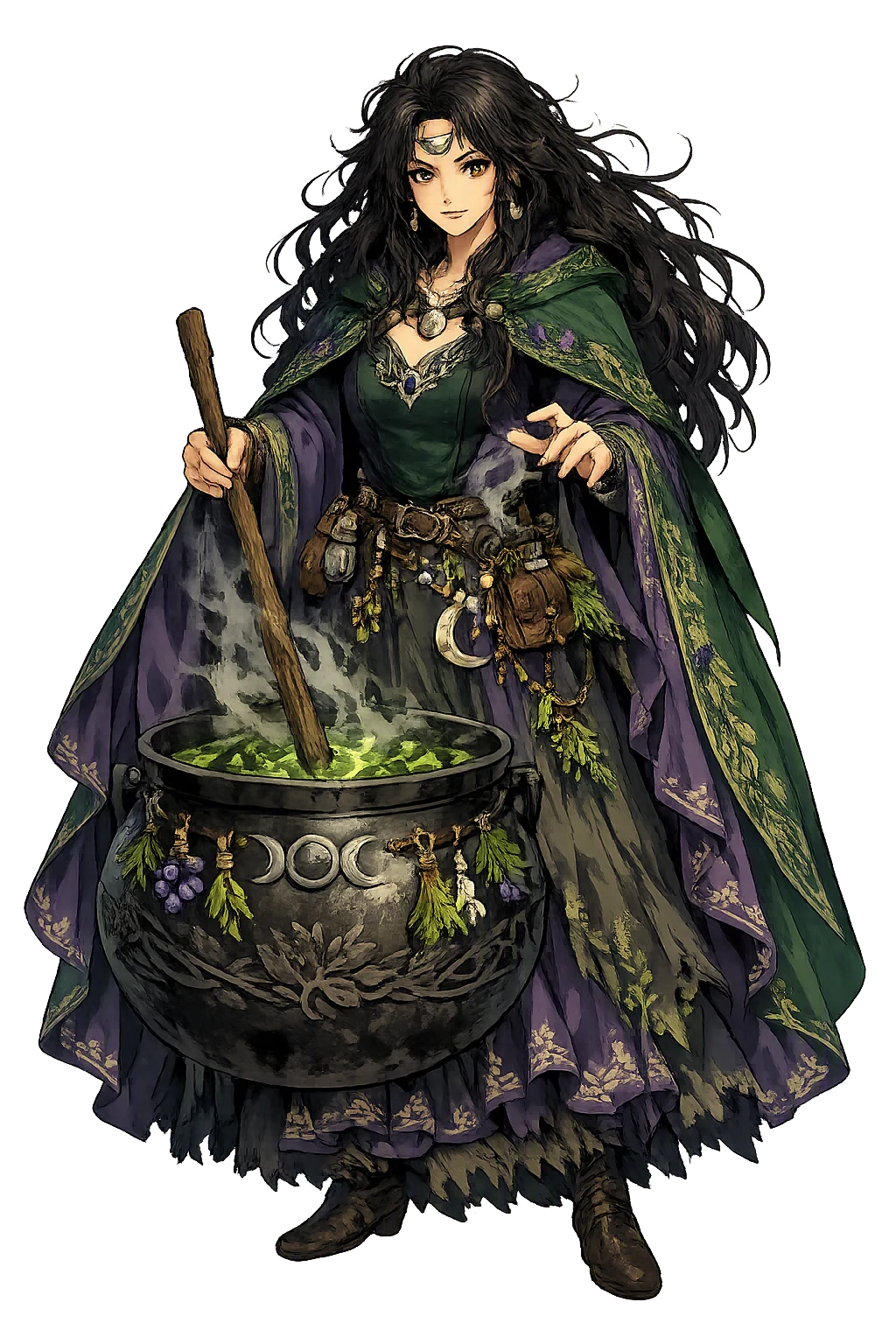
Stories of Ceridwen
Ceridwen's whole dossier is a single tale — Hanes Taliesin, the Tale of Taliesin — preserved in sixteenth-century Welsh manuscripts and customarily printed with the Mabinogion, though it is none of the Four Branches. Within that tale she owns its great engine: the cauldron, the hunt, and the rebirth.
In the beginning, the tale says, Ceridwen lived beside Llyn Tegid in the land of Penllyn, the wife of Tegid Foel — Tegid the Bald — whose name the lake still carries. They had two children whose fortunes were weighed in opposite scales: a daughter, Creirwy, the fairest maiden in the world, and a son, Morfran, so dark and ill-favoured that he was called Afagddu, Utter Darkness. No god could have made the boy handsome; but Ceridwen was skilled in the arts, and she resolved to give him what nature had refused — knowledge and the gift of poetry, so that his birth might yet be honoured among men of culture. The household is the tale's moral center of gravity: everything that follows — the cauldron, the chase, the sea — is a mother's engineering on behalf of a child the world despised. Welsh tradition never asks whether her favoritism was just; it asks what a mother with power will do, and then follows the answer for a year and a day.
From the books of the feryllt — the Welsh name for the alchemist's art — Ceridwen compounded a cauldron of Inspiration and Science. It must boil a year and a day, ceaselessly, until three drops of the spirit of inspiration should be won from it. To keep the vigil she set a blind man, Morda, to kindle the fire beneath, and a servant-boy, Gwion Bach, son of Gwreang of Llanfair in Powys, to stir the pot. The design was exact and the patience enormous: everything in the tale that follows is the unmaking of this design by a single splash. A year and a day is not a deadline but a discipline. The tale insists that inspiration, like ale, is a product of time, fire, and someone else's ceaseless labor — and that the brewer who does everything right is already at the mercy of the last hour, when the drops rise and every plan becomes a hope.
At the year's end the three charmed drops leapt from the cauldron — and fell, not on Morfran, but on the finger of Gwion Bach. The boy put his burning finger in his mouth, and in that instant all the awen was his: he knew all that was past and all that was to come, and knew above all that Ceridwen would kill him. He fled. She pursued; and the pursuit is the oldest Welsh telling of the magic flight, the transformation chase of the folktales. He became a hare; she became a greyhound and gained on him. He leapt into a river and became a fish; she became an otter-bitch behind him. He rose into the air as a bird; she was a hawk on his wing. Every shape he took, she took its hunter — and the chase is a catalogue of the world's appetite, which the boy learns at full speed. The myth encodes what every poet since has suspected: to receive the awen is to become quarry.
Spent at last, Gwion dropped into a barn and hid himself as one grain of winnowed wheat on the threshing-floor. Ceridwen became a high-crested black hen, went to the wheat, found the grain, and swallowed it. The swallowing is the tale's hinge: she carried him nine months, and when she bore him again he was so beautiful that she could not do what she had sworn — she could not kill him. So she sewed him in a hide bag and cast him into the sea, to the mercy of God, on the twenty-ninth of April. With that, Ceridwen passes out of her own story; she never appears again. The oath-breaking is the tale's quiet miracle: the witch who swore to kill cannot kill, and the mercy she substitutes — the sea — delivers him to exactly the fate she feared most, a greatness she never planned. With that, Ceridwen passes out of her own story; the tale follows the boy to the water and lets the witch of Llyn Tegid rest, her cauldron empty, her work done, her name over the door of every song that comes unplanned.
The sea carried the bag to the salmon-weir of Gwyddno Garanhir, near the mouth of the Dyfi, and there on May Day Gwyddno's son Elffin found it among the fish. Opening it, he saw the boy's forehead and cried out what became a name: 'Behold the radiant brow' — tal iesin. 'Taliesin be I called,' the child answered, and as Elffin carried him home on horseback the boy sang his first poem, a song of consolation: Fair Elphin, cease your weeping. Years later, when Maelgwn Gwynedd imprisoned Elffin, the boy Taliesin went to the king's court, shamed every bard in the hall with poems they could not match, foretold the king's death, and freed his foster-father. The inspiration Ceridwen brewed for one son had become the making of another: the greatest poet of the Welsh tradition is, in the end, her child — swallowed, carried, born again, and set adrift by her own hands. The tale does not call her defeated. It simply follows the boy to the sea, and lets her failure stand as the only kind of success the awen has ever accepted.
The Cauldron of Awen, the Three Drops, the Flight of Shapes
Ceridwen is the keeper of the cauldron of awen — the poetic inspiration of Welsh tradition. From her house by Llyn Tegid she brews a year and a day for the three drops of inspired knowledge, hunts the servant-boy who steals them through every shape in creation, swallows him as a grain of wheat, and gives him back to the world as Taliesin, the greatest poet Wales remembers. The early Welsh sources concur on the essential fact: she is the owner of the cauldron that is the source of poetic inspiration.
Boiled a year and a day from the books of the feryllt, the alchemist's art, until three drops of inspired knowledge should rise from it.
All the virtue of the brew gathered in three drops — meant for her ugly son, splashed instead on the finger of Gwion Bach, who put it to his lips.
Hare and greyhound, fish and otter, bird and hawk — the pursuit through every form until the grain of wheat meets the high-crested black hen.
The lake of Tegid Foel — modern Bala Lake, the largest natural lake in Wales — beside which her household stood and which still keeps her husband's name.
From the original script to the living URL
Ceridwen
The name survives in scholarly transliteration. Ceridwen is the standard Celtic romanisation, documented in academic sources — “Bent or crooked woman”. Because the spelling uses only Latin letters, the form is the same in both ASCII and Unicode.
No indigenous writing system is securely attested for individual celtic names. The form shown is a modern scholarly transliteration.
ceridwen
The plain ceridwen form is identical to the Unicode restoration. Because this name is already written in Latin letters, no diacritics, stress, or script information were lost — only capitalization differs.
Ceridwen
The Unicode restoration does not need to recover lost marks for Ceridwen. Its value is canonical spelling and consistent cataloguing, not the reconstruction of erased orthography. The domain is readable as-is to both DNS and humanity.
Ceridwen.com
This restoration is written entirely in ASCII letters — no Punycode encoding stands between Ceridwen and the DNS. The domain reads identically to machines and to human eyes.
Owned, ideal, and ASCII forms of Ceridwen
Ceridwen
The full Unicode restoration. ceridwen.com is not in the PuniCodex collection — it is watched for release; if it drops, this temple upgrades to an owned flagship.
How Ceridwen was spoken
How Ceridwen is preserved in writing
No indigenous writing system is securely attested for individual celtic names. The form shown is a modern scholarly transliteration.
Contribute scholarly provenance →The lore you have read is the living myth. Extended Lore opens the scholarly vault beneath it: the cult and its material remains, a history of the image, the name after antiquity, a meditation on what the name still means, and the full scholarly apparatus — etymology, orthography, sources.
Enter Extended Lore