PuniCodex

Extended Lore

Ceridwen

Etymology · Phonology · Orthography · Cultural Legacy · Primary Sources

Tier 2 Ceridwen
Ceridwen — Inspiration, Transformation
01

Quick Facts

Essential information about Ceridwen, Inspiration, Transformation

Scholarly TransliterationCeridwen
Unicode RestorationCeridwen
Reconstructed Pronunciation/kɛrˈɪd.wɛn/
PantheonCeltic
DomainInspiration, Transformation
MeaningBent or crooked woman
ClassificationTier 2
Primary DomainCeridwen
Sacred SymbolsThe cauldron, The three drops, The high-crested black hen, The hide bag, The weir on the Dyfi
02

Etymology & Word Family

From original script to Unicode restoration

Scholarly Transliteration Ceridwen Ceridwen — "Bent or crooked woman"
Unicode Restoration Ceridwen Restored stress, length, and script
Modern ASCII ceridwen Plain-ASCII fallback

Ceridwen is Tier 2 by the mechanical rule: the Welsh form is already plain ASCII — there is no diacritic and no distinctive letter for the restoration to recover, and only the capital distinguishes the restored form from the input. The etymology is a genuine scholarly debate: Ifor Williams derived the name from an original Cyridfen, 'crooked woman', while the traditional analysis reads cerdd 'poetry' + gwen 'fair, blessed'; the handbooks register both rather than settle the question.

03

Unicode Character Breakdown

Character-by-character philological analysis

CharacterUnicodeNameBlockPhonetic Role
CU+0043Latin Capital Letter CBasic LatinSame, capitalized
eU+0065Latin Small Letter EBasic LatinSame
rU+0072Latin Small Letter RBasic LatinSame
iU+0069Latin Small Letter IBasic LatinSame
dU+0064Latin Small Letter DBasic LatinSame
wU+0077Latin Small Letter WBasic LatinSame
eU+0065Latin Small Letter EBasic LatinSame
nU+006ELatin Small Letter NBasic LatinSame

The Tier 2 classification reflects how much of the original phonology this restoration preserves — stress and vowel length for Greek names, distinctive letters and diacritics for every other tradition.

04

Cultural Significance

From ancient cult to modern Unicode

Ancient Domain

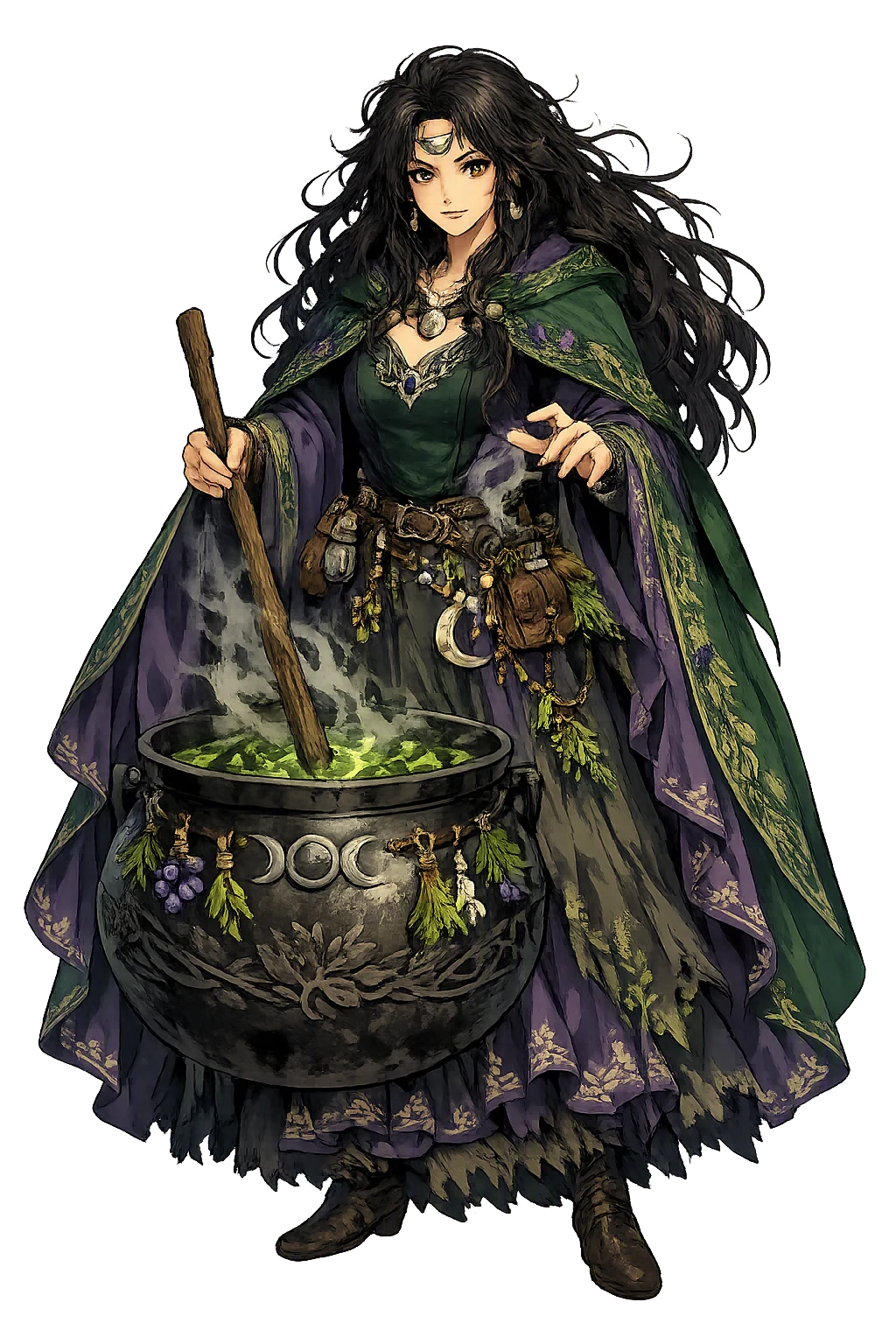
Ceridwen is the keeper of the cauldron of awen — the poetic inspiration of Welsh tradition. From her house by Llyn Tegid she brews a year and a day for the three drops of inspired knowledge, hunts the servant-boy who steals them through every shape in creation, swallows him as a grain of wheat, and gives him back to the world as Taliesin, the greatest poet Wales remembers. The early Welsh sources concur on the essential fact: she is the owner of the cauldron that is the source of poetic inspiration.

Ceridwen in Later Traditions

The strongest cross-border parallels are Irish. The accidental acquisition of a wisdom brewed for another is the plot of the Irish boyhood deeds of Finn mac Cumaill: cooking the salmon of knowledge for his master Finnéces, the boy Finn burns his thumb, puts it in his mouth, and the knowledge intended for the teacher passes to the servant — the same economy of the three drops and the burning finger. The swallowing that becomes rebirth has its Irish twin in Tochmarc Étaíne, where Étaín, transformed into a fly, falls into a cup of wine, is swallowed by the wife of Étar, and is born again into the mortal world. And the cauldron itself is pan-Celtic furniture: [[dagda|the Dagda]]'s cauldron from Murias feeds every company that comes to it, while the Old Irish text The Cauldron of Poesy locates a cauldron of poetry inside every human being. Folklorists — Juliette Wood chief among them — have shown that Hanes Taliesin braids these native strands with international folktale types, above all the magic flight with its transformation chase. The last syncretism is modern: Iolo Morganwg's Barddas set Ceridwen and the awen at the centre of revival Druidry, and modern Druids and pagans honour her as goddess of the cauldron — a reception Ronald Hutton's histories of the revival document and dissect.

Modern Legacy

Lady Charlotte Guest carried the Tale of Taliesin into English in the nineteenth century, appended to her Mabinogion, and the witch of Llyn Tegid entered the English-speaking imagination beside the Four Branches she never belonged to. Patrick K. Ford's edition and translation fixed the tale's modern scholarly form. Robert Graves made her a figure of international consequence: The White Goddess (1948) read Ceridwen's cauldron and her hunt as the grammar of all true poetry, and though Celticists have never accepted Graves's method, his book set her at the centre of twentieth-century writing about the muse. In Wales the awen she brewed never left the tradition — the word still names poetic inspiration at the National Eisteddfod, and modern Druid orders invoke it in her name — while modern paganism worldwide honours her as keeper of the cauldron of transformation. The name itself, rare in the medieval record, has come back into use as a Welsh given name, carried by the only myth in the language in which a goddess's failure becomes a nation's poetry.

Unicode Restoration as Cultural Act

Restoring Ceridwen in a domain name is more than orthographic accuracy. It is a statement that the internet should recognize the full range of human writing — not only the ASCII keyboard.

05

Frequently Asked Questions

Common questions about Ceridwen, Inspiration, Transformation, and Unicode restoration

01How do you pronounce Ceridwen?

In reconstructed pronunciation, Ceridwen is /kɛrˈɪd.wɛn/ — approximately 'keh-RID-wen' — every c is hard, the r is rolled, and the stress falls on the middle syllable, the Welsh penult..

02What does Ceridwen mean?

Ceridwen means Bent or crooked woman in the celtic tradition.

03What are the symbols of Ceridwen?

Ceridwen is associated with The cauldron (Inspiration brewed by art and patience — knowledge as something cooked, not granted), The three drops (The whole of awen compressed into an accident — inspiration that chooses its own vessel), The high-crested black hen (The final shape of the hunt: the swallowing that is not death but the first cell of a poet), The hide bag (The coracle-skin sewn round the unwanted child and given to the sea — rejection that becomes deliverance), The weir on the Dyfi (Gwyddno's salmon-weir where the bag comes to rest — the threshold between the hunted boy and the radiant brow).

04Why restore Ceridwen in Unicode?

Plain ASCII ceridwen strips the stress, length, and script that make the name specific. Unicode restoration returns the name to its original written dignity.

05What is the most important myth about Ceridwen?

In the beginning, the tale says, Ceridwen lived beside Llyn Tegid in the land of Penllyn, the wife of Tegid Foel — Tegid the Bald — whose name the lake still carries. They had two children whose fortunes were weighed in opposite scales: a daughter, Creirwy, the fairest maiden in the world, and a son, Morfran, so dark and ill-favoured that he was called Afagddu, Utter Darkness. No god could have made the boy handsome; but Ceridwen was skilled in the arts, and she resolved to give him what nature had refused — knowledge and the gift of poetry, so that his birth might yet be honoured among men of culture.

06

Scholarly Sources

The philological foundations of this restoration

Every claim on this page is grounded in established scholarship. The orthographic restorations follow disciplinary convention. The etymological chain follows the best available reference works. This is not invention — it is resurrection through scholarship.

Lexicography & Philology

  • Mabinogion
  • MacKillop

Primary Texts

  • Bartrum, Peter C., A Welsh Classical Dictionary (Aberystwyth: National Library of Wales, 1993), s.v. Ceridwen — early spellings Kerritwen, Kyrridven; the association with Ogyrwen

Archaeology & Art History

  • Material evidence — iconography, inscriptions, and temple archaeology — for Ceridwen and related cults.
  • Ceridwen is a textual figure: no temple, votive deposit, or inscription names her, and pre-Christian Wales left no theonymic epigraphy of the continental kind. Her witnesses are manuscripts. The fullest early text of Hanes Taliesin is embedded in the great world-chronicle of Elis Gruffydd, a Welsh soldier and chronicler, compiled c. 1530–1552 (Aberystwyth, National Library of Wales, MS 5276D); a second version was copied by the recusant scribe John Jones of Gellilyfdy around 1607. The name itself is older than its tale: medieval Welsh poetry preserves it in spellings such as Kerritwen and Kyrridven, and the triads' editors record that the early sources agree on her one fixed attribute — the cauldron of awen. The geography of the story is real and still legible: Llyn Tegid, her lake, is Bala Lake in Gwynedd, the largest natural lake in Wales, which keeps her husband Tegid Foel's name; and Gwyddno's weir, where the bag comes ashore, stands in the tradition at the Dyfi estuary below his drowned realm. No sanctuary of hers is known, and none is claimed: her monument is the tale itself, and the lake that still carries the name.

Religious Studies

  • Hanes Taliesin (The Tale of Taliesin) — ed. Patrick K. Ford, Ystoria Taliesin (Cardiff: University of Wales Press, 1992); trans. Ford, The Mabinogi and Other Medieval Welsh Tales (Berkeley, 1977)
  • The Mabinogion, trans. Lady Charlotte Guest (1838–49; the Tale of Taliesin appended in later editions)
  • Bromwich, Rachel, ed., Trioedd Ynys Prydein: The Triads of the Island of Britain, 3rd ed. (Cardiff, 2006), p. 309 — 'the early sources concur in presenting Ceridwen as the owner of a cauldron which was the source of poetic inspiration (awen)'; Ifor Williams' proposed Cyridfen, 'crooked woman'
  • MacKillop, James, Dictionary of Celtic Mythology (Oxford, 1998), s.v. Ceridwen — the lexicon's cited authority for this entry
  • Koch, John T., ed., Celtic Culture: A Historical Encyclopedia (ABC-CLIO, 2006), s.vv. Ceridwen, Taliesin
  • Geiriadur Prifysgol Cymru / A Dictionary of the Welsh Language (GPC), s.v. Ceridwen
  • Macgnímartha Finn (The Boyhood Deeds of Fionn); Nagy, Joseph Falaky, The Wisdom of the Outlaw (Berkeley, 1985) — the salmon of knowledge parallel
  • Tochmarc Étaíne, ed. and trans. Bergin and Best, Ériu 12 (1938) — the swallowing and rebirth parallel
  • Breatnach, Liam, ed., 'The Cauldron of Poesy', Ériu 32 (1981) — the Old Irish cauldron of poetry
  • Wood, Juliette, 'The Elphin Section of Hanes Taliesin', Études Celtiques 18 (1981) — the folktale structure of the tale
  • Graves, Robert, The White Goddess (London, 1948) — Ceridwen as muse-goddess; the modern reception
  • Hutton, Ronald, The Druids (London, 2007) — Iolo Morganwg, the Barddas, and the awen in the Druid revival
Return

The Surface Awaits

You have traced the name from its earliest attestation to its Unicode restoration. Now return to the myth. The story is where the name lives.

Back to Lore
Ceridwen mascot