Stories of Qāyīn
Qāyīn's mythology is short, dense, and endlessly reinterpreted. In a few verses, Genesis gives us the first birth, the first vocation, the first sacrifice, the first rejection, the first murder, the first lie, the first curse, and the first city.
In Eve's cry — 'I have acquired a man with the help of the LORD' (Genesis 4:1) — the Hebrew qaniti, 'I have acquired,' rings on the name Qāyīn itself; the mother already hears what the son will become. Abel (Hevel) means 'breath' or 'vapor,' and the text treats him like one: he appears only to be slain. The brothers bring parallel offerings — fruit of the ground, firstlings of the flock — 'and the LORD had regard for Abel and his offering, but for Cain and his offering he had no regard.' No reason is given, and the silence is the story's engine: later readers supplied motives by the shelf-full, but the text refuses, and the refusal is honest — favor, like weather, is not always legible. What matters is what Cain does with the unexplained. God meets him before the fall: 'Why are you angry? ... sin is crouching at the door; its desire is for you, but you must rule over it.' The first temptation scene in scripture is a warning delivered in the second person singular — God speaks to the murderer before the murder, and the chapter's whole weight hangs on that one unsent sentence.
Cain speaks to Abel — the text gives no content to the conversation, and later tradition filled the gap with a quarrel over land or over a twin sister (the Book of Jubilees 4 makes the brothers twins born with sisters, and their rivalry the world's first inheritance dispute) — and then, when they were in the field, Cain rose up against his brother and killed him. No weapon is named, no blow described: the Bible's first human death gets less narrative attention than any animal sacrifice in the chapter. Then God asks the question that has not stopped being asked: 'Where is Abel your brother?' And Cain answers with the first lie spoken to God: 'I do not know; am I my brother's keeper?' The grammar of the retort is immortal — a rhetorical question used as a wall, an appeal to the absurdity of responsibility, the oldest evasion on record. Every ethics since is a footnote to that unanswered question; the murderer's deflection became the syllabus of civilization, and the field where it happened has never been located because it is everywhere.
'What have you done? Listen — your brother's blood cries out to me from the ground!' (Genesis 4:10). The earth, which Cain worked, has become a witness that cannot be silenced, and God pronounces the sentence from the same soil: now cursed from the ground that received the blood, it will no longer yield to Cain its strength; he will be a fugitive and a wanderer on the earth. Cain's protest is the first recorded plea against a disproportionate punishment: 'My punishment is greater than I can bear; whoever meets me will kill me.' And here the story performs its most startling act of mercy — God sets a sign (ʾôt) on Cain, not as a stigma but as a shield: 'Not so! Whoever kills Cain will suffer a vengeance sevenfold.' The mark protects the killer from the very cycle he started. Exiled east of Eden to the land of Nod — 'Wandering' — he walks out under guard. Justice and mercy are braided from the very first crime: the God who curses the murderer still stands between him and the mob, and the mark of Cain was a shelter long before it was a scar.
Exiled to Wandering, Cain does the most characteristically human thing in the chapter: he builds. His son is named Enoch, and the first city in the Bible is named for the boy — a wall against the world, built by the man the world could not keep. And in that city, culture explodes from his line: Jabal, father of tent-dwellers and cattle-herders; Jubal, father of the lyre and the pipe; Tubal-cain, 'forger of every bronze and iron tool.' Music, architecture, and metallurgy are all Cainite inventions — civilization born in the murderer's household. The line closes with Lamech's terrible song to his two wives: 'I have killed a man for wounding me, a young man for striking me; if Cain is avenged sevenfold, truly Lamech seventy-sevenfold.' The arithmetic of vengeance has learned to compound. The Bible places the concert and the sword in one family tree: every city, every instrument, every blade descends from the man the ground itself testified against — and the story leaves us holding both facts at once, unable to set either down.
Tiller, Outcast, Marked Man
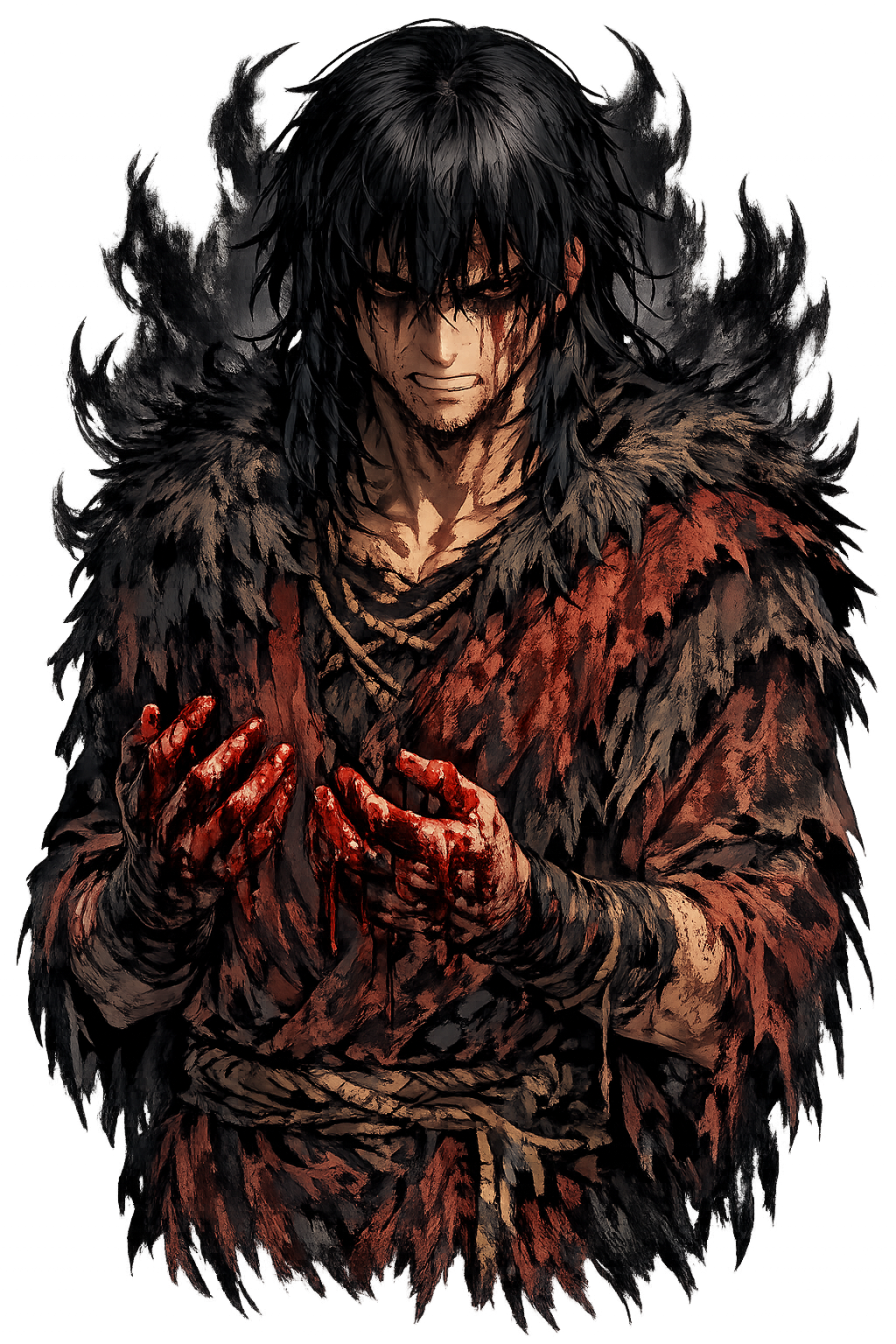
Qāyīn is the first child of the first couple and the first human to shatter the world he was born into. A tiller of soil, he brings the fruit of his labor to God and sees it rejected while his brother's offering is accepted. The rejection does not merely disappoint him; it unlocks something ancient and violent. His story is the Bible's first meditation on envy, anger, and the blood that cries out from the ground.
Cain works the soil, the oldest human vocation; his offering is the fruit of the earth he has labored over (Genesis 4:2–3).
God looks with favor on Abel's offering but not on Cain's; the text never explains why, leaving the reader with the mystery of divine preference (Genesis 4:4–5).
After the murder, God places a sign on Cain to protect him from vengeance, transforming the killer into a wandering, guarded man (Genesis 4:15).
Cain names his city Enoch after his son, becoming the biblical ancestor of tent-dwellers, musicians, and metalworkers (Genesis 4:17–22).
From the original script to the living URL
קַיִן
The name in its original Canaanite form. Qāyīn (קַיִן) is attested in the source tradition — “First son of Adam and Eve”. Its macron-length vowels carry the full phonetic and orthographic weight of the source tradition.
qayin
Reduced to plain qayin, the name loses everything that made it specific: macron-length vowels. What remains is an ASCII string that machines can parse but that no longer speaks with its original voice.
Qāyīn
The Unicode restoration recovers what ASCII flattened. Qāyīn restores macron-length vowels, returning the name to its original written dignity. The domain encodes to Punycode, but the browser displays the truth.
Qāyīn.com → xn--qyn-1oa5s.com
The non-ASCII characters in Qāyīn are encoded while the ASCII remains visible. To the DNS, it is Punycode. To humanity, it is Qāyīn.
Owned, ideal, and ASCII forms of Qāyīn
Qāyīn
Restores קַיִן. The live temple domain — qāyīn.com.
qayin
Flattens קַיִן. The plain ASCII fallback — what DNS and legacy systems see.
How Qāyīn was spoken
How Qāyīn travels from ancient script to the modern URL
Hebrew Qayin; the name is traditionally connected with qānîti “I have gotten" (Genesis 4:1) or with a root for “smith, metalworker".
First Murderer
The Unicode restoration Qāyīn uses registrable Latin diacritics; the Ugaritic form is not registrable in .com.
The lore you have read is the living myth. Extended Lore opens the scholarly vault beneath it: the cult and its material remains, a history of the image, the name after antiquity, a meditation on what the name still means, and the full scholarly apparatus — etymology, orthography, sources.
Enter Extended Lore