PuniCodex

Extended Lore

קַיִן Qāyīn

Etymology · Orthography · Cult · Iconography · Reception · Sources

Tier 1 Qāyīn.com
Qāyīn — First Murderer
01

Quick Facts

Essential information about Qāyīn, First Murderer

Original Scriptקַיִן
Unicode RestorationQāyīn
Reconstructed Pronunciation/qaˈjiːn/
PantheonCanaanite
DomainFirst Murderer
MeaningFirst son of Adam and Eve
ClassificationTier 1
Primary DomainQāyīn.com
Sacred SymbolsPlowshare, Blood, The mark, City walls, Bronze and iron tools
02

Etymology & Word Family

From original script to Unicode restoration

Original Script קַיִן Qāyīn — "First son of Adam and Eve"
Unicode Restoration Qāyīn Restored stress, length, and script
Modern ASCII qayin Plain-ASCII fallback

The name Qāyīn carries the orthographic signature of the canaanite tradition: קַיִן. Unicode restoration recovers what ASCII flattens.

03

Unicode Character Breakdown

Character-by-character philological analysis

CharacterUnicodeNameBlockPhonetic Role
QU+0051Latin Capital Letter QBasic LatinSame, capitalized
āU+0101Latin Small Letter A with MacronLatin Extended-AMacron: long vowel
yU+0079Latin Small Letter YBasic LatinSame
īU+012BLatin Small Letter I with MacronLatin Extended-AMacron: long vowel
nU+006ELatin Small Letter NBasic LatinSame

The Tier 1 classification reflects how much of the original phonology this restoration preserves — stress and vowel length for Greek names, distinctive letters and diacritics for every other tradition.

04

Cult & Worship

How the sacred was kept — rites, sanctuaries, remains

The Cult

Cain was never worshipped, and no sanctuary, festival, or priesthood ever bore his name; the evidence for a cult is a deliberate blank. What the Bible preserves instead is the first cult narrative in scripture — a man bringing the fruit of his tilling to God, and the offering refused — which likely reflects the later Israelite practice of presenting firstfruits and firstlings at the altar. The only ancient group said to have honored Cain were the Cainites, a second-century Gnostic sect known from Irenaeus, who read his story as resistance to a lesser creator god — a cult of reversal recorded only by its enemies. Any modern 'worship' of Cain belongs to occult revivalism, not to antiquity.

In the Earth

No archaeological evidence links to the individual Cain, whose story belongs to the primeval history of Genesis rather than to datable history. The narrative does reflect the broader transition to agricultural and pastoral lifeways in the ancient Levant during the Neolithic and Chalcolithic periods. Early settled communities, metallurgy, and the tension between farmers and herders are all part of the material backdrop against which the story was told.

05

Iconography

How Qāyīn was imaged across the ages

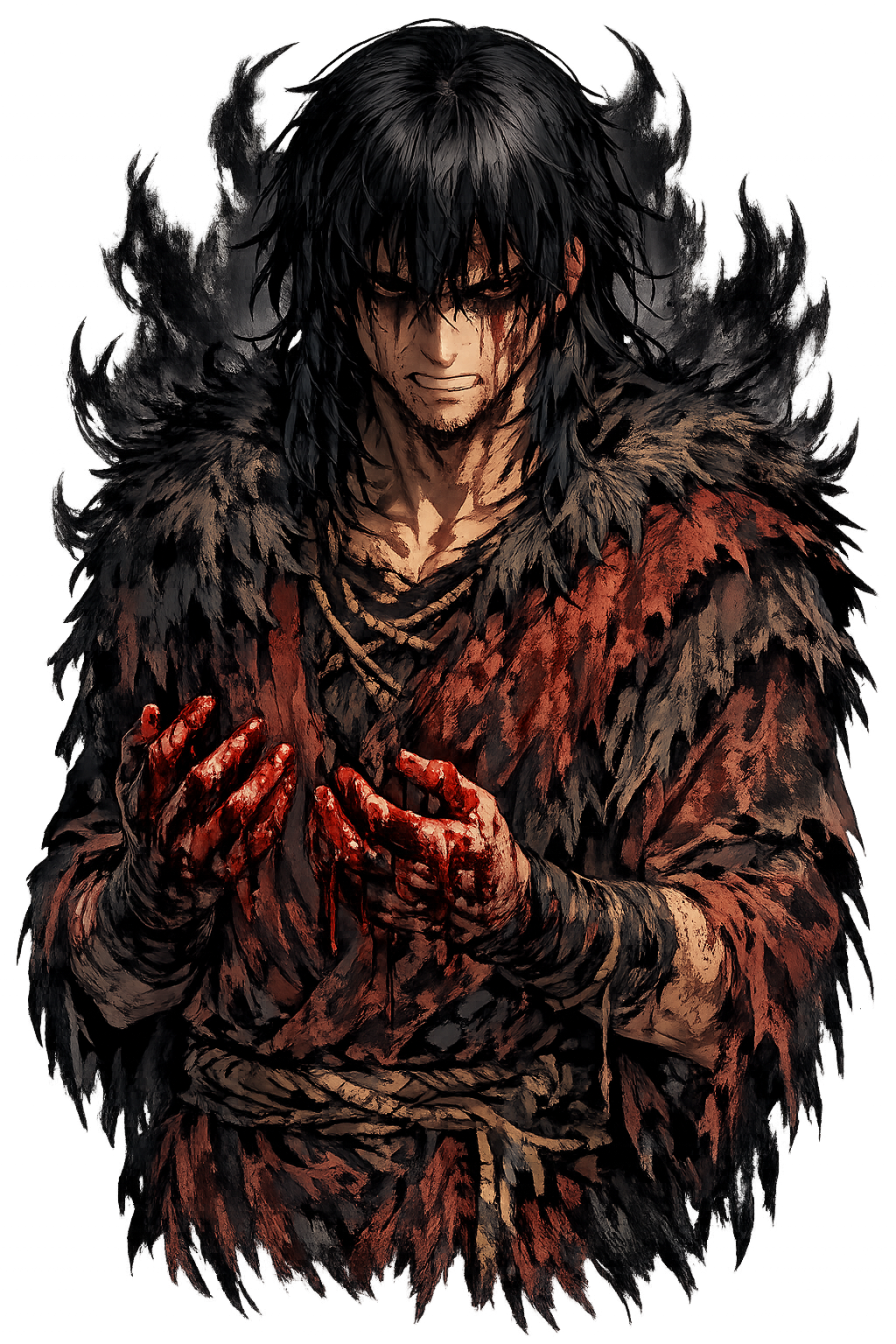
The Image

No image of Cain survives from ancient Israel, whose visual culture avoided the primeval story almost entirely. He enters art with early Christianity: fourth- and fifth-century sarcophagi and Roman catacomb frescoes pair his rejected offering with Abel's accepted lamb. Medieval art moved to the murder: the bronze doors of Hildesheim Cathedral (c. 1015) show Cain raising a weapon — later tradition made it the jawbone of an ass — over his kneeling brother, and Ghiberti's Gates of Paradise (1425–1452) compresses the offerings, the killing, and the curse into one crowded panel. The mark is rendered cautiously, as a sign, a glyph, or a shadow across the brow; no canonical form ever settled, because the text never says what it saw.

06

Reception & Transformation

The name after its own age — transmission, translation, survival

Afterlives

Genesis 4 traveled far and multiplied voices. The Septuagint and then the Vulgate — signum Cain — fixed the story in the two translations that carried it through late antiquity; Josephus retold it as history, Philo allegorized Cain as the self-loving soul, and the New Testament made Abel's accepted offering a byword for faith while Cain's act became 'of the evil one.' Augustine built Western political theology on the pair, making Cain's city the archetype of the earthly city founded in bloodshed. Medieval Europe heard the story in the mystery cycles — the Towneley Sacrificium Cayme et Abell is the great English example — and Reformation commentators pored over the unexplained rejection of his offering. Modern scholarship finally read the chapter as literature: source criticism assigned it to the Yahwist stratum, and philology recovered the name's pun on 'acquiring,' the mother's cry ringing under the whole tale.

Identifications Across Traditions

The Qur'an tells the story of Qābīl and Hābīl (Surah 5:27–31), offering a more explicit motive — Cain threatens to kill Abel because God accepts only Abel's sacrifice — and making Abel the first prophet-martyr; a raven shows Cain how to bury the dead. Gnostic traditions, especially the Cainites, reversed the biblical valuation and celebrated Cain as the one who resisted the creator god. Medieval Jewish legend filled in the silences of Genesis: Cain grew a horn, the mark was a letter of the divine name, and he was eventually killed by the blind Lamech, whom his own son led to mistake him for an animal. John Milton gave him a fallen grandeur in Paradise Lost, while Lord Byron made him a Romantic rebel against an unjust heaven. Across cultures, Cain is the figure who forces us to ask why violence begins and how it can be stopped.

Modern Legacy

Qāyīn and his brother have become the archetype of fratricide — every killing of brother by brother carries their names. The 'mark of Cain' has been misunderstood as a sign of racial blackness and used to justify slavery and racism, though the text gives no hint of ethnicity. In literature, Cain appears as the first rebel, the first exile, the first city-builder, and the first artist of violence. Psychologically, the 'Cain complex' names the rivalry between siblings that can turn deadly. The story's central question — 'Am I my brother's keeper?' — remains a test for every society.

07

The Meditation

What Qāyīn means — beyond the dictionary

Qāyīn is the first human being who does not know what to do with failure. His offering is rejected, and instead of asking why or changing, he destroys the one whose offering was accepted. In that, he is the ancestor of every envious heart that mistakes another's success for its own diminishment.

The ground that receives Abel's blood becomes a witness; it will not be silent. Cain is cursed from it because the earth has absorbed what should have lived. To meditate on Cain is to meditate on the moment before violence — the warning that sin is crouching at the door — and on how rarely we heed it. The story does not let us write him off as a monster; it shows us a farmer, a brother, a city-builder, a man who could have mastered the crouching thing and did not.

08

Frequently Asked Questions

Common questions about Qāyīn, First Murderer, and Unicode restoration

01How do you pronounce Qāyīn?

In reconstructed pronunciation, Qāyīn is /qaˈjiːn/ — approximately 'kah-YEEN' — the first consonant is a deep 'k' made at the back of the throat (like Arabic qāf); the second syllable is a long 'yeen'.

02What does Qāyīn mean?

Qāyīn means First son of Adam and Eve in the canaanite tradition.

03What are the symbols of Qāyīn?

Qāyīn is associated with Plowshare (His identity as a worker of the soil, later ironically turned to violence), Blood (The blood of Abel that cries out from the ground and cannot be silenced), The mark (A protective sign whose exact nature is never described; later imagined as a horn, a letter, or a visible stigma), City walls (Enoch, the first city, built by an outcast as a refuge against the world he has wounded), Bronze and iron tools (Through his descendants Tubal-cain and others, Cain becomes associated with the crafts of metalwork).

04Why restore Qāyīn in Unicode?

Plain ASCII qayin strips the stress, length, and script that make the name specific. Unicode restoration returns the name to its original written dignity.

05What is the most important myth about Qāyīn?

“Two Brothers, Two Offerings” — the Genesis 4:1–7 story that anchors the mythology of Qāyīn, told in full on the lore page.

09

Scholarly Sources

The philological foundations of this restoration

Every claim on this page is grounded in established scholarship. The orthographic restorations follow disciplinary convention. The etymological chain follows the best available reference works. This is not invention — it is resurrection through scholarship.

◈

Lexicography & Philology

  • Abraham
◎

Primary Texts

  • The Ugaritic Baal Cycle; ritual texts from Ugarit and Phoenician inscriptions.
◉

Archaeology & Art History

  • Material evidence — iconography, inscriptions, and temple archaeology — for Qāyīn and related cults.
✦

Religious Studies

  • HALOT s.v. קַיִן
  • TDOT s.v. Cain
  • Genesis 4
  • Book of Jubilees 4:1–2
  • Qur'an, Surah 5:27–31
  • Milton, Paradise Lost, Books 11–12
Return

The Surface Awaits

You have traced the name from its earliest attestation to its Unicode restoration. Now return to the myth. The story is where the name lives.

Back to Lore
Qāyīn mascot