
How Brigid found its canonical form
The ASCII form brigid is not missing anything that this name requires. Brigid is the canonical spelling supported by the scholarly record and the tradition's scholarly conventions. This post explains what that form preserves, how it is pronounced, which narratives surround it, and why consistency matters. There are no recovered accents to celebrate; there is something more useful — a spelling whose history can actually be checked.
At a Glance
- Canonical name: Brigid
- ASCII form: brigid
- Meaning: "The Exalted One (from Old Irish Brigit)"
- Domain of influence: Poetry, Healing, Smithcraft, Fire
- Pantheon: Celtic
- Restoration: ASCII-equivalent form
Overview
Brigid (brigid) — Poetry, Healing, Smithcraft, Fire · The Exalted One (from Old Irish Brigit) — belongs to the Celtic tradition, where it is catalogued under the domain "Poetry, Healing, Smithcraft, Fire". The name means "The Exalted One (from Old Irish Brigit)".
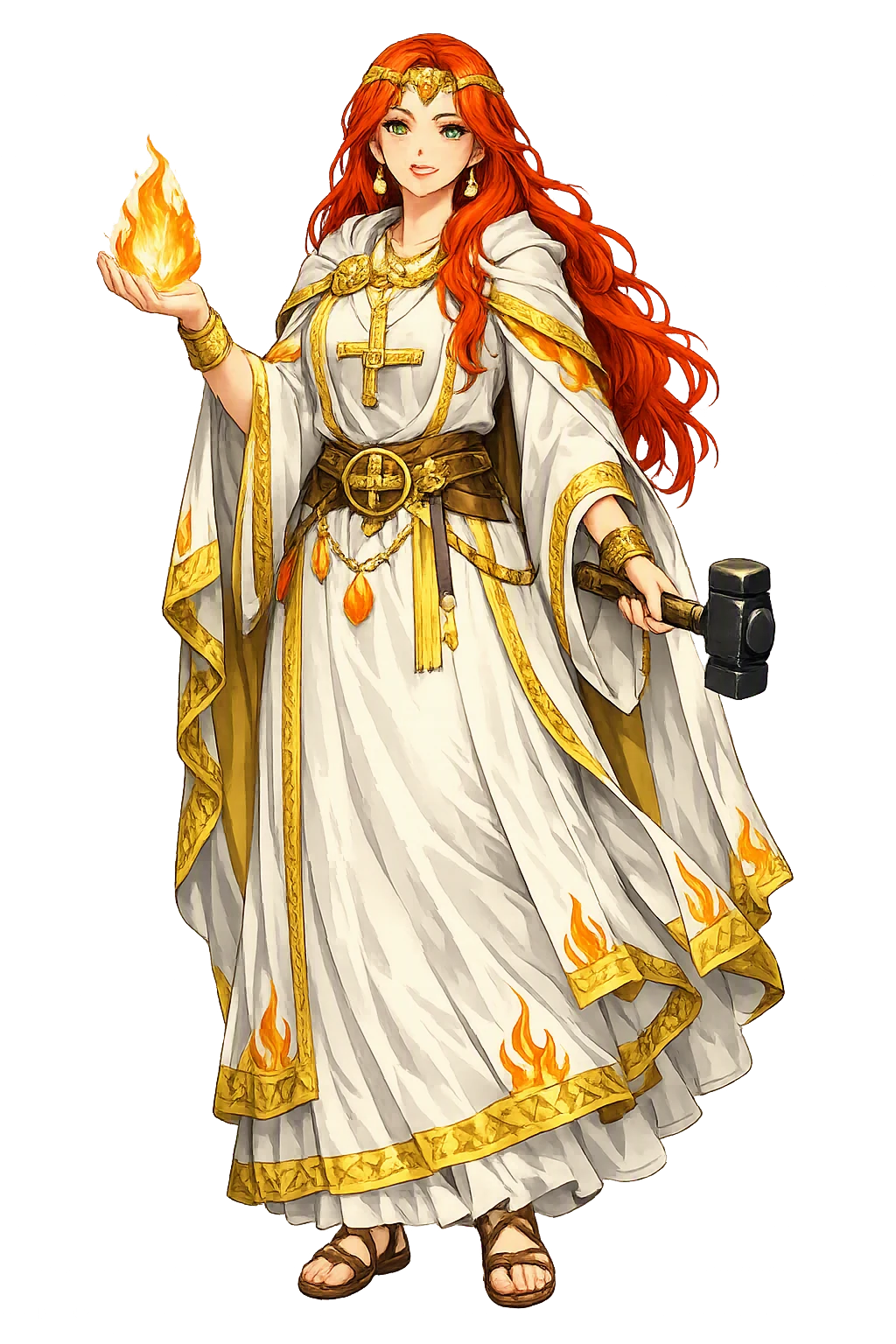
Brigit, daughter of the Dagda, is the triple hearth of the Irish gods: Cormac's Glossary gives her two sisters of the same name — Brigit the smith and Brigit the leech beside Brigit the poet — so that the one name covers the forge, the well, and the word. Her feast is Imbolc, the first of February, when the ewes come into milk; and at Kildare a fire burned for her, Giraldus says, that no man might approach and no night ever saw go out.
PuniCodex records the canonical scholarly spelling Brigid and serves its temple at its temple. The displayed form is ASCII-equivalent — a description computed from the displayed form itself. The plain ASCII form brigid contains the same letters: no recovered diacritics or special encoding is claimed. The work here is consistent citation, capitalization, provenance, and cultural context.
The Name
No indigenous written attestation survives for this name; Brigid is a scholarly transliteration of the reconstructed spoken form. Etymologically the name means "The Exalted One (from Old Irish Brigit)".
The canonical spelling Brigid matches the conventional scholarly romanization. The plain ASCII form brigid contains the same letters, so no lost diacritics or encoding transition is claimed. The editorial work is to fix one reviewed reference spelling, preserve capitalization and provenance, and keep the original evidence visible. The displayed form is ASCII-equivalent — a description computed from the displayed form itself.
The letter-by-letter transformation runs:
- b → B — Same
- r → r — Same
- i → i — Same
- g → g — Same
- i → i — Same
- d → d — Same
The Original Script
No indigenous writing system is securely attested for individual celtic names. The form shown is a modern scholarly transliteration.
The form Brigid is therefore a scholarly transliteration rather than an attested ancient spelling; it encodes the reconstructed sound of the name for modern use, and no mark in it is decorative.
The normalized Old Irish form is Brigit — already plain ASCII in its modern scholarly spelling, with no diacritic or distinctive letter for the restoration to recover (hence a plain restoration by the mechanical rule). The medieval manuscripts wrote the name in Insular script, the Irish hand of the Latin alphabet; in the older Ogham alphabet it would have been notched ᚁᚏᚔᚌᚔᚈ (B-R-I-G-I-T), a normalized reconstruction only — no Ogham stone records the theonym. Because the name is pure ASCII, its .com was registered decades ago in the ordinary way: brigid.com is held by a third party outside the PuniCodex collection and is watched for release — no form of the name is currently owned, and this temple claims none.
Pronunciation
The reconstructed pronunciation of the name is /ˈbrʲiɣʲitʲ/ — Old Irish Reconstruction.
Phoneme by phoneme:
- Br- — Voiced bilabial stop [b] and slender (palatalized) trill [rʲ]; Old Irish r was always palatalized after an initial b in this name, as in modern Irish.
- -i- — Short front [i], held brief; in the later language the vowel lengthened, giving modern Irish Bríd.
- -g- — Voiced velar fricative [ɣ] between vowels — not a hard stop but a soft continuant, the sound Old Irish wrote g in medial position.
- -id — Short front [i] and slender dental [dʲ]; the final d was devoiced and palatalized, surviving as the -d of modern Bríd /bʲrʲiːdʲ/.
For the modern speaker, the closest approximation is: 'BRIJ-id' — like 'bridge' split in two, the g softened to a voiced fricative (a gargled g), both r and d slender; the modern Irish form Bríd is simply 'breed'.
Kindred and historical forms of the name:
- Old Irish — Brigit (genitive Brigte), daughter of the Dagda in the Mythological Cycle.
- Proto-Celtic — *Brigantī, 'the Exalted One', source also of the tribal name Brigantes and the Romano-British goddess Brigantia.
- Modern Irish — Bríd, /bʲrʲiːdʲ/, the living form of the name and of the saint.
- Scottish Gaelic and Manx — Brìde and Breeshey, the name carried into the sister Gaelic languages.
- Watched form — brigid.com — held outside the PuniCodex collection and watched for release; no form of the name is currently owned.
Brigid is a plain restoration by the mechanical rule: the normalized form is already plain ASCII — the Old Irish spelling Brigit carries no diacritic and no distinctive letter for the restoration to recover. Only the capital distinguishes the temple's form from the input; the name's fame, like Baldr's, vastly outruns its orthography.
Mythology
Irish tradition gives Brigit few long tales but a peculiar density of testimony: the great pseudohistory of the Lebor Gabála knows her genealogy, the battle-tale Cath Maige Tuired gives her the first keening heard in Ireland, and Cormac's Glossary preserves the triad that made her three goddesses in one name.
The Dagda's Daughter (Lebor Gabála Érenn)
The Book of Invasions places Brigit firmly in the family of the Túatha Dé Danann: Brigit the poetess, daughter of the Dagda, the good god who owns the cauldron and the club. The same tradition marries her to Bres, the half-Fomorian king whose beautiful face and niggardly rule nearly undid the Túatha Dé Danann, and gives her three sons — Ruadán, Iuchar, and Iucharba — so that the exalted one stands, by marriage and blood, on both sides of the great conflict of Irish myth. The later tradition adopted her sons into another house entirely, making them the three sons of Tuireann for whose killing Lugh exacted a blood-price. The Lebor Gabála is pseudohistory, written by Christian scholars ordering the gods into an ancestry, but its genealogies are the tradition's own filing system: Brigit belongs to the Dagda's house, and her griefs run through both armies.
Three Sisters, One Name (Sanas Cormaic)
Cormac mac Cuilennáin's glossary, compiled around 900 by the bishop-king of Cashel, preserves the tradition's clearest statement of her triple nature. Brigit, it says, is the poetess, daughter of the Dagda — and she had two sisters, Brigits also: Brigit the woman of smithcraft and Brigit the female physician, from whose names all the Irish used to call a goddess Brigit. Three crafts, three sisters, one name: from this single entry comes the familiar picture of the triple goddess of poetry, smithcraft, and healing. No saga ever dramatizes the three sisters — their entire biography is this glossary entry and the keening of the Second Battle — which is itself a kind of testimony: Brigit's worship was a matter of crafts and calendar, not of story. Whether the triad records three genuinely distinct figures or one goddess's three provinces arranged in the Irish love of threes, the Glossary is the witness every later account follows.
The First Keening in Ireland (Cath Maige Tuired)
The Second Battle of Mag Tuired gives Brigit her one moment of action, and it is grief. Her son Ruadán, sent by his Fomorian kin to spy on the smith Goibniu — whose forge armed the Túatha Dé — hurled a spear at the smith; Goibniu drew it out of his own side and cast it back, and Ruadán went to his father's camp to die. Brigit came to the field and bewailed her son — and the text says she wept and shrieked over him, the first keening and the first whistling for grief that was heard in Ireland. The tradition sets her love against her blood: she was of the Túatha Dé, her son of the Fomorians, and the battle made her choose which grief to keep. The inventor of lamentation is a terrible dignity: the goddess of the word is the one who first taught Ireland what a mother says at a grave — and the saga sets poetry's darkest strain beside the forge it avenges.
The Fire at Kildare (Giraldus Cambrensis, Topographia Hiberniae)
Writing about 1188, Gerald of Wales describes the wonder of Kildare with a traveller's precision: a fire hedged round with a circular fence of brushwood, which no male may cross — any man who tries, he says, does not escape Brigid's vengeance. Nineteen nuns tend the flame, one each night, each adding fuel; on the twentieth night the last nun lays the wood and says, 'Brigid, guard your fire, it is yours.' In the morning the fire is found still burning, and its ashes, Gerald marvels, never increase though the wood is always consumed. The nuns themselves, he adds, hold that once the fire is out it can never be rekindled — so it is never allowed to go out. Half a millennium earlier, Cogitosus's Life of St Brigit (c. 650) already described the same hearth tended at Kildare. Gerald records it as a marvel of the saint's church; scholarship has never doubted that the hedge, the number nineteen, and the unashing flame belong to a far older hearth.
Imbolc, the Ewe's Milk (Sanas Cormaic · the quarter days)
Her feast stands at Imbolc, the first of February, one of the four great hinges of the Irish year beside Beltaine, Lugnasad, and Samain. Cormac's Glossary explains the word itself as oimelc, 'ewe's milk' — the season when the sheep come into milk and the year's hunger begins to turn. The old texts keep the day as Brigit's own; the keening, the forge, and the word all gather at the one date, when the light is just beginning to return and the flocks give their first milk. In the Scottish Highlands the eve was kept with the rhyme Carmichael recorded in the Carmina Gadelica: the serpent will come from its hole on Bride's morn, though it dreads the cold. It is the oldest continuously observed fact about her: whatever else changed, the first of February stayed hers.
Symbols & Iconography
The iconography associated with Brigid concentrates in a small set of recurring attributes, each a compressed statement about the name:
- The flame of Kildare — The fire that neither dies nor accumulates ash — patronage that outlasts the night-watch of its keepers
- The anvil and the forge — Smithcraft, the making province — skill that transforms raw metal the way poetry transforms raw speech
- The holy well — Healing drawn from the ground — the countless wells of St Brigit where the leech-sister's province is still visited
- Fea and Femen, the two oxen — The Dagda's daughter's beasts, who gave their names to plains of Ireland — wealth and the working land
- Imbolc — The first of February, the milk returning to the ewes — the year's first hinge, kept as her day
Archaeology & Evidence
Brigit herself is unattested in pre-Christian Irish material: no Ogham stone, votive, or image names the goddess, and Ireland's Iron Age left no cult sites securely hers. Her name's material record lies across the water: Romano-British inscriptions honour Brigantia from the Wall country — most famously the relief from Birrens (Dumfriesshire), where the goddess stands with Minerva's globe, spear, and crown — and a Gaulish inscription from Volnay (Côte-d'Or) invokes Brigindu, the same name-element on the Continent. In Ireland the evidence is ecclesiastical and hydronymic: the monastic site of Kildare (Cill Dara, 'church of the oak'), with its round tower and its memory of the perpetual fire Giraldus describes, and the hundreds of holy wells dedicated to St Brigit, whose rag-trees and cure customs are the living deposit of the leech-sister's province.
Realm & Domain
Brigit, daughter of the Dagda, is the triple hearth of the Irish gods: Cormac's Glossary gives her two sisters of the same name — Brigit the smith and Brigit the leech beside Brigit the poet — so that the one name covers the forge, the well, and the word. Her feast is Imbolc, the first of February, when the ewes come into milk; and at Kildare a fire burned for her, Giraldus says, that no man might approach and no night ever saw go out.
The Sacred Flame
The perpetual fire of Kildare, tended by nineteen nuns in turn — on the twentieth night, Giraldus says, it was left to Brigid herself.
The Anvil
Smithcraft, one of the three provinces Cormac assigns to the sisterhood of Brigits — the forge where Goibniu's art and mortal craft meet.
The Poet's Harp
The first of her provinces in the Glossary — Brigit banfhiled, Brigit the woman-poet, patroness of the learned craft of filidecht.
The Rush Cross
St Brigid's cross, woven of rushes on Imbolc eve — the small loom on which the goddess's feast was carried into the saint's day.
Across Cultures
Brigit's syncretic life runs in two directions. Across the water, her name is one with the goddess Brigantia of Roman Britain, honoured in inscriptions from the Wall country and portrayed on the Birrens relief with Minerva's globe and spear — the interpretatio romana pairing the exalted one with the Roman goddess of craft and war-wisdom; the tribal Brigantes and the Gaulish Brigindu carry the same name-element, and the old comparison with Sanskrit bṛhatī, 'the high, exalted one', shows how deep the root runs. Within Ireland, the identification is Christian: Brigit of Kildare, the sixth-century saint whose feast falls on Imbolc, whose church kept a perpetual fire, and whose wonder-tales in Cogitosus's Life echo the goddess's provinces. Whether saint succeeded goddess, goddess was Christianized into saint, or two figures fused in one name, the sources do not let us decide — and Mac Cana and Koch both counsel holding the question open. What is certain is the continuity of the name: the Exalted One never left Ireland's calendar.
Kindred figures in the PuniCodex cross-tradition index include Asklēpiós (healing / medicine), Bhaiṣajyaguru (healing / medicine), Eir (healing / medicine), Gula (healing / medicine), Hēphaistos (fire / forge / craft), and Hoderi (fire / forge / craft).
Cultural Legacy
No Celtic deity has a longer unbroken afterlife. Imbolc is still celebrated as St Brigid's Day — Lá Fhéile Bríde — and since 2023 it has been a public holiday in the Republic of Ireland, the first named for a woman. Rushes are still woven into Brigid's crosses on the eve of the feast and hung above doors; hundreds of holy wells bear the saint's name, and the clootie and cure customs at them preserve the leech-sister's province in folk practice. Modern paganism and Celtic Reconstructionism restored the goddess explicitly, keeping Imbolc as the feast of the returning light and of the three crafts; poets, smiths, and healers alike claim her patronage. And the name itself — Brigid, Bridget, Bríd — never ceased to be given to Irish daughters, carrying the Proto-Celtic word for exaltation into every generation since the Iron Age.
The Scholarly Record
The account of Brigid given in this edition rests on the witnesses and reference works listed below. Lexica and etymological dictionaries secure the form and meaning of the name; the literary and religious texts supply the narrative evidence.
- Sanas Cormaic (Cormac's Glossary), s.v. Brigit (the three sister Brigits: poetess, smith, physician) and s.v. oimelc (Imbolc, 'ewe's milk').
- Cath Maige Tuired (The Second Battle of Mag Tuired), ed. and trans. Elizabeth A. Gray, Irish Texts Society 52 (1982) — Ruadán's death and the first keening in Ireland.
- Lebor Gabála Érenn (The Book of Invasions), ed. R. A. S. Macalister, Irish Texts Society — Brigit the poetess, daughter of the Dagda.
- Giraldus Cambrensis, Topographia Hiberniae II.34–36 (the perpetual fire of Kildare, the hedge, and the nineteen nuns).
- Cogitosus, Vita Sanctae Brigitae (Life of St Brigit of Kildare, c. 650).
- Vendryes, Lexique étymologique de l'irlandais ancien, s.v. Brigit (Proto-Celtic Brigantī, 'the Exalted One').
- Mac Cana, Celtic Mythology; Koch, Celtic Culture: A Historical Encyclopedia; Jackson, Language and History in Early Britain — s.v. Brigit, Brigantia, Brigantes.
A Meditation
Brigit is the rare goddess whose three provinces are one act seen from three sides. The smith and the poet do the same thing: they take what is raw — ore, breath — and by heat and pressure give it a form that outlasts them. The healer does it too, coaxing the broken body back toward the shape it was made for. Cormac's three sisters are really a single lesson: that making is sacred wherever it happens, at the anvil, on the tongue, or at the sickbed. Her fire at Kildare, hedged and watched and never consumed, is the emblem of that lesson — a flame tended by nineteen keepers that still belongs, on the twentieth night, to the name itself. Craft, kept in common, does not go out.
The Canonical Spelling
Brigid is the canonical spelling used by this temple. The plain ASCII form brigid contains the same letters, so there are no lost diacritics to recover and no special encoding transition to explain. What the temple preserves is the reviewed reference form: capitalization, conventional romanization, original evidence, and a stable place to inspect them. The value here is not added decoration; it is fidelity to the attested record.
Why This Record Matters
The letters in Brigid were never lost, and no replacement marks are needed to make them whole. The burden is instead one of fidelity: every use should carry the same attested spelling and the history attached to it. The PuniCodex temple keeps that form in circulation — as a digital address, a dataset entry, and a scholarly argument — so consistency becomes the easy choice rather than an accident of citation.
Explore Further
This post is one doorway into the temple. The home page carries the full character breakdown and the ambient canvas; the lore page tells the myths in long form; the Scholarly Edition preserves the sources, pronunciation data, and revision history; and the patron wall supports the restoration directly. For the wider map, browse the Lexicon, explore the Pantheon, or return to the PuniCodex blog.
Related Names
Sources
The full scholarly apparatus — every citation, revision, and review — lives in the Scholarly Edition. Key references for this post:
- Sanas Cormaic (Cormac's Glossary), s.v. Brigit (the three sister Brigits: poetess, smith, physician) and s.v. oimelc (Imbolc, 'ewe's milk').
- Cath Maige Tuired (The Second Battle of Mag Tuired), ed. and trans. Elizabeth A. Gray, Irish Texts Society 52 (1982) — Ruadán's death and the first keening in Ireland.
- Lebor Gabála Érenn (The Book of Invasions), ed. R. A. S. Macalister, Irish Texts Society — Brigit the poetess, daughter of the Dagda.
- Giraldus Cambrensis, Topographia Hiberniae II.34–36 (the perpetual fire of Kildare, the hedge, and the nineteen nuns).
- Lexicon authorities for this entry: Vendryes.