The Living Myth
Poetry, Healing, Smithcraft, Fire · The Exalted One (from Old Irish Brigit)
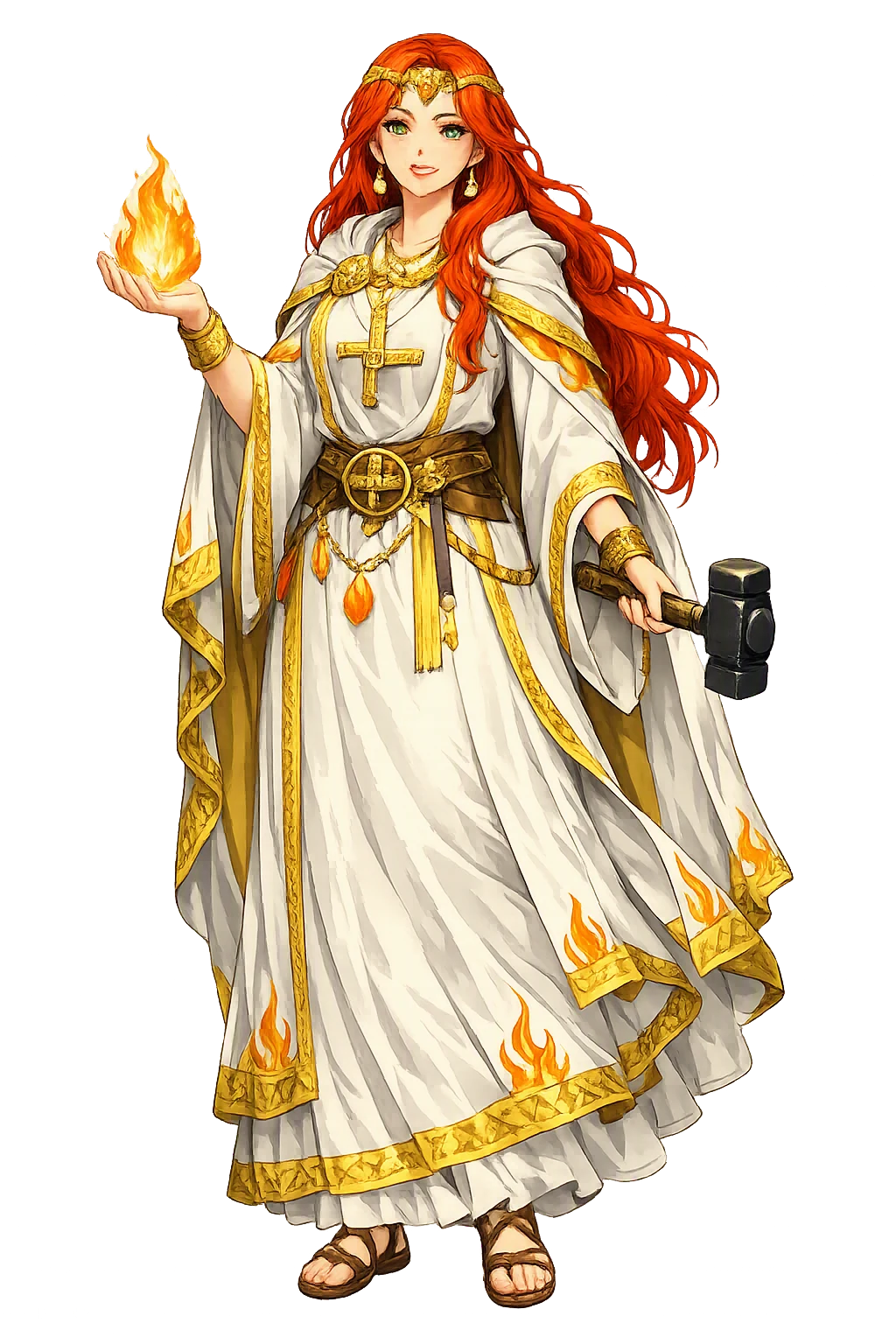
Stories of Brigid
Irish tradition gives Brigit few long tales but a peculiar density of testimony: the great pseudohistory of the Lebor Gabála knows her genealogy, the battle-tale Cath Maige Tuired gives her the first keening heard in Ireland, and Cormac's Glossary preserves the triad that made her three goddesses in one name.
The Book of Invasions places Brigit firmly in the family of the Túatha Dé Danann: Brigit the poetess, daughter of the Dagda, the good god who owns the cauldron and the club. The same tradition marries her to Bres, the half-Fomorian king whose beautiful face and niggardly rule nearly undid the Túatha Dé Danann, and gives her three sons — Ruadán, Iuchar, and Iucharba — so that the exalted one stands, by marriage and blood, on both sides of the great conflict of Irish myth. The later tradition adopted her sons into another house entirely, making them the three sons of Tuireann for whose killing Lugh exacted a blood-price. The Lebor Gabála is pseudohistory, written by Christian scholars ordering the gods into an ancestry, but its genealogies are the tradition's own filing system: Brigit belongs to the Dagda's house, and her griefs run through both armies.
Cormac mac Cuilennáin's glossary, compiled around 900 by the bishop-king of Cashel, preserves the tradition's clearest statement of her triple nature. Brigit, it says, is the poetess, daughter of the Dagda — and she had two sisters, Brigits also: Brigit the woman of smithcraft and Brigit the female physician, from whose names all the Irish used to call a goddess Brigit. Three crafts, three sisters, one name: from this single entry comes the familiar picture of the triple goddess of poetry, smithcraft, and healing. No saga ever dramatizes the three sisters — their entire biography is this glossary entry and the keening of the Second Battle — which is itself a kind of testimony: Brigit's worship was a matter of crafts and calendar, not of story. Whether the triad records three genuinely distinct figures or one goddess's three provinces arranged in the Irish love of threes, the Glossary is the witness every later account follows.
The Second Battle of Mag Tuired gives Brigit her one moment of action, and it is grief. Her son Ruadán, sent by his Fomorian kin to spy on the smith Goibniu — whose forge armed the Túatha Dé — hurled a spear at the smith; Goibniu drew it out of his own side and cast it back, and Ruadán went to his father's camp to die. Brigit came to the field and bewailed her son — and the text says she wept and shrieked over him, the first keening and the first whistling for grief that was heard in Ireland. The tradition sets her love against her blood: she was of the Túatha Dé, her son of the Fomorians, and the battle made her choose which grief to keep. The inventor of lamentation is a terrible dignity: the goddess of the word is the one who first taught Ireland what a mother says at a grave — and the saga sets poetry's darkest strain beside the forge it avenges.
Writing about 1188, Gerald of Wales describes the wonder of Kildare with a traveller's precision: a fire hedged round with a circular fence of brushwood, which no male may cross — any man who tries, he says, does not escape Brigid's vengeance. Nineteen nuns tend the flame, one each night, each adding fuel; on the twentieth night the last nun lays the wood and says, 'Brigid, guard your fire, it is yours.' In the morning the fire is found still burning, and its ashes, Gerald marvels, never increase though the wood is always consumed. The nuns themselves, he adds, hold that once the fire is out it can never be rekindled — so it is never allowed to go out. Half a millennium earlier, Cogitosus's Life of St Brigit (c. 650) already described the same hearth tended at Kildare. Gerald records it as a marvel of the saint's church; scholarship has never doubted that the hedge, the number nineteen, and the unashing flame belong to a far older hearth.
Her feast stands at Imbolc, the first of February, one of the four great hinges of the Irish year beside Beltaine, Lugnasad, and Samain. Cormac's Glossary explains the word itself as oimelc, 'ewe's milk' — the season when the sheep come into milk and the year's hunger begins to turn. The old texts keep the day as Brigit's own; the keening, the forge, and the word all gather at the one date, when the light is just beginning to return and the flocks give their first milk. In the Scottish Highlands the eve was kept with the rhyme Carmichael recorded in the Carmina Gadelica: the serpent will come from its hole on Bride's morn, though it dreads the cold. It is the oldest continuously observed fact about her: whatever else changed, the first of February stayed hers.
Poetry, Smithcraft, Healing — and the Undying Flame of Kildare
Brigit, daughter of the Dagda, is the triple hearth of the Irish gods: Cormac's Glossary gives her two sisters of the same name — Brigit the smith and Brigit the leech beside Brigit the poet — so that the one name covers the forge, the well, and the word. Her feast is Imbolc, the first of February, when the ewes come into milk; and at Kildare a fire burned for her, Giraldus says, that no man might approach and no night ever saw go out.
The perpetual fire of Kildare, tended by nineteen nuns in turn — on the twentieth night, Giraldus says, it was left to Brigid herself.
Smithcraft, one of the three provinces Cormac assigns to the sisterhood of Brigits — the forge where Goibniu's art and mortal craft meet.
The first of her provinces in the Glossary — Brigit banfhiled, Brigit the woman-poet, patroness of the learned craft of filidecht.
St Brigid's cross, woven of rushes on Imbolc eve — the small loom on which the goddess's feast was carried into the saint's day.
From the original script to the living URL
Brigid
The name survives in scholarly transliteration. Brigid is the standard Celtic romanisation, documented in academic sources — “The Exalted One (from Old Irish Brigit)”. Because the spelling uses only Latin letters, the form is the same in both ASCII and Unicode.
No indigenous writing system is securely attested for individual celtic names. The form shown is a modern scholarly transliteration.
brigid
The plain brigid form is identical to the Unicode restoration. Because this name is already written in Latin letters, no diacritics, stress, or script information were lost — only capitalization differs.
Brigid
The Unicode restoration does not need to recover lost marks for Brigid. Its value is canonical spelling and consistent cataloguing, not the reconstruction of erased orthography. The domain is readable as-is to both DNS and humanity.
Brigid.com
This restoration is written entirely in ASCII letters — no Punycode encoding stands between Brigid and the DNS. The domain reads identically to machines and to human eyes.
Owned, ideal, and ASCII forms of Brigid
Brigid
The full Unicode restoration. brigid.com is not in the PuniCodex collection — it is watched for release; if it drops, this temple upgrades to an owned flagship.
How Brigid was spoken
How Brigid is preserved in writing
No indigenous writing system is securely attested for individual celtic names. The form shown is a modern scholarly transliteration.
Contribute scholarly provenance →The lore you have read is the living myth. Extended Lore opens the scholarly vault beneath it: the cult and its material remains, a history of the image, the name after antiquity, a meditation on what the name still means, and the full scholarly apparatus — etymology, orthography, sources.
Enter Extended Lore