
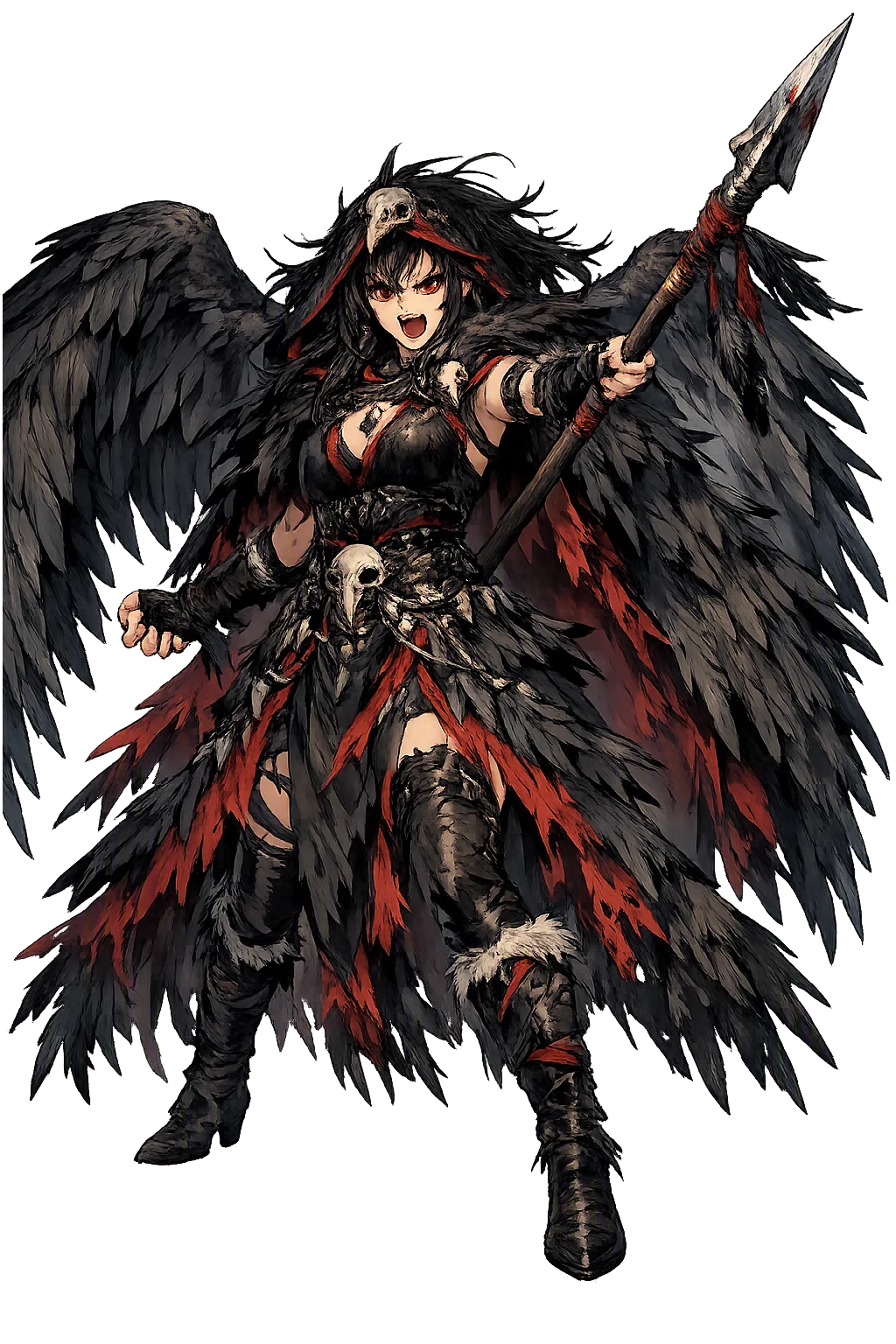
Pronouncing Badb: a guide for the curious
Saying Badb aloud is harder than reading it on a screen, and more rewarding. The restored spelling is a compressed pronunciation guide: every accent and macron is an instruction. This post unpacks those instructions — the reconstructed sound, the phoneme-by-phoneme record, the kindred forms in neighboring languages — and then zooms out to the full record around the name: its Celtic transcription writing, its mythology, its cult, and its modern life as a Unicode domain. Whether you arrive as a linguist, a reader of myth, or a domainer, you will leave able to say the name the way the evidence suggests it was said — and able to type it the way it was written.
At a Glance
- Restored name: Badb
- ASCII form: badb
- Meaning: "Crow, scald-crow"
- Domain of influence: Battle, Death, Crow
- Pantheon: Celtic
- Classification: Tier 2
Overview
Badb (badb) — Battle, Death, Crow · Crow, scald-crow — is the Irish war-goddess whose name is her shape: Old Irish badb, the scald-crow, is the common noun for the hooded crow (Corvus cornix) and the theonym in a single word, and the medieval writers never felt the need to choose between them. Her standing title in the texts is badb catha, 'crow of battle' — the bird that haunts the field and the goddess who owns it, named in one breath.
She belongs to the war-goddess complex the Lebor Gabála Érenn calls the daughters of Ernmas — Badb, Macha, and Anand, of whom are the Paps of Anu in Luachair — a genealogy the verse recension gives as Badb, Macha, and the Morrígu, so that the tradition itself is of two minds as to whether the Morrígan is the third sister or the single name for all three. The same book marries her to the war-god: Neit son of Indui had two wives, Badb and Nemain. Her dossier is voice and omen rather than adventure: the shriek over the hosts in the Táin that kills a hundred warriors with fright, the war-goddess washing at the ford of the Unius before Mag Tuired, and the scald-crows settling on the dying Cú Chulainn's pillar-stone.
PuniCodex restores the name as Badb — identical to the ASCII input, because normalized Old Irish writes no diacritic in this name. The mechanical rule therefore places it in Tier 2: nothing distinctive is lost in transit, a statement about orthography and never about the goddess. No domain is claimed: the plain-ASCII badb.com is registered to a third party outside the collection and is watched for release.
The Name
The theonym is attested in Old and Middle Irish as badb (later badhbh), a feminine noun whose first and never-abandoned sense is zoological: the scald-crow, the grey-and-black hooded crow of the Irish countryside. The Dictionary of the Irish Language records both registers — the bird and the supernatural battle-being — and the texts exploit the identity deliberately: when the war-goddess is named, the hearer already knows her shape. Her standing phrase is badb catha, 'the crow of battle', used of the battlefield terror itself as readily as of the goddess.
The etymology is old Celtic, not Irish alone. Vendryes' LEIA and Matasović's Proto-Celtic dictionary trace the word to Proto-Celtic bodwā, 'battle, fighting' — a root the continental languages kept in war-names — and the Gaulish altar from Mieussy in Haute-Savoie dedicates to Cathubodua, catu-bodwā, 'battle-crow': the precise reverse compound of the Irish phrase. The crow of battle is therefore not an Irish literary conceit but an inherited Celtic formation, attested in stone on the continent and in saga in Ireland.
Within the Irish tradition the name shades into her sisters': the Táin couples her with Bé Néit, 'woman of battle', and Némain, and the Lebor Gabála's two recensions of the daughters of Ernmas make the Morrígan now the third sister, now the collective name. The honest verdict of the handbooks is fluidity, not error: Badb, Macha, Némain, and the Morrígan behave as one complex with several voices.
The ASCII form badb loses nothing, because the normalized Old Irish spelling is already plain Latin letters; the restoration is therefore a matter of canonical reference, not rescued diacritics, and the name is classified Tier 2 by the project's mechanical rule.
The letter-by-letter transformation runs:
- b → B — Same, capitalized
- a → a — Same
- d → d — Same
- b → b — Same
The project holds no domain for this name: badb.com is registered to a third party outside the PuniCodex collection and is watched for release. The temple lives at its canonical lexicon address.
The Original Script
The name is preserved in medieval Irish manuscripts in the Latin alphabet as badb — Old Irish / Middle Irish in Insular script, attested Old Irish, c. 7th–10th c. CE, in the glossaries and in the great codices that preserve the Táin and the Lebor Gabála. The earlier monumental alphabet, ogham, predates the manuscript tradition, but no attestation of this theonym has ever been read on an ogham stone; the manuscript form is the primary witness.
The scholarly rendering proceeds step by step:
- Old Irish was written in the Latin alphabet using Insular minuscule from the early medieval period; the spelling badb requires no diacritic.
- The word is a common noun — the scald-crow, the hooded crow — and the theonym is the same word; the Dictionary of the Irish Language records both registers.
- The medial d and final b are lenited in pronunciation — [ð] and [β] — but the orthography writes plain d and b; nothing distinctive is lost in ASCII.
- The Unicode restoration Badb is therefore identical to the ASCII form apart from the capital; the temple form is a canonical reference, not a rescued spelling.
One caution attaches to the record: the texts keep her name fluid with her sisters' — Bé Néit, Némain, Macha, the Mórrígan — and the handbooks treat the complex as one figure with several voices rather than a scribal confusion to be solved.
Pronunciation
The reconstructed pronunciation of the name is /ˈbaðβ/ — Old Irish Reconstruction.
Phoneme by phoneme:
- Ba- — Broad bilabial stop [b] and short open [a], stressed on the first — here the only — syllable, as in all Old Irish
- -db — Lenited [ð], the voiced dental fricative of English this, running into lenited final [β], a soft bilabial v; both consonants melt in speech though the spelling keeps them whole
For the modern speaker, the closest approximation is: 'BAH-dhuv' — one short syllable, the d softened to the 'th' of this, the final b to a light v. Modern Irish badhbh keeps the softening, and English ears often hear the word as something like 'bave'.
Kindred and historical forms of the name:
- Old Irish — badb, 'scald-crow', the common noun and the theonym in one word; badb catha, 'crow of battle'
- Proto-Celtic — *bodwā, 'battle, fighting', the root beneath the name (Matasović, EDPC)
- Gaulish — Cathubodua, 'battle-crow', the goddess of the Mieussy altar
- Modern Irish — badhbh, 'scald-crow, hooded crow', the unbroken living word
Badb is Tier 2 because the restoration preserves nothing ASCII loses: the letters of the manuscript form are the letters of the keyboard. The capital alone marks the temple form.
Mythology
Badb's mythology is genealogy, sound, and omen rather than adventure: she is the sister in the list, the voice over the army, the bird on the pillar-stone. Four texts carry her dossier, and the commentators have spent a century and a half working out where she ends and her sisters begin.
The Daughters of Ernmas (Lebor Gabála Érenn)
The Lebor Gabála Érenn gives the war-goddesses their pedigree: 'Badb and Macha and Anand, of whom are the Paps of Anu in Luachair, were the three daughters of Ernmas the she-farmer.' The verse recension sings the family in another key — 'Badb and Macha, greatness of wealth, Morrígu, springs of craftiness, sources of bitter fighting, were the three daughters of Ernmas' — so the tradition itself is of two minds about the third sister. The same book marries her into the war-god's house: Neit son of Indui, god of battle, had two wives, Badb and Nemain, and the pedigree records their slaying at Ailech by the Fomorians. Cormac's Glossary had already fixed the marriage in the record: Neith, the god of battle among the pagan Gael, and Nemon his wife.
The Shriek over the Hosts (Táin Bó Cúailnge)
When the men of Ireland march under Medb for the brown bull of Cooley, the Táin marks the nights of the hosting with the sound of the war-goddesses: 'Badb and Bé Néit and Némain shrieked above them that night in Gáirech and Irgáirech, so that a hundred of their warriors fell dead of fright.' She does not wound; she announces. The shriek is prophecy delivered as noise — and the Irish phrase for battlefield terror, badb catha, is simply her name at work as a common noun.
The War-Goddess at Mag Tuired (Cath Maige Tuired)
On Samain night before the Second Battle of Mag Tuired, the Dagda met the Morrígan at the ford of the Unius in Connacht, where she stood washing with one foot on either bank; she pledged herself to the Túatha Dé Danann's cause, promising the hearts of the Fomorian host and the blood of their king Indech. After Lugh's sling-stone felled Balor, it was the Morrígan who proclaimed the rout to the heights of Ireland and uttered the prophecy — 'Peace up to heaven, heaven down to earth, earth beneath heaven' — and then its darker twin, the vision of the world's ending. The texts keep the sisters' voices interchangeable; what the manuscript gives to the Morrígan, the tradition hears also in Badb's register.
The Crow on the Pillar-Stone (Aided Con Culainn)
Cú Chulainn's death-tale, Brislech Mór Maige Muirthemni, gives the crow-goddesses the last word. Mortally wounded, Cú Chulainn lashed himself to a pillar-stone to die on his feet, and for three days his enemies would not close in — until the battle-goddess Morrígu came with her sisters in the form of scald-crows and settled on his shoulder. 'That pillar is not wont to be under birds,' said Erc, and only then did the host dare take the hero's head. The living man keeps her off; the dead man is her perch.
The Washer at the Ford (Gaelic tradition)
The medieval texts give the war-goddess her washing-place at the ford of the Unius; the later Gaelic tradition gives the figure her full shape — the washer at the ford, rinsing the blood-stained garments of those about to die in battle. In Scottish Gaelic folklore she is the bean nighe, and the commentators, Mac Cana among them, treat her as the folk continuation of the Badb's own figure. The washing is prophecy, not threat: the doom is already written, and she merely launders the evidence.
Symbols & Iconography
Badb's attributes are a species, a sound, a place, a number, and a chore — the sparest regalia in the Irish corpus, and the most exact:
- The scald-crow — The hooded crow, grey and black: her name, her shape, and her retinue on every field
- The shriek — Panic as a weapon: the sound over the hosts that kills men with fear before the spear is thrown
- The ford — The boundary between bank and bank, living and dead: the water where the war-goddess stands washing
- The triad — Badb, Macha, Némain: the three of war, one terror in three voices
- The washing of spoils — The harness and garments of the soon-dead, rinsed in the ford before the battle that will bloody them
Archaeology & Evidence
Badb is a textual goddess: no ogham stone names her, no votive inscription invokes her, and Irish paganism generally left literature rather than dedications. Her manuscript witnesses, however, are exact. The Táin Bó Cúailnge survives in its oldest recension in Lebor na hUidre, the Book of the Dun Cow (Royal Irish Academy, c. 1100), and in the twelfth-century Book of Leinster; Lebor Gabála Érenn likewise rests on the Book of Leinster and its sister codices; and Cath Maige Tuired survives uniquely in the sixteenth-century British Library MS Harley 5280, the basis of Gray's edition.
The nearest epigraphic witness is continental: the altar from Mieussy in Haute-Savoie dedicating to Cathubodua, 'battle-crow', is the standing proof that the crow-of-battle compound is old Celtic and not an Irish literary invention — comparative evidence across the water, never an identification.
Realm & Domain
Badb is catalogued under the domain 'Battle, Death, Crow' — three words that map exactly onto her dossier: the field she haunts, the knowledge she carries, and the shape she wears.
Battle
She never fights, and the texts are exact about it: her weapon is the voice. In the Táin, Badb and Bé Néit and Némain shriek above the marching hosts at Gáirech and Irgáirech until a hundred warriors fall dead of fright — the battle's true opening, fought and won before a spear is cast.
Death
She is the reader of the doomed: the war-goddess washing at the ford of the Unius on the eve of Mag Tuired, the scald-crows settling on Cú Chulainn's pillar-stone to tell his enemies he is gone — 'that pillar is not wont to be under birds'. Death is not her doing; it is her knowledge.
Crow
Her name is the animal: badb, the scald-crow, the grey-and-black hooded crow that comes down to the field when the field is finished. The theonym refuses metaphor — the goddess has a species.
The Moment Before
The connective tissue of all three domains is foreknowledge: shriek, washing, and settling are the same act in three scenes — the end of the day, seen at its beginning. The later Gaelic washer at the ford, the Scottish bean nighe, keeps exactly this brief.
Across Cultures
Badb's clearest cross-border witness is Gaulish, and it is exact. An altar from Mieussy in Haute-Savoie dedicates to Cathubodua — catu-bodwā, 'battle-crow' — the precise reverse compound of Irish badb catha. Delamarre and Koch treat the two names as one formation across the Celtic languages: the crow of battle named in stone on the continent and in saga in Ireland. The Welsh corpus, by contrast, is silent on her — no figure of the Mabinogi continues the name, and the Brythonic silence is recorded rather than repaired. Typological comparison has set her beside the Norse valkyries, the raven-feeding choosers of the slain; the handbooks note the parallel without claiming descent.
Within the Irish tradition her closest kin are her own sisters, the Mórrígan and Macha — one complex with several voices — and the war she prophesied binds her to the Dagda, Lugh, and Nuadu. The Christian scribes who preserved her did not euhemerize her into a queen or a druid, as they did the great gods; they left her what she was, a bird and a voice, which may be why the name needed no rehabilitation.
Cultural Legacy
The crow of battle rode the Celtic revival in English dress. W. M. Hennessy's 'The Ancient Irish Goddess of War' (Revue Celtique, 1870) had already gathered the Morrígan material for scholars, and Lady Gregory's Gods and Fighting Men (1904) carried Cath Maige Tuired and its war-goddesses to a wide reading public, crow-form and prophecy complete. Modern fantasy and games have made the war-goddess's crow-shape one of the stock images of the genre, and contemporary pagan practice honors Badb among the three of the Morrígan.
In the Irish language the word never needed reviving: badhbh has meant the hooded crow all along, and the grey bird on the battlefield needed no gloss for any Irish hearer. Across the water, the Scottish bean nighe kept her folk shape washing at the ford deep into the era of the great folklore collections — the longest-lived of all her forms, and the one that never had to be reconstructed.
The Scholarly Record
The account of Badb given in this edition rests on the witnesses and reference works listed below. The Táin supplies the voice; the Lebor Gabála the family; Cath Maige Tuired the ford and the prophecy; the death-tale the pillar-stone; the glossaries and etymological dictionaries secure the name; the Gaulish material is cited for comparison only.
- O'Rahilly, Cecile, ed. and trans., Táin Bó Cúailnge, Recension 1 (Dublin: Dublin Institute for Advanced Studies, 1976).
- Macalister, R. A. S., ed. and trans., Lebor Gabála Érenn, 5 vols. (Dublin: Irish Texts Society, 1938–56).
- Gray, Elizabeth A., ed. and trans., Cath Maige Tuired: The Second Battle of Mag Tuired, Irish Texts Society 52 (Naas: Irish Texts Society, 1982).
- Stokes, Whitley, ed. and trans., 'The Second Battle of Moytura', Revue Celtique 12 (1891), 52–130, 306–308.
- Stokes, Whitley, ed. and trans., 'The Death of Cú Chulainn', Revue Celtique 3 (1877), 175–185.
- Hennessy, W. M., 'The Ancient Irish Goddess of War', Revue Celtique 1 (1870), 27–57.
- Meyer, Kuno, ed., 'Sanas Cormaic: An Old-Irish Glossary', Anecdota from Irish Manuscripts 4 (Halle: Niemeyer; Dublin: Hodges, Figgis, 1912), s.v. Neth.
- Dictionary of the Irish Language (Dublin: Royal Irish Academy, 1913–76; electronic ed. eDIL 2019), s.v. badb.
- Vendryes, Joseph (gen. ed.), Lexique étymologique de l'irlandais ancien (Dublin: Dublin Institute for Advanced Studies, 1959–96), s.v. badb.
- Matasović, Ranko, Etymological Dictionary of Proto-Celtic (Leiden: Brill, 2009), s.v. *bodwo-.
- Delamarre, Xavier, Dictionnaire de la langue gauloise (Paris: Errance, 2003), s.v. catu-, boduā.
- Mac Cana, Proinsias, Celtic Mythology (London: Hamlyn, 1970).
- Sjoestedt, Marie-Louise, Gods and Heroes of the Celts, trans. Myles Dillon (London: Methuen, 1949).
- Koch, John T., ed., Celtic Culture: A Historical Encyclopedia, 5 vols. (Santa Barbara: ABC-CLIO, 2006), s.v. Badb, Cathubodua, Mórrígan.
- Gregory, Lady Augusta, Gods and Fighting Men (London: John Murray, 1904).
- McManus, Damian, A Guide to Ogam, Maynooth Monographs 4 (Maynooth: An Sagart, 1991).
- Thurneysen, Rudolf, A Grammar of Old Irish, trans. D. A. Binchy and Osborn Bergin (Dublin: Dublin Institute for Advanced Studies, 1946).
A Meditation
Badb is the rare theonym that refuses to be a metaphor: the word for the bird and the name of the goddess are one, and the medieval writers never felt the need to choose between them. To name her is already to say what she does. Other gods have attributes; she has a species — the grey scald-crow that comes down to the field when the field is finished, and the texts simply ask us to understand that the bird knew all along.
Her power is the moment before. In no surviving text does she strike a blow: she shrieks over the marching column, washes at the boundary water, settles on the pillar-stone — the goddess of foreknowledge and of aftermath, of everything in a battle except the fighting. That is not a small dossier but a strange and exact one: she is what war feels like to those who already know its end. The name keeps the question open in every grey bird on a fence-post: if you could see the end of the day at its beginning, what would you do with the hours between?
The Unicode Restoration
Badb is classified as Tier 2: the restoration needs no distinctive letters or diacritics its ASCII form would lose. The ASCII fallback badb still resolves everywhere, but it is the restored form that carries the name's full information. That is the whole thesis of this temple: the marks are the message.
Why This Restoration Matters
Pronunciation turns out to be the heart of the matter. The marks in Badb are instructions for the voice, and a web that strips them is a web that mispronounces the past at scale. The restoration hands the instructions back: say it as the evidence suggests, type it as the tradition wrote it, and let the punycode machinery do the quiet translation in between. That is all the PuniCodex project asks of the infrastructure — and everything it asks of you, the reader, is to use the whole name.
Explore Further
This post is one doorway into the temple. The home page carries the full character breakdown and the ambient canvas; the lore page tells the myths in long form; the Scholarly Edition preserves the sources, pronunciation data, and revision history; and the patron wall supports the restoration directly. For the wider map, browse the Lexicon, explore the Pantheon, or return to the PuniCodex blog.
Related Names
Sources
The full scholarly apparatus — every citation, revision, and review — lives in the Scholarly Edition. Key references for this post:
- Dictionary of the Irish Language (Dublin: Royal Irish Academy, 1913–76; electronic ed. eDIL 2019), s.v. badb.
- Macalister, R. A. S., ed. and trans., Lebor Gabála Érenn, vol. 4 (Dublin: Irish Texts Society, 1941).
- O'Rahilly, Cecile, ed. and trans., Táin Bó Cúailnge, Recension 1 (Dublin: Dublin Institute for Advanced Studies, 1976).
- Gray, Elizabeth A., ed. and trans., Cath Maige Tuired: The Second Battle of Mag Tuired, Irish Texts Society 52 (Naas: Irish Texts Society, 1982).
- Lexicon authorities for this entry: Táin Bó Cúailnge, MacKillop.