PuniCodex

Extended Lore

Badb — The Deeper Record

Etymology · Orthography · Cult · Iconography · Reception · Sources

ASCII-equivalent form Badb
Badb — Battle, Death, Crow
01

At a Glance

Badb — every fact links to its home

PantheonCeltic
DomainBattle, Death, Crow
Scholarly TransliterationBadb →
Cited Works15 cited →
02

Etymology & Word Family

From attested form to canonical spelling — the full etymology page →

Scholarly Transliteration Badb Badb — "Crow, scald-crow"
Canonical Restoration Badb Canonical scholarly spelling — ASCII-identical
Modern ASCII badb Plain-ASCII fallback

The name Badb reaches the modern world through scholarly transliteration of the celtic tradition. Because the conventional spelling uses only Latin letters, its canonical and ASCII forms coincide — the tradition it carries is in the name itself, not in diacritics.

03

Character breakdown

Character-by-character philological analysis

CharacterUnicodeNameBlockPhonetic Role
BU+0042Latin Capital Letter BBasic LatinSame, capitalized
aU+0061Latin Small Letter ABasic LatinSame
dU+0064Latin Small Letter DBasic LatinSame
bU+0062Latin Small Letter BBasic LatinSame

This restoration reflects fidelity to the attested tradition, not recovered diacritics: every character of Badb already survives in ASCII. What the restoration preserves is the canonical spelling itself — the form scholarship standardised.

04

Cult & Worship

How the sacred was kept — rites, sanctuaries, remains

The Cult

No cult of Badb is attested, and the silence is itself evidence: Irish paganism left saga and gloss rather than temples or dedications, and no sanctuary, festival, priesthood, or votive deposit anywhere in the corpus can be assigned to her. The continental altar from Mieussy that names Cathubodua, 'battle-crow', proves the formation was old Celtic, but it is Gaulish evidence, not hers — worship of her figure on Irish ground is an inference, not a fact. What survives of her 'service' is the watch itself: the scald-crow's descent on a field was read as her verdict, and the later Gaelic tradition of the bean nighe — the washerwoman seen rinsing the garments of the doomed — kept the omen alive as folklore long after any priesthood was gone. Modern Celtic pagan practice has built rites around her, but that is revival, warmly meant and historically new.

In the Earth

Badb is a textual goddess: no ogham stone names her, no votive inscription invokes her, and Irish paganism generally left literature rather than dedications. Her manuscript witnesses are exact. The Táin Bó Cúailnge survives in its oldest recension in Lebor na hUidre, the Book of the Dun Cow (Royal Irish Academy, c. 1100), and in the twelfth-century Book of Leinster; Lebor Gabála Érenn likewise rests on the Book of Leinster and its sister codices; and Cath Maige Tuired survives uniquely in the sixteenth-century British Library MS Harley 5280, the basis of Gray's edition. The nearest epigraphic witness is continental: the altar from Mieussy in Haute-Savoie dedicating to Cathubodua, 'battle-crow', is the standing proof that the crow-of-battle compound is old Celtic and not an Irish literary invention — comparative evidence across the water, never an identification.

05

Iconography

How Badb was imaged across the ages

The Image

Badb's only portrait is a species. No figurine, relief, or manuscript illumination from pagan Ireland depicts her; the art of the conversion centuries was carving crosses, not crow-goddesses, and her dossier reached us as words. The texts supply the iconography in negative, in two scenes a listener could see: the scald-crow settling on Cú Chulainn's pillar-stone — 'that pillar is not wont to be under birds' — which paints its picture in a single line of dialogue, and the washer stooping over blood-darkened garments in running water at the ford. What later ages did with those two images is instructive: Celtic revival art of the nineteenth and twentieth centuries froze her as the grey crow above the battlefield, a silhouette now so standard it is easily mistaken for an ancient attribution. The honest record runs to three nouns — bird, water, stone — and no surviving image.

06

Reception & Transformation

The name after its own age — transmission, translation, survival

Afterlives

Badb's afterlife is a story about manuscripts before it is a story about anything else. Her texts descend through three great codices: Lebor na hUidre, the Book of the Dun Cow (c. 1100), which carries the oldest Táin; the twelfth-century Book of Leinster; and the sixteenth-century British Library Harley 5280, the unique witness of Cath Maige Tuired. Modern acquaintance with her begins with the great nineteenth-century editors — Eugene O'Curry's lectures, and Whitley Stokes's translations and editions in Revue Celtique from the 1870s to the 1890s, which first put the death-tale of Cú Chulainn and the battle of Moytura into English. The folklore collectors ran the same race on the ground: J. G. Campbell's Superstitions of the Highlands and Islands (1900) set the bean nighe, her folk double, into print for scholarship. The twentieth century consolidated rather than discovered: the Dictionary of the Irish Language, Sjoestedt's Gods and Heroes of the Celts, Mac Cana's Celtic Mythology, and the etymological dictionaries of Vendryes, Matasović, and Delamarre fixed her name, her family, and the Celtic reach of the crow-of-battle formation. The dossier is small — five scenes and a gloss — but it has been continuously read for a century and a half, which is more than most gods with temples can say.

Identifications Across Traditions

Badb's clearest cross-border witness is Gaulish, and it is exact. An altar from Mieussy in Haute-Savoie dedicates to Cathubodua — *catu-*bodwā, 'battle-crow' — the precise reverse compound of Irish badb catha. Delamarre and Koch treat the two names as one formation across the Celtic languages: the crow of battle named in stone on the continent and in saga in Ireland. The Welsh corpus, by contrast, is silent on her — no figure of the Mabinogi continues the name, and the Brythonic silence is recorded rather than repaired. Typological comparison has set her beside the Norse valkyries, the raven-feeding choosers of the slain; the handbooks note the parallel without claiming descent. Within the lexicon her closest kin are her own sisters, the Mórrígan and Macha, and the war she prophesied binds her to the Dagda, Lugh, and Nuadu.

Modern Legacy

The crow of battle rode the Celtic revival in English dress. W. M. Hennessy's 'The Ancient Irish Goddess of War' (Revue Celtique, 1870) had already gathered the Morrígan material for scholars, and Lady Gregory's Gods and Fighting Men (1904) carried Cath Maige Tuired and its war-goddesses to a wide reading public, crow-form and prophecy complete. Modern fantasy and games have made the war-goddess's crow-shape one of the stock images of the genre, and contemporary pagan practice honors Badb among the three of the Morrígan. In the Irish language the word never needed reviving: badhbh has meant the hooded crow all along, and the grey bird on the battlefield needed no gloss for any Irish hearer. Across the water, the Scottish bean nighe kept her folk shape washing at the ford deep into the era of the great folklore collections.

07

The Scholarly Transliteration Note

What the written record preserves — and what it does not

Scholarly Transliteration

The normalized Old Irish form is Badb — already plain ASCII, with no diacritic or distinctive letter for the restoration to recover. Old Irish was written in the Insular Latin script; the earlier monumental alphabet, ogham, survives on some four hundred stones bearing personal names, but no attestation of this theonym has ever been read on any of them. Because the name is pure ASCII, its domain was registered decades ago in the ordinary way: badb.com is held by a third party outside the PuniCodex collection and is watched for release — no form of the name is currently owned, and this temple claims none.

08

The Meditation

What Badb means — beyond the dictionary

Badb is the rare theonym that refuses to be a metaphor: the word for the bird and the name of the goddess are one, and the medieval writers never felt the need to choose between them. To name her is already to say what she does. Other gods have attributes; she has a species — the grey scald-crow that comes down to the field when the field is finished, and the texts simply ask us to understand that the bird knew all along.

Her power is the moment before. In no surviving text does she strike a blow: she shrieks over the marching column, washes at the boundary water, settles on the pillar-stone — the goddess of foreknowledge and of aftermath, of everything in a battle except the fighting. That is not a small dossier but a strange and exact one: she is what war feels like to those who already know its end. The name keeps the question open in every grey bird on a fence-post: if you could see the end of the day at its beginning, what would you do with the hours between?

09

Frequently Asked Questions

Deep-dives into the cult, attestation, reception, and sources of Badb

01How do we know how Badb was worshipped?

Badb is a textual goddess: no ogham stone names her, no votive inscription invokes her, and Irish paganism generally left literature rather than dedications. The full cult record →

02Where do the earliest attestations of Badb come from?

The record rests on Táin Bó Cúailnge, Recension 1, ed. and trans. Cecile O'Rahilly (Dublin Institute for Advanced Studies) — Badb, Bé Néit, and Némain shrieking over the hosts at Gáirech and Irgáirech, Lebor Gabála Érenn, ed. and trans. R. A. S. Macalister (Irish Texts Society) — the daughters of Ernmas; the two wives of Neit son of Indui, Cath Maige Tuired, ed. and trans. Elizabeth A. Gray, Irish Texts Society 52 (1982); also Stokes, 'The Second Battle of Moytura', Revue Celtique 12 (1891) — the ford of the Unius; the proclamation of victory and the prophecy of peace, among 13 cited works. The full source apparatus →

03How did later traditions reinterpret Badb?

Badb's afterlife is a story about manuscripts before it is a story about anything else. Reception & transformation →

04What do the surviving images of Badb actually show?

Badb's only portrait is a species. The iconography →

05What does the written record of Badb actually preserve?

The normalized Old Irish form is Badb — already plain ASCII, with no diacritic or distinctive letter for the restoration to recover. The Scholarly Transliteration note →

10

Scholarly Sources

The philological foundations of the record

Every claim on this page is grounded in established scholarship. The orthographic restorations follow disciplinary convention. The etymological chain follows the best available reference works. This is not invention — it is resurrection through scholarship.

◈

Lexicography & Philology

  • Táin Bó Cúailnge
  • MacKillop
◎

Primary Texts

  • The Immram Brain (Voyage of Bran); Tochmarc Étaíne; Cóir Anmann; medieval Irish saga literature.
◉

Archaeology & Art History

  • Megaw, R., & Megaw, V. Celtic Art: From Its Beginnings to the Book of Kells; Green, M. The Gods of the Celts.
✦

Religious Studies

  • Táin Bó Cúailnge, Recension 1, ed. and trans. Cecile O'Rahilly (Dublin Institute for Advanced Studies) — Badb, Bé Néit, and Némain shrieking over the hosts at Gáirech and Irgáirech
  • Lebor Gabála Érenn, ed. and trans. R. A. S. Macalister (Irish Texts Society) — the daughters of Ernmas; the two wives of Neit son of Indui
  • Cath Maige Tuired, ed. and trans. Elizabeth A. Gray, Irish Texts Society 52 (1982); also Stokes, 'The Second Battle of Moytura', Revue Celtique 12 (1891) — the ford of the Unius; the proclamation of victory and the prophecy of peace
  • Brislech Mór Maige Muirthemni (Aided Con Culainn), ed. Stokes, 'The Death of Cú Chulainn', Revue Celtique 3 (1877) — the scald-crows on the pillar-stone
  • Sanas Cormaic (Cormac's Glossary), s.v. Neth — 'the god of battle among the pagan Gael, and Nemon his wife'
  • Hennessy, W. M., 'The Ancient Irish Goddess of War', Revue Celtique 1 (1870) — the Morrígan-Badb material gathered for scholarship
  • Dictionary of the Irish Language (Dublin: Royal Irish Academy; electronic ed. eDIL), s.v. badb — 'scald-crow'; the war-goddess
  • Vendryes, Lexique étymologique de l'irlandais ancien, s.v. badb — the etymology and the Celtic cognates
  • Matasović, Etymological Dictionary of Proto-Celtic, s.v. *bodwo- 'battle, fighting'
  • Delamarre, Dictionnaire de la langue gauloise, s.v. catu-, boduā — Cathubodua, 'battle-crow'
  • Mac Cana, Celtic Mythology — the war-goddesses; the washer at the ford
  • Sjoestedt, Gods and Heroes of the Celts — the Irish war-goddesses and the triple figure
  • Koch, ed., Celtic Culture: A Historical Encyclopedia, s.v. Badb, Cathubodua, Mórrígan
Return

The Surface Awaits

You have traced the name from its earliest attestation to its canonical restoration. Now return to the myth. The story is where the name lives.

Back to Lore
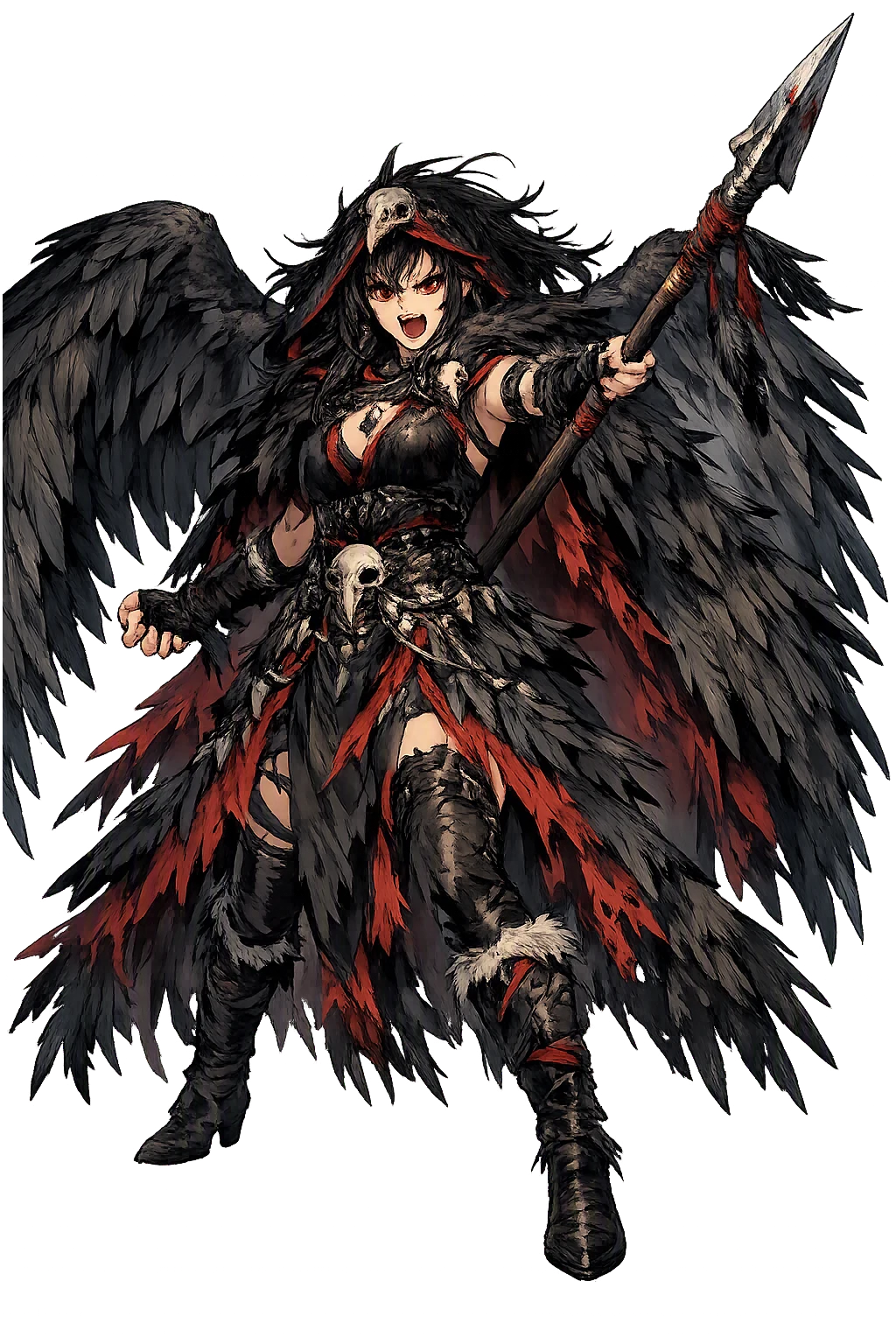
Badb mascot