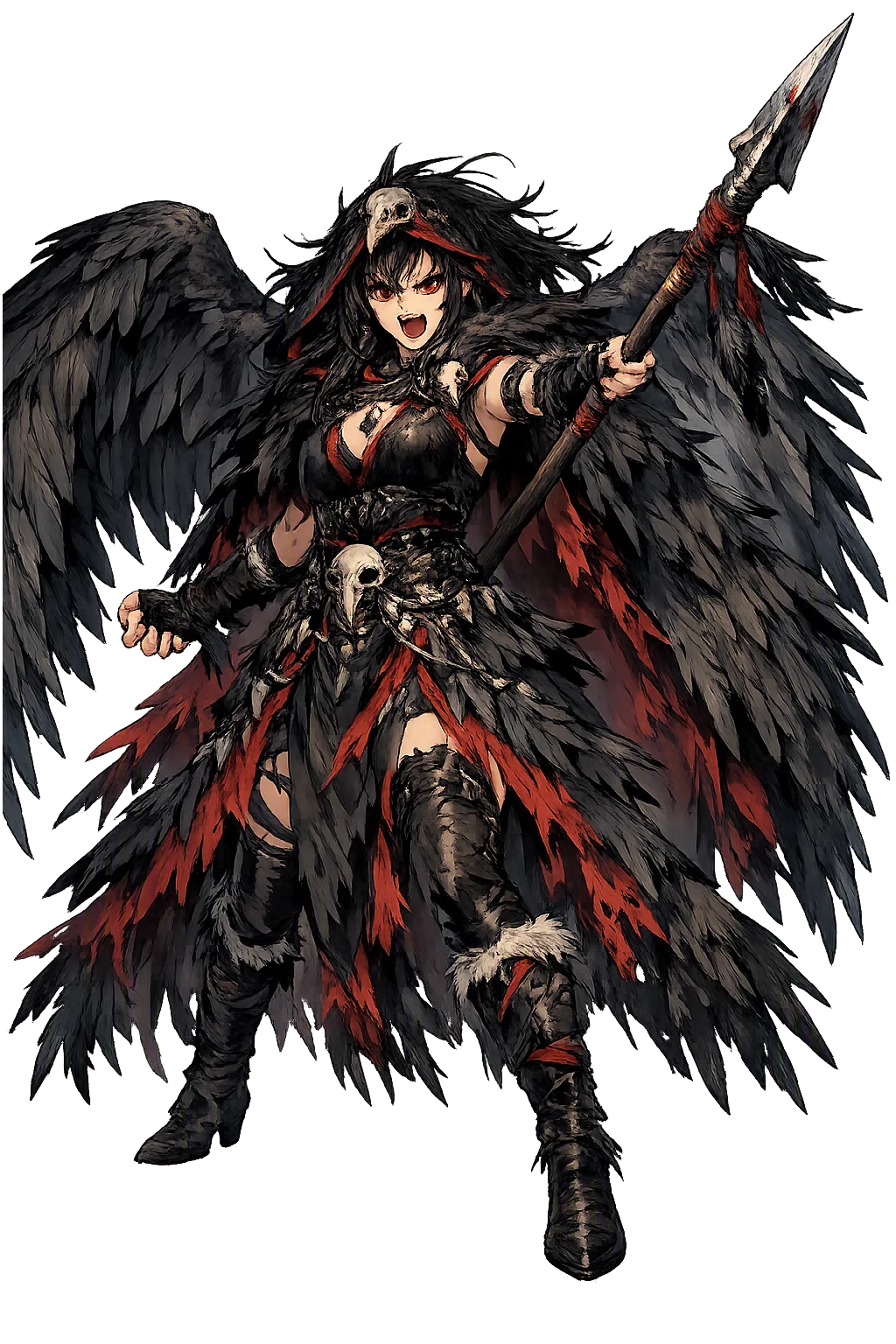
Stories of Badb
Badb's dossier is genealogy, sound, and omen rather than adventure: she is the sister in the list, the voice over the army, the bird on the pillar-stone. The Lebor Gabála fixes her family, the Táin fixes her weapon, and the death-tales fix her posture — and the commentators have spent a century and a half working out where she ends and her sisters begin.
The Lebor Gabála Érenn, Ireland's medieval book of invasions, gives the war-goddesses their pedigree: 'Badb and Macha and Anand, of whom are the Paps of Anu in Luachair, were the three daughters of Ernmas the she-farmer.' The verse recension sings the same family in another key — 'Badb and Macha, greatness of wealth, Morrígu, springs of craftiness, sources of bitter fighting, were the three daughters of Ernmas' — so that the tradition itself is of two minds: sometimes the Morrígan is the third sister, sometimes the single name for all three.
The same book marries her into the house of the war-god. Neit son of Indui, the god of battle, had two wives — Badb and Nemain — and the pedigree records the slaying of the three of them at Ailech by the Fomorians. Cormac's Glossary had already fixed the marriage in the language of record: Neith, the god of battle among the pagan Gael, and Nemon his wife. Badb is never an isolated figure; she is a sister and a wife in a family whose whole business is war.
When the men of Ireland march under [[medb|Medb]] for the brown bull of Cooley, the Táin marks the nights of the hosting with the sound of the war-goddesses: 'Badb and Bé Néit and Némain shrieked above them that night in Gáirech and Irgáirech, so that a hundred of their warriors fell dead of fright.' It is the battle's true opening — the killing has begun before a single spear is cast, and its instrument is a voice.
The passage tells you everything about her method. She does not wound; she announces. The shriek over the column is prophecy delivered as noise, the knowledge of the field's end injected into the march at its beginning — and the Irish phrase for the whole business of battlefield terror, badb catha, the crow of battle, is simply her name at work as a common noun.
The Second Battle of Mag Tuired, the war the Túatha Dé Danann fight against the Fomorians, runs on the war-goddess's work from its eve to its aftermath. On Samain night [[dagda|the Dagda]] met the Morrígan at the ford of the Unius in Connacht, where she stood washing with one foot on either bank; they lay together at the ford, and she pledged herself to the Túatha Dé Danann's cause, promising to bring the hearts of the Fomorian host and the blood of their king Indech.
After [[lugh|Lugh]]'s sling-stone felled [[balor|Balor]] and the Fomorians broke, it was the Morrígan who proclaimed the battle and the rout to the royal heights of Ireland and its síd-hosts, and who uttered the great prophecy — 'Peace up to heaven, heaven down to earth, earth beneath heaven' — and then its darker twin, the vision of the world's ending. The commentators note that the texts keep the sisters' voices interchangeable: what the manuscript gives to the Morrígan, the tradition hears also in Badb's register, and the Lebor Gabála had already made them one family.
Cú Chulainn's death-tale, Brislech Mór Maige Muirthemni, gives the crow-goddesses the last word over the greatest of the Ulster heroes. Mortally wounded at Muirthemne, [[cuchulainn|Cú Chulainn]] lashed himself to a pillar-stone so that he would die on his feet, and for three days his enemies would not close in, uncertain whether he lived. Then the battle-goddess Morrígu came with her sisters in the form of scald-crows and settled on his shoulder — and Erc said, 'That pillar is not wont to be under birds,' and only then did the host dare approach and take the hero's head.
It is the emblematic scene of her whole dossier: the scald-crow is the signature of death itself, the field's first and final reader. The living man keeps her off; the dead man is her perch.
The medieval texts give the war-goddess her washing-place — the Morrígan washing at the ford of the Unius on the eve of Mag Tuired — and the later Gaelic tradition gives the figure her full shape: the washer at the ford, the woman seen at the boundary water rinsing the blood-stained garments and harness of those about to die in battle. In Scottish Gaelic folklore she is the bean nighe, the washerwoman whose sight foretells death, and the commentators, Mac Cana among them, treat her as the folk continuation of the Badb's own figure.
The washing is prophecy, not threat. The doom is already written — the garments in her hands belong to men still alive and armed — and she merely launders the evidence. No Irish figure holds the moment before death so patiently: not the blow, not the battle, but the foreknowledge, rinsed clean in running water.
The Scald-Crow of the Battlefield
Badb is the Irish war-goddess whose name is her shape: badb, the scald-crow — the grey-and-black hooded crow that walks the battlefield when the spears have done their work. She is one of the three of war whom the Lebor Gabála calls the daughters of Ernmas — Badb, Macha, and Anand, the Morrígan — and the Táin gives her its most terrible sound: the shriek over the marching hosts that kills men with fear before a blow is struck. She never fights; she foretells, she panics, and she gathers what the battle leaves.
'Crow of battle' — her standing title in the texts: the bird that haunts the field and the goddess who owns it are one word.
At Gáirech and Irgáirech, the Táin says, Badb and Bé Néit and Némain shrieked above the armies until a hundred warriors fell dead of fright.
The boundary water where the war-goddess stands washing — the Morrígan at the ford of the Unius, the washer of the doomed in the later Gaelic tradition.
Badb, Macha, and Anand — the triple face of Irish war, three sisters of one mother whom the sources also call by the single name Morrígan.
From the original script to the living URL
Badb
The name survives in scholarly transliteration. Badb is the standard Celtic romanisation, documented in academic sources — “Crow, scald-crow”. Because the spelling uses only Latin letters, the form is the same in both ASCII and Unicode.
No indigenous writing system is securely attested for individual celtic names. The form shown is a modern scholarly transliteration.
badb
The plain badb form is identical to the Unicode restoration. Because this name is already written in Latin letters, no diacritics, stress, or script information were lost — only capitalization differs.
Badb
The Unicode restoration does not need to recover lost marks for Badb. Its value is canonical spelling and consistent cataloguing, not the reconstruction of erased orthography. The domain is readable as-is to both DNS and humanity.
Badb.com
This restoration is written entirely in ASCII letters — no Punycode encoding stands between Badb and the DNS. The domain reads identically to machines and to human eyes.
Owned, ideal, and ASCII forms of Badb
Badb
The full Unicode restoration. badb.com is not in the PuniCodex collection — it is watched for release; if it drops, this temple upgrades to an owned flagship.
How Badb was spoken
How Badb is preserved in writing
No indigenous writing system is securely attested for individual celtic names. The form shown is a modern scholarly transliteration.
Contribute scholarly provenance →The lore you have read is the living myth. Extended Lore opens the scholarly vault beneath it: the cult and its material remains, a history of the image, the name after antiquity, a meditation on what the name still means, and the full scholarly apparatus — etymology, orthography, sources.
Enter Extended Lore