Stories of Athēnai
Athēnai is not merely a city; it is a mythic body shaped by gods, kings, and heroes. Its foundation stories explain why Athena's olive tree outranked Poseidon's salt spring, why its earliest kings were said to be born from the earth itself, why one king's daughter saved the state at the cost of her life, and why the city's unification became the political myth of democracy's favorite ancestor.
Both gods claimed the land of Cecrops. Poseidon struck the rock of the Acropolis with his trident and a salt spring welled up — Apollodorus (3.14.1) records that some said a horse sprang forth beside it. Athena struck her spear into the ground and an olive tree rose, the first the world had seen. Cecrops judged for the goddess: her tree gives fruit, oil, and wood, where the sea-god's spring is salt. Poseidon's wrath flooded the Thriasian plain, and for centuries the Athenians answered his lingering claim by withholding the third part of their tribute at Cape Sounion. But the city took Athena's name, and both gifts were kept forever in the Erechtheion, god's spring beside goddess's tree. Herodotus (8.55) preserves the proof of the contest in living memory: when Xerxes burned the sacred olive in 480 BCE, the Athenians swore it sprouted a cubit high the very next day. The charter myth chooses the patient abundance of craft over the spectacle of power — and builds the reconciliation into the temple floor.
Cecrops, the first king of Athēnai, was said to be born from the earth itself — half-man, half-snake, a body that literally grew out of Attic soil (Apollodorus 3.14.1). His line kept the claim: Erichthonius, the child born from the earth where Hephaestus's seed fell on Athena's wool, whom the goddess herself entrusted to the daughters of Cecrops; and Erechtheus, sprung likewise from the ground and finally swallowed back into it. The autochthony myth is not quaint folklore but political technology. A people 'born from the soil' needs no conquest to justify its standing, no immigrant aristocracy to honor, no hereditary caste to prop up — and Thucydides (2.36.1) puts the claim in Pericles' own mouth: Attica has 'from the remotest times contained the same people', and for that reason alone could call itself a democracy of equals. The city that invented equality began by declaring everyone a native.
When Eumolpus, son of Poseidon, led the Eleusinians and a Thracian host against Attica, the oracle answered Erechtheus in Euripides' lost tragedy (Erechtheus, fr. 360 Nauck): the city would be saved only if one of his daughters died for it. The mother Praxithea's reply became the most quoted sentence of Athenian patriotism, preserved by Lycurgus (Against Leocrates 98–101): 'I hate women who prefer their children's survival to the common good.' The daughter — named Chthonia in later tradition — went to her death willingly, swearing the oath of the ephebes with her sisters beside her. Erechtheus won the war and was then destroyed by Poseidon's trident, swallowed into the earth beside the temple of Athena, becoming a hero-chthonic power of the city he saved. Athens kept quoting this play in every crisis for three centuries: the state that asked its families for their children and called the demand justice. The Parthenon frieze and the Erechtheion are, between them, the myth's monument — victory paid for in advance, by the house that agreed to pay.
Thucydides (2.15) tells the rationalized version without embarrassment: the villages and townships of Attica had long governed themselves, until Theseus dissolved their councils and magistracies and concentrated everything at Athens — 'synoikismos', the dwelling-together. Plutarch (Theseus 24–25) keeps the mythic detail: Theseus went among the demes not as a conqueror but as an orator, persuading the independent towns to surrender their separate identities to a single polis, and the people, persuaded, celebrated the union with the festival of the Synoikia. It is the only city-foundation myth in Greece about consent — no twins suckled by a she-wolf, no armed exogamy, no fratricide marking the walls. A cluster of villages voluntarily joined into one body under Athena's protection, and the myth quietly mirrors the Assembly on the Pnyx: many voices, one decision, no king left standing over it. Democracy did not invent the ideal; it inherited the myth and built the machinery to match it.
Wisdom · Democracy · Sacred Polis
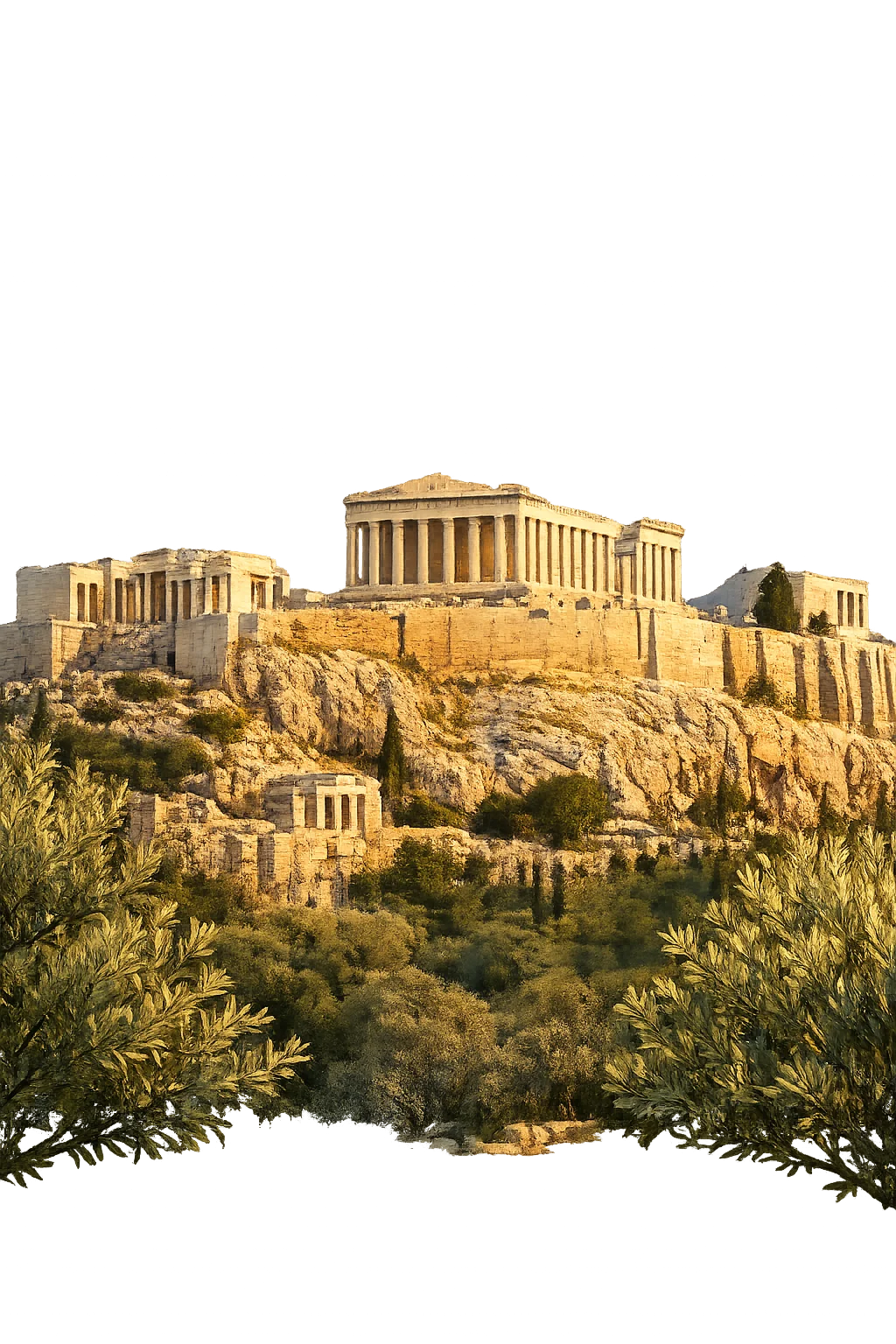
Athēnai is not merely a place on the map; it is the city that gave the West the vocabulary of citizenship, philosophy, and ordered public speech. Nestled between the Acropolis and the Piraeus, it was a polis whose gods, assemblies, and festivals turned a limestone outcrop into the symbolic home of wisdom.
Athena's sacred rock, crowned by the Parthenon, the treasury of the Delian League and a temple to the maiden goddess.
Athena's bird, stamped on tetradrachms and carved into the city's identity, became an emblem of learning and vigilance.
The open square where citizens debated law, ostracized tyrants, and practiced the democracy that bore the city's name.
The fortified corridor to the Piraeus and the trireme fleet made Athēnai a maritime power and an imperial democracy.
From the original script to the living URL
Ἀθῆναι
The name in its original Greek form. Athēnai (Ἀθῆναι) is attested in the source tradition — “Of Athena”. Its aspirated consonants, diphthongs, long vowels, and acute accents carry the full phonetic and orthographic weight of the source tradition.
athenai
Reduced to plain athenai, the name loses everything that made it specific: aspirated consonants, diphthongs, long vowels, and acute accents. What remains is an ASCII string that machines can parse but that no longer speaks with its original voice.
Athēnai
The Unicode restoration recovers what ASCII flattened. Athēnai restores aspirated consonants, diphthongs, long vowels, and acute accents, returning the name to its original written dignity. The domain encodes to Punycode, but the browser displays the truth.
Athēnai.com → xn--athnai-r3a.com
The non-ASCII characters in Athēnai are encoded while the ASCII remains visible. To the DNS, it is Punycode. To humanity, it is Athēnai.
Owned, ideal, and ASCII forms of Athēnai
Athēnai
Restores Ἀθῆναι. The live temple domain — athēnai.com.
athenai
Flattens Ἀθῆναι. The plain ASCII fallback — what DNS and legacy systems see.
How Athēnai was spoken
How Athēnai travels from ancient script to the modern URL
Greek Ἀθῆναι; the plural toponym of Athens, named after the goddess Athena.
City of Wisdom
The Unicode restoration Athēnai preserves Greek stress and length; the ASCII form athenai loses these features.
The lore you have read is the living myth. Extended Lore opens the scholarly vault beneath it: the cult and its material remains, a history of the image, the name after antiquity, a meditation on what the name still means, and the full scholarly apparatus — etymology, orthography, sources.
Enter Extended Lore