
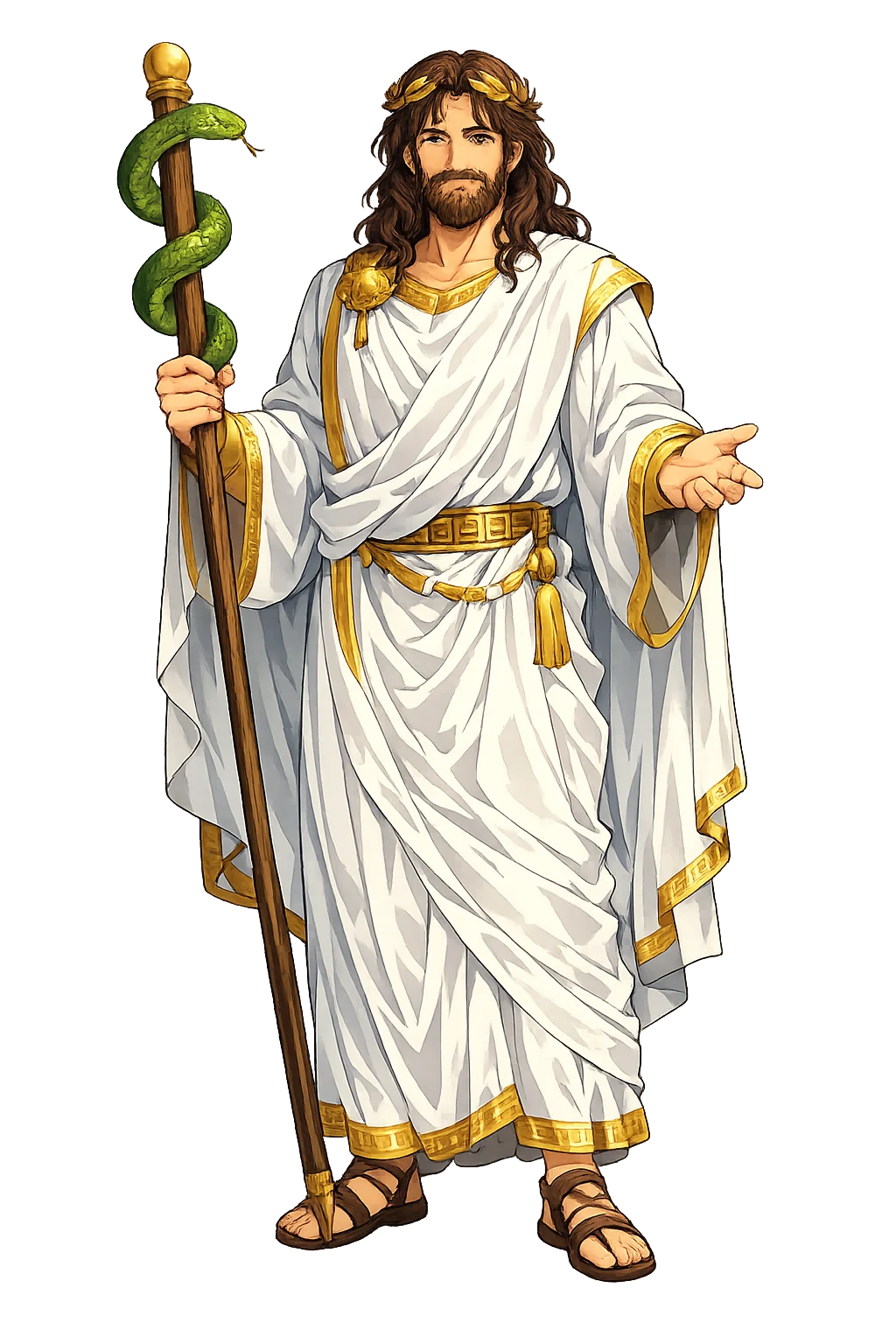
Why Asklēpiós is spelled that way — and what it costs to get it right
There is a version of this name the early internet had to settle for: asklepios. This is the file on how Asklēpiós replaced it.
Born from catastrophe — cut from the womb of the dying Korōnis by his father Apóllōn — Asklēpiós was raised by the centaur Cheirōn, who taught him the pharmaka of roots and the surgery of the knife.
At a Glance
- Restored name: Asklēpiós
- ASCII form: asklepios
- Meaning: "Uncertain; possibly related to ἀσκαλαβώτης (lizard) or a pre-Greek healing root"
- Domain of influence: Medicine, Healing, Renewal
- Pantheon: Greek
- Classification: Tier 1
- Original script: Ἀσκληπιός
- Series: The Restoration Files, No. 61 of 546
The Name Before the Marks
The name is attested as Ἀσκληπιός, as LSJ and Pindar, Pythian 3 preserve it. On the evidence, it means "Uncertain; possibly related to ἀσκαλαβώτης (lizard) or a pre-Greek healing root".
Strip Asklēpiós to asklepios and 2 pieces of evidence vanish:
- e → ē — Macron marks the long vowel: the vowel length the ASCII form cannot show.
- o → ó — Stress mark (acute/tone): the stress position the ASCII form cannot show.
None of these marks is decoration. Each one is a fact about how the name was spoken, and each one is checkable against the scholarly record the temple cites.
Spoken, the name runs `/a.skliː.pi.ós/` — ah-SKLAY-pee-OSS, with the stress on the ultima and a long ē.
The Temple That Stands Now
The restored name is not a plaque; it is an address. The temple of Asklēpiós lives at /asklepios/, with its mythology in the lore halls, its peer-reviewed record in the Scholarly Edition, and its place in the pattern atlas on the patterns floor.
What survives here cannot be shown in ASCII: a feature of the original that the fallback alphabet flattens. That is the Tier-1 test, and this name passes it without argument.
Where the Name Stood First
Epidaurus is the crown: a UNESCO World Heritage sanctuary preserving the abaton, the great theatre, and the circular tholos — the labyrinthine building Pausanias (2.27.3) attributes to Polykleitos the Younger, possibly the god’s ritual ‘dance floor’. The iamata stelai (IG IV² 1, 121–124) are the largest surviving archive of ancient patient testimony. At Kos the terraced Asklepieion climbs the hill behind the plane tree said to shade Hippocrates; at Pergamon, Galen’s home sanctuary, the great altar overlooked the healing terraces. In Rome the Tiber Island temple is gone, but its memory is carved in travertine: the island’s embankment still wears the relief prow of the ship that brought the god. Across all his shrines, the humblest artifacts speak loudest — thousands of terracotta votives shaped like the body parts the god had healed, hung on his walls like a catalogue of gratitude in clay. The temple on the web is the newest of these addresses — the first one that fits in a pocket.
The Archetype at Work
The pattern atlas seats this temple in 3 industries, each match argued and weighted: Biotech, Longevity & Life Sciences (he healed so well that Zeús destroyed him for emptying the underworld — the physician who pressed the boundary of death itself.); Healthcare, Pharma & Medicine (the surgeon-son of Apóllōn whose sanctuaries were antiquity’s hospitals; his snake-entwined staff still hangs over every pharmacy.); Yoga, Meditation & Holistic Wellness (incubation sanctuaries were antiquity’s wellness retreats — sleep, dream, cure.). The Resonance File reads those seats through the myths themselves.
In the Sacred Texts
The Greek tradition is not a vibe; it is a library. The Sacred Texts collection holds Theogony, Homeric Hymns, and Works and Days — the primary sources the temple's scholarship is built on. The temple is the argument; the texts are the evidence.
The File Continues
The temple's founding dispatch tells the name's story; its Resonance File reads the myths into the industries; the blog index holds the whole archive.
Continue the series — previous file: Asía (read it here) · next file: Aštart (read it here).
The Restoration Files are written from the same canonical record as the temples themselves: the lexicon, the lore catalog, the pattern atlas, and the cited scholarly sources. If a file ever disagrees with its temple, the temple is right — tell us, and the file will be corrected.