The Living Myth
Medicine, Healing, Renewal · The Physician of the Gods
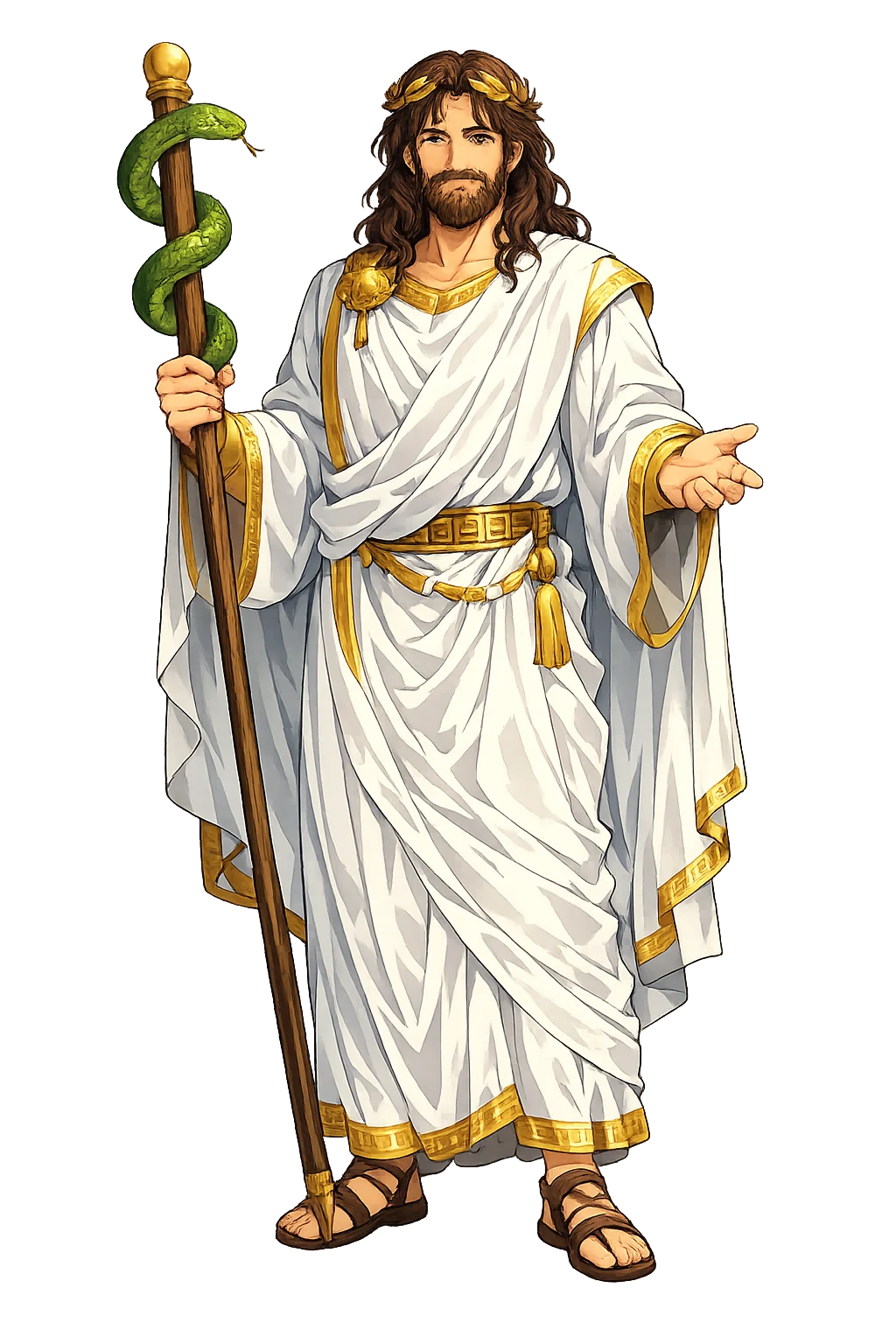
Stories of Asklēpiós
Born from catastrophe — cut from the womb of the dying Korōnis by his father Apóllōn — Asklēpiós was raised by the centaur Cheirōn, who taught him the pharmaka of roots and the surgery of the knife.
Korōnis, daughter of Phlegyas, lay with Apóllōn and bore his child — and then, ‘in the error of her heart’, loved a mortal, Ischys of Arcadia. A raven brought the news to Delphi, and Apóllōn, in the grip of his godhead, sent his sister to deal death while the girl already lay on her father’s pyre. From the flames the god himself snatched the unborn infant (Pindar, Pythian 3.1–46; Apollodorus 3.10.3). The child was given to Cheirōn, the wise centaur of Pelion, who reared him on the mountain’s roots and simples — and Pausanias (2.26.6) records the Arcadian variant in which no fire was needed: the babe was exposed and found by a goat and a dog, his first nurses and his first patients. Pindar builds the whole ode as a warning around the birth: even the god’s beloved could not escape her own choice. The myth’s meaning is surgical — the greatest healer of antiquity begins his career on the table, rescued from death by the father whose arrows also caused it.
From Athēnā, Asklēpiós received the blood of the Gorgōn Medousa — half of it a poison that kills, half a pharmakon that restores the dead (Apollodorus 3.10.3). He used the saving half. Pausanias records the tradition that he raised Hippolytos, the prince cursed by Aphrodítē, and that the grateful Troezenians thereafter thanked the god as ‘the one raised from the dead’ (2.27.4); Diodorus (4.71), more cynical, says he grew rich charging fees for resurrections, until Hāidēs complained of an empty kingdom. Zeús settled the matter with the thunderbolt: the healer who unmade death had unmade the order that made healing necessary. Apóllōn avenged his son by killing the Kyklōpes who forge Zeús’ bolts, served a year of penance in Admetos’ house, and at last Zeús raised Asklēpiós among the stars (Ovid, Metamorphoses 2.534–632). The myth draws medicine’s oldest line in the sand, and the ancients walked it openly: to cure for a fee is piety, to resurrect for a fee is hubris.
The sanctuaries turned the god’s art into an institution. At Epidaurus the sick underwent purification — baths, fasting, abstinence from wine — then slept in the abaton, the ‘place of not-walking’, waiting for the god (Pausanias 2.26–27). He came in a dream, or sent his animals: the sacred dogs that licked wounds — Aristophanes stages one licking a blind man’s eyes in the Plutus (653–747) — and the harmless serpents whose touch was diagnosis. Morning brought the priests’ interpretation, diet, regimen, and sometimes surgery; the cures were inscribed on marble, the iamata (IG IV² 1, 121–124), and some seventy survive: a man with an arrowhead in his jaw dreams the god extracts it and wakes holding it; a pregnant sleeper is delivered in her dream and wakes holding her newborn. However one weighs miracle against medicine, the system worked — the sanctuary grew into the ancient world’s greatest hospital complex, with a theatre where patients watched drama as therapy. Dream became the first diagnostic instrument, and the temple the first hospital.
Plato records the last words of Sócrates in the Phaedo (118a). The hemlock had done its work, and the philosopher lifted the covering from his face: ‘Krítōn, we owe a cock to Asklēpiós; pay it, and do not neglect it.’ A cock — the vigil-bird, the traditional thank-offering of the healed. The sentence has been turned over ever since: was Sócrates thanking the god for the cure of a life? Ironizing his judges? Marking philosophy’s debt to the healer of bodies? The ancients themselves read it both piously and ironically, and the crux survives every exegesis. What is beyond argument is the offering’s ordinariness: the greatest mind of the city dies owing a chicken, exactly like any farmer cured of a fever. Asklēpiós’ last appearance in Greek literature is a reminder that his economy ran on small, precise debts — and that even death, in his books, could be entered as a treatment successfully concluded.
Medicine, Healing, Incubation, and the Boundary of Death
Asklēpiós is the only hero whose skill frightened the gods: the surgeon-son of Apóllōn who healed so well that Zeús destroyed him for emptying the underworld. His sanctuaries were the hospitals of the ancient world, and his snake-entwined staff still hangs over every pharmacy on earth.
A single serpent on a staff — the true emblem of medicine, distinct from Hermês' two-snaked caduceus.
The greatest healing sanctuary of antiquity, where patients slept among sacred snakes and dogs.
Temple sleep: the god visited dreams and prescribed the cure, recorded on the iamata tablets.
Zeús' answer to resurrection — the line past which even healing becomes transgression.
From the original script to the living URL
Ἀσκληπιός
The name in its original Greek form. Asklēpiós (Ἀσκληπιός) is attested in the source tradition — “Uncertain; possibly related to ἀσκαλαβώτης (lizard) or a pre-Greek healing root”. Its long vowels and acute accents carry the full phonetic and orthographic weight of the source tradition.
asklepios
Reduced to plain asklepios, the name loses everything that made it specific: long vowels and acute accents. What remains is an ASCII string that machines can parse but that no longer speaks with its original voice.
Asklēpiós
The Unicode restoration recovers what ASCII flattened. Asklēpiós restores long vowels and acute accents, returning the name to its original written dignity. The domain encodes to Punycode, but the browser displays the truth.
Asklēpiós.com → xn--asklpis-q0a9z.com
The non-ASCII characters in Asklēpiós are encoded while the ASCII remains visible. To the DNS, it is Punycode. To humanity, it is Asklēpiós.
Owned, ideal, and ASCII forms of Asklēpiós
Asklēpiós
Restores Ἀσκληπιός. The live temple domain — asklēpiós.com.
Asklēpios
Restores Ἀσκληπιός. LSJ convention: length only, no stress mark.
asklepios
Flattens Ἀσκληπιός. The plain ASCII fallback — what DNS and legacy systems see.
How Asklēpiós was spoken
How Asklēpiós is preserved in writing
A bespoke provenance study for Asklēpiós is being prepared by the PUNICODEX scholarly team.
Contribute scholarly provenance →The lore you have read is the living myth. Extended Lore opens the scholarly vault beneath it: the cult and its material remains, a history of the image, the name after antiquity, a meditation on what the name still means, and the full scholarly apparatus — etymology, orthography, sources.
Enter Extended Lore